



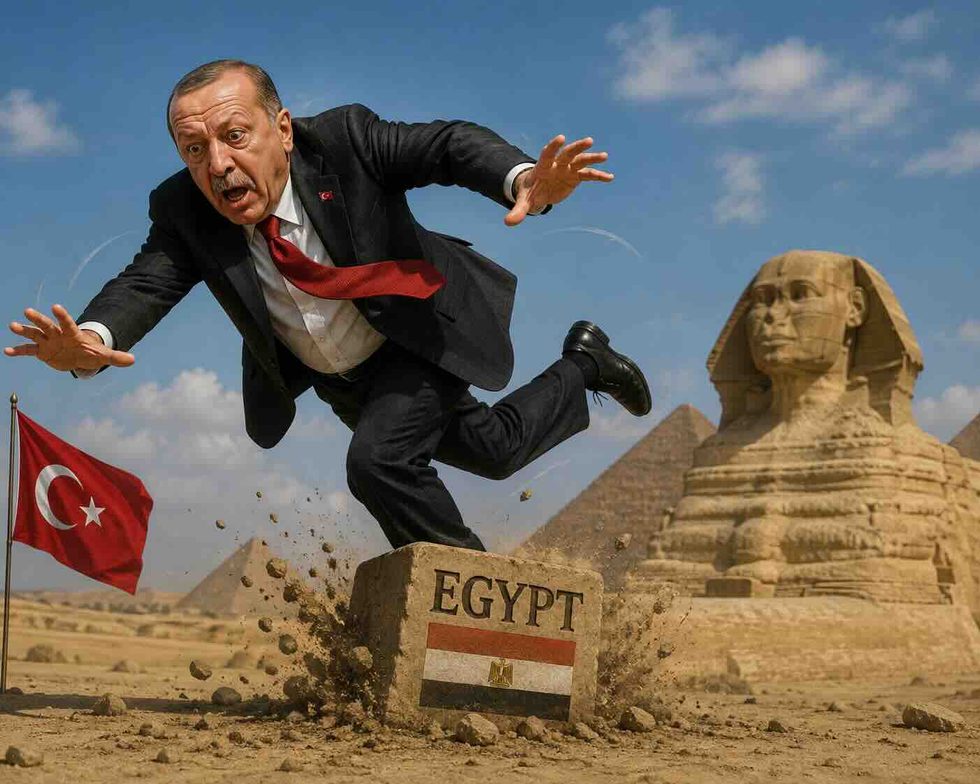
The Turkish leader may find himself in more trouble just because of his diplomatic successes. Egypt, Israel, and the ideal of the Arab Risorgimento are on his path.
If there is one thing that cannot be downplayed, it is the skill of Turkish President Recep Erdogan in executing his political strategy to restore, within possible limits, Turkish influence over all the areas that, for centuries, were part of the Ottoman Empire.
Turkish sway is rising around Italy, for instance.
Ankara has easily supplanted Rome as the reference power in Tripolitania, Libya — thereby also becoming a co-participant in control of the Sicilian Channel — and in Somalia.
Turkish power grows over the “green backbone” of the Balkans — the spine of the region where the population is almost entirely Muslim.
This is being achieved with a GNP markedly lower than Italy’s, inviting rather sad comparisons: either the Turks are extraordinary, or Italian policy is throwing money out the window.
Turkey now confronts an entirely new situation, brought about by the strategic treaty recently concluded in Jeddah with Saudi Arabia and Pakistan. This is a diplomatic instrument that opens entirely new prospects for a genuinely enlarged Middle East.
It links, at the military level, the only officially recognized Islamic nuclear power, Pakistan, with a medium conventional power such as Turkey. Turkey has NATO’s second-largest land force and a defense industry so advanced that it effectively invented “drone warfare”. Together with an economic giant like Saudi Arabia, both are capable of financing even the costliest innovations. Or perhaps it is capable of financing the longest future conflicts.
Such a concentration of Islamic forces appears to be a risk to Israel, especially given that Erdogan has long proclaimed himself a champion of the Palestinian cause and has pursued international legal action against Israeli Prime Minister Benjamin Netanyahu just days after his Jeddah pact.
Moreover, the diplomatic act might affect that process, sometimes referred to as the “Arab Risorgimento”. It began with the so-called “springs” in numerous states of the Middle East and North Africa. It dreamed of what could one day be the reunification — as Lawrence of Arabia had foreseen in his “The Seven Pillars of Wisdom” in the 1920s — of the entire Arab Sunni ecumene under a single banner. Then it was an anti-Ottoman plan, since the Ottoman Empire ruled most of the Arab world.
It is therefore no coincidence that Egypt — the state that alone accounts for roughly half of the world’s Sunni Arab population and controls the “Arab League” — has remained outside the Jeddah Pact. Perhaps it’s cultivating other projects that could prove to be at odds with those of its three signatories.
Iran reacted immediately and hostilely. It regards Saudi Arabia, Pakistan, and Turkey as too close to the United States for any real trust in the sincerity of their intentions. Despite its Shia faith, Iran has, over the course of its now-lengthy standoff with the US and Israel, reinforced its influence over several smaller states in the region. Tehran also has a grip on the “Muslim Brotherhood” and on the various movements derived from and controlled by it.
Under these conditions, there is a real risk that the Sunni world could split into two competing camps: one led by a Turkey bound to its dream of restoring Ottoman imperial glory. The other — perhaps steered by Egypt or the Muslim Brotherhood — would pursue the dream of a Sunni Risorgimento.
In any case, this is bad news for Israel. Its strategic perimeter has expanded to the point that it is difficult to defend. It faces three hostile medium powers, ready to seize the first opportunity to challenge a vision of the region that Jerusalem is trying to impose.




Erdoğan’ın Stratejik Başarıları, Yeni Sorunlara Yol Açabilir mi? – nebilim.net