



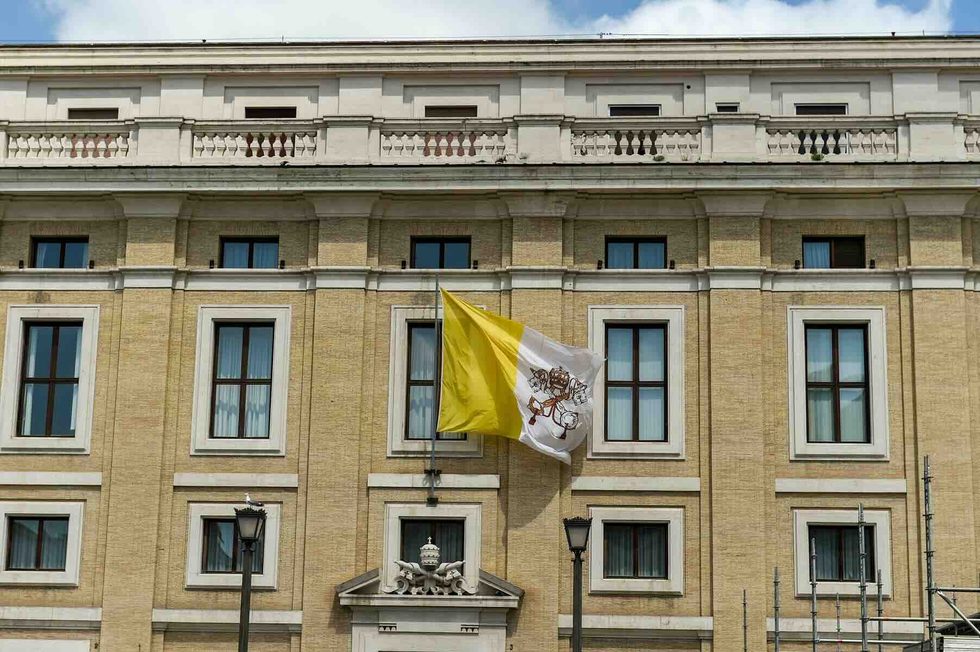
Nearly a century after the Lateran Pacts, the crisis in voter turnout and the new premiership law could turn Italy into a low-representation democracy. The Vatican, bound to Rome’s political destiny, is also concerned.
The new electoral law that Parliament just passed raises delicate questions for the Holy See. In 1929, with the signing of the Lateran Pacts, Italy reached an agreement with the Holy See to coexist, sharing its capital with the seat of the world’s largest unified religion. In many ways, it tied its destiny to this exceptional relationship. Nearly half a century of Christian Democrat rule (the Italian Catholic party), with its particular and direct connection to the throne of Peter, was the plainest proof of this.
In recent decades, non-Italian popes have increasingly looked to the world, and less to Italy, at an accelerating pace. But that does not mean they can afford to be indifferent to Italian affairs. If Italy heads in the “wrong” direction, one that diverges from the Church’s interests, its geographic proximity creates a problem. The Church has to pay more attention to the peninsula than it would like, at the expense of the wider world.
That may be about to happen.
Democracy may be rolling the dice. Consider a few numbers. In the recent mayoral election in southern Italy’s Reggio Calabria, 23% of eligible voters turned out. At the next general election, fewer than half of eligible voters are expected to cast a ballot.
Under the new electoral law, a coalition that reaches 42% of the vote wins an outright, decisive majority. Take 42% of a turnout below 50%, and you end up with roughly 20% of Italians deciding who governs for the next five years. The figure shrinks further when you consider the leading party of the winning coalition, which would receive a super-bonus under the new law. The prime minister could head a party that won about 30% of the vote, meaning 15%, 14%, or even 13% of the electorate as a whole.
The next Parliament will also elect the next President of the Republic in 2029. Whoever wins, on the left or the right, will choose its own head of state.
With a full majority in Parliament and the presidency in hand, the winner of the next election, held under the law approved on Thursday, could effectively turn Italy’s political system into a “democratship,” a hybrid of democracy and autocracy. It could resemble, and perhaps surpass, the Hungarian model that gave Viktor Orbán control of the government in Budapest for 16 consecutive years. But Hungary was a small country, only relatively influential in the European balance of power.
This is not only an Italian matter; it concerns the Holy See as well. What would it mean for the Vatican to share its capital with Europe’s first major democratship? What impact would even the prospect of such a law have in other European countries, where the radical right is on the rise and may soon govern, as in France with Marine Le Pen? Would it push Le Pen further to the right or toward the center? And what will happen in Germany with the AfD? A century ago, Italy’s example paved the way for Germany’s.
In effect, the Church finds itself in a very difficult position, just short of a century after the Lateran Pacts.
It signed them with Mussolini. A century ago, caught between the opposing extremes of communism (atheist and militant, and a source of fear across the world since the 1917 Russian Revolution) and fascism (then in its infancy), the Church chose fascism.
In 2029, would the pope have to bless a new Italian regime, as it did a century ago? Things did not go well for the Church then. It knows better than most that errare humanum est, perseverare autem diabolicum.
Today there is no such anticlerical ideological struggle. Instead, there is a pile of open questions. Since the end of the Cold War, almost 40 years ago, Europeans have, in effect, outsourced a series of strategic agendas. They have handed their security to the US, their energy to Russia, their industrial production to China, their labor force to immigrants, and their currency to a never-clarified crossing of Brussels, Frankfurt, and assorted national governments.
These outsourcing arrangements have come home to roost in recent years and have become acutely painful since Russia’s invasion of Ukraine.
The rise of the right in Europe is a search for answers to these knots, which have tangled over the years and are now increasingly urgent. But can they be untied by rushing to transform democratic systems, first in Italy and then, perhaps, across Europe?
Will the Holy See agree? For better or worse, the Lateran Pacts bound the Holy See to Italy in a special way. The reverse is also true.
(first published in Italian on Formiche.net)