



The dollar is the global centerpiece; even the RMB is pegged to it. Despite everything, few people trust another world currency. The prices for China’s trilemma and its strategies.
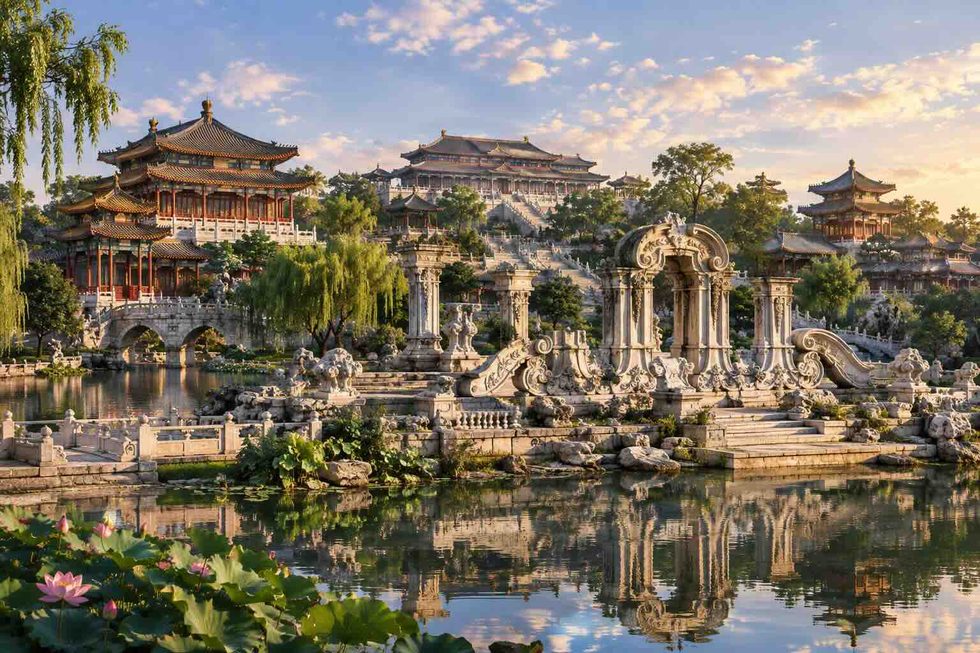
The Summer Palace Yiheyuan in Beijing was completed by the last empress, Ci Xi, shortly before the dynasty’s end, a little over a hundred years ago. It is an immense endeavor, with pavilions, gardens, hills, and a lake that covers three-quarters of the area. Inspired by the scenery of southern China, it was built on the foundations of earlier work accumulated over centuries and is almost entirely artificial.
It is a masterpiece of Chinese architecture, one that seeks to remake nature according to a plan devised by man. It aligns auspicious geomantic points–the mountain behind the lake positioned in front of the main audience hall. It was meant to bring the emperor good fortune, longevity, power, and wealth. It is natural yet artificial. It rebuilds the geographic environment, bends the cosmos to the sovereign’s will. It clearly didn’t work its magic because the dynasty fell shortly after its completion.
Ci Xi was built in a purely Chinese style after Western powers ransacked and tore down the Yuanmingyuan, the 18th-century summer palace inspired by Italian Jesuit Giuseppe Castiglione that blended Western and Chinese architecture.
+++
In Europe, there are also centuries-long projects, but these are the cathedrals—entirely human constructions, built in stone, as solid as possible, seeking to raise man toward God, and spanning centuries because time belongs not to man but to the divine.
Beyond that, the Mediterranean world never managed to tame or reshape its geographic environment, that treacherous sea, ruled by the whims and moods of a wrathful Poseidon going after 17th-century pirates as he had Ulysses three thousand years earlier. Even as Portuguese and Spanish navigators sailed around the world, relying on the steady oceanic winds harnessed by their sails, the capricious, moody Mediterranean continued to demand the inhuman effort of men bound to oars, right up until the arrival of the Industrial Revolution’s motor-powered ships.[1]
Here, nature is not remade; the cosmos is not reconstructed according to an emperor’s will — rather, human beings must come together, guided by discipline and abstract rules that govern the rowing of a vessel, to try to confront the fury of the waters.
Perhaps a different mindset is also present in China when it comes to thinking about money.
Trust money
Ultimately, money is based on mass trust; the broader the base, the better, and the more effectively I can use the currency. I can trust the Norwegian krone, but if no one outside Scandinavia recognizes it, its practical use is limited.
Practicality and ease of exchange also influence trust. I can trust diamonds or gold, but they require an extra step to use in everyday life. I can’t really walk into a bakery with a diamond or a gold coin. In both cases, it wouldn’t be a fair trade because the baker wouldn’t recognize their full value in exchange for the loaf of bread I want to buy.
Lorenzo Infantino[2] argued, quoting Carl Menger and George Simmel, that “money is the expression and means of the relationship and the mutual dependency between men,” and that “satisfying the desires of some” depends on “interacting with others.” Which means that it finds no place only where there is no dependence, “because one no longer desires anything from other men.”
$$$
All of this brings us back to the dollar today, the currency with the widest recognition and the most trust in the most places around the world. With a dollar bill, I can go anywhere in the world and get a piece of bread in a reasonably fair trade. I can’t do the same with a ten Chinese yuan bill.
The free market sets the dollar’s value, which is ultimately linked to the American stock and bond markets, the largest in the world. They set the price for basically anything that changes hands all over the world.
The RMB itself has a crawling peg, allowing 3% fluctuations up or down in a month against the dollar. It’s an ambiguous arrangement, held together by an underlying agreement between China and the United States, but one under growing pressure over time. China’s expanding trade surplus, coupled with political and military frictions with the US, makes it harder to maintain this exchange-rate system with the dollar.
The concrete problem is how to get out of it.
The trilemma[3] offers three main paths for addressing the issue. These aren’t clean-cut alternatives — there’s room for compromise and accommodation — but they are the three main roads.
The first is that China conquers the world and thereby imposes its currency and economy. The second is that it shuts itself off from the rest of the world and keeps its currency under control only within its own country. The third is that it fully integrates into the world and into world trade. All three choices carry risks and a price.
Politics first
Let’s start from the end. The third option, China’s integration into the world, implies the full convertibility of the Chinese currency. This carries the risk of capital flight from China, given that the Chinese themselves don’t have enormous confidence in their own economy. The classic example is Indonesia in 1998. Capital flight triggered a wave of corporate failures, which led to millions losing their jobs overnight, then to social protests, then to a political crisis, and ultimately to the end of a dictatorship that had lasted thirty years.
To avoid this, China should start at the top. A more flexible political system, facing the possibility of an economic and social crisis, would move toward elections, form a new government, and start over—with ultimately contained upheavals. In China’s case, the Party would need to undertake political reform before tackling monetary and financial reform. The political system would need to tolerate political crises and be substantially open.
Here lies a problem within the problem. Thirty years ago, China could have carried out political reform on its own terms, and the world would have applauded it — simply and almost automatically. Today, a political reform in China would have to be “sold” abroad because, unlike thirty years ago, China no longer enjoys much international trust. In other words, a Chinese political reform today would have to be judged “sufficient” by the rest of the world, particularly by the US, which prints dollars and maintains the RMB’s peg. But given China’s difficult and tense relations with America, that mediation could prove complicated.
The second option would be to close itself off from the dollar entirely. This was essentially the path used by the Soviet Union. But since some exchange with the rest of the world inevitably still takes place, the risk is a black-market exchange rate, as happened with the Soviet ruble, pressuring the economy in a different, more uncontrollable way.
Before the 1990s, China believed it could mitigate this risk by introducing a dual RMB system — one for Chinese citizens and another for foreigners. But even this did not prevent a black-market exchange rate, leading to the slow but steady erosion of the national currency.
This choice would be paradoxical because, in the name of nationalism, China could shrink and wither.
The first option would be largely political: China would conquer the world. This could be done softly, through political campaigns, or forcefully, through the use of military power — or through a mix of both.
In some respects, China today may appear to be on track to pursue this third option. The expansion of its political footprint around the world, and the overall rise in trust toward China at the expense of an America led by controversial President Donald Trump, seem to objectively indicate that Beijing is pursuing this path.
But it is a long and uneven road. In fact, even as China’s credibility rises relative to America’s, still fairly few Europeans or Asians would prefer China over their own countries.
America’s popularity was different. For decades, millions of people worldwide would have preferred to be American rather than citizens of their birth country.
What seems to be happening instead is a rise in trust in third countries, complicating the political game: it no longer looks simply bilateral but multilateral—a multilateralism with undertones unfriendly to America perhaps as much as to China. Few people want to move to live in China, and even if they did, there would be no clear immigration procedure as there is in America.
In other words, China’s path toward “conquering the world” may have become more complicated because it faces not only America but also a growing number of countries. They are increasingly concerned about Beijing’s geopolitical ambitions, its support for hostile states like Russia and Iran, and its trade policies, which are eroding their own countries’ domestic productive base.
This difficulty can consolidate and reinforce a complex cordon of distrust around China that keeps growing, even as distrust toward America also rises.
Most importantly, structural problems remain around the possibility of China’s control of the financial world. The RMB would need to delink from the dollar and muzzle Wall Street to boost the state-controlled markets of Shanghai or Shenzhen.
Can it do it? Would the world like to use a currency controlled directly by Beijing’s whims? It’d take a lot of force to bend markets in this direction, and right now it is completely unforeseeable. The only prospect of this could gather a huge storm against China.
So, at the end of the day, no matter how hard it is, integration could be the easiest way out of the trilemma.
Undecided
China hasn’t decided what to do, as Yu Jie argued in our conversation. The government recognizes the difficulties but doesn’t know how to proceed. It’s playing it by ear, day by day. It’s not like its grand infrastructure plans.
Beijing just announced it could spend $3.7trn over the next five years on “the six networks”: water (including reservoirs and canals), electricity (such as smart grids), computing (data centers), communications (fifth- and sixth-generation mobile), logistics, and urban pipelines. It has no grand plan for its money, which is perhaps more important than infrastructure. Here it needs direction, at least.
In this situation, China has no objective interest in chaos; it needs calm to sort out its direction. Chaos outside could spill over at home; it’d be hard to establish a firewall with the rest of the world.
Conversely, Russia, a declining power with great aspirations, has an interest in chaos. Chaos can create opportunities to make Russia great again thanks to its capabilities for subversion and hybrid war.
The American strategy could then be easier: hold on to the dollar, project trust to the free markets, and deal with chaos mongering first and foremost. If the dust of chaos settles, China maybe could have time and opportunities to rethink itself.
(I have to thank Yu Jie for the discussion and suggestions about this article)
[1] I owe these nautical notions to Amedeo Candelli, whom I thank here.
[2] https://asiatimes.com/2016/10/a-defense-of-money-as-freedom-of-choice/
[3] https://www.appiainstitute.org/articles/china/only-one-money-for-china/





Только одни деньги для Китая 2 | Время И Мир