

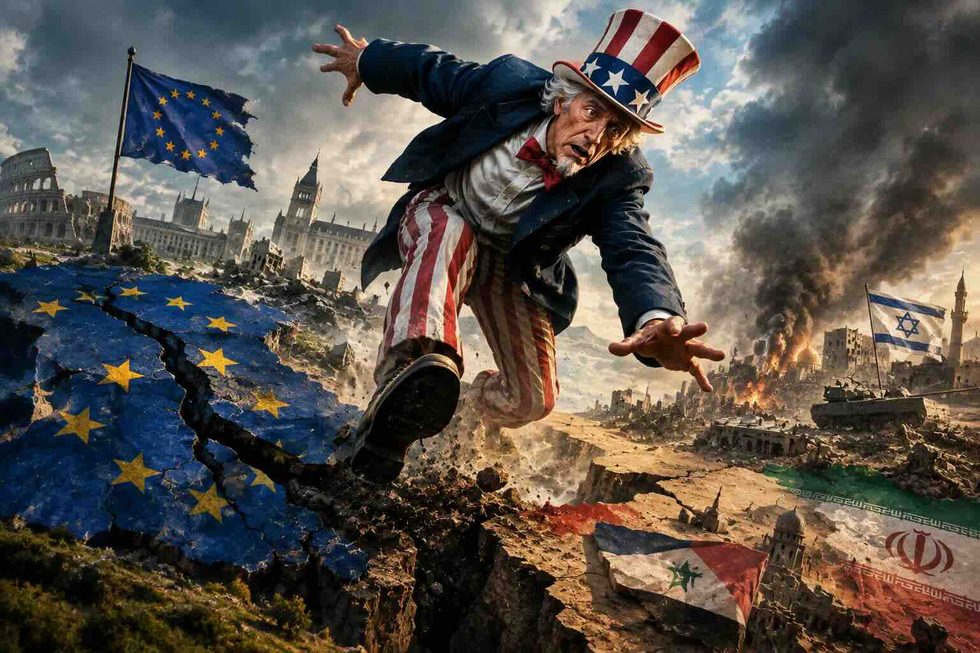
America’s small and big mistakes pave the way for China’s rise as leader of a new multipolar world. Clumsiness in European politics could spin all out of control. Will Trump rethink?
After the AfD victory in Saxony-Anhalt, the loudest noise was French radical-right leader Marine Le Pen’s silence. She may fear that the AfD scares moderates and the French public in general, who still haven’t forgotten the Nazi invasion in WWII.
The day after the vote, Hungary expelled ten Russian diplomats, marking a shift even from the approach of the previous Prime Minister, Viktor Orbán. The UK hard right was also silent about the offspring of those who bombed London 85 years ago.
Without other European parties, the AfD, openly pro-Russia, is isolated, and the EU overall opposes it. The AfD’s victory, in other words, created a first consensus in Europe against it.
A lesson for the US?
Right after the vote, German Chancellor Friedrich Merz canceled a call with US President Donald Trump. Trump had congratulated the AfD on its win, a clear signal against Merz, the head of government of Europe’s largest economy and second in NATO.
Did Trump mean he wants ‘regime change’ in Germany, which for 80 years has been the bulwark of American politics on the continent? The world noticed and considered its options.
Joseph DeTrani warned[1] that any real or perceived tension between the US and member countries in NATO, the QUAD, or AUKUS will make China President Xi Jinping’s efforts to create “an orderly multipolar world,” with China in the lead, more attractive to developing countries.
Xi is on a spree that could end with a triumphant visit to the US at the end of the month.
The real contest isn’t just Europe versus America. It’s about the world and the future of America and China within it. The developing world, the rest of the world, is watching closely, trying to find its footing amid this great mess. Here, China is emerging as more solid and reliable than America.
The most serious issue is not the AfD’s victory itself, but Trump’s easy embrace of it as a message to Germany and the rest of Europe. The US seems to be saying it would rather support an openly neo-Nazi party, even without a majority across all of Germany, than work with the old partners.
Frustration in America can run high over European foot-dragging on defense spending. But the sudden cure may kill more and faster than the disease.
In September Xi had the busiest travel schedule in more than seven years. He will be in four countries, on three state visits, at two multilateral summits, and at one widely anticipated meeting with President Trump.
On August 31, Xi held bilateral talks with Kyrgyz President Sadyr Japarov. The two sides signed a Treaty on Eternal Good-Neighbourliness, Friendship and Cooperation, a joint declaration on a comprehensive strategic partnership, and more than 30 other bilateral documents. On September 1, he was the main guest at the 26th SCO summit in Bishkek. Attendees included Russia’s Vladimir Putin, India’s Narendra Modi, Iran’s Masoud Pezeshkian, Kazakhstan’s Kassym-Jomart Tokayev, Pakistan’s Shehbaz Sharif, Belarus’ Alexander Lukashenko, Tajikistan’s Emomali Rahmon, and Uzbekistan’s Shavkat Mirziyoyev.
The day after, until September 3, he went to Egypt for a state visit, the first there in a decade.
On September 12–13,Xi traveled to New Delhi for the 18th BRICS summit — his first visit to India in close to seven years. A bilateral Xi–Modi meeting is expected on the sidelines.
The apparent goal is to show off to the domestic and foreign audience China’s growing footing in the international arena, compared to the US’s growing isolation.
Who’s Houthi
In the meantime, the Saudis launched an offensive against the Iranian proxies, the Houthis, and are losing. The Saudis proved they can’t win a war on their own. Turkey and Pakistan, who had just signed the Mecca pact a few days ago, won’t intervene. Their tripartite pact, which should have transformed the region, has been de facto aborted.
The Hormuz blockade was driving global inflation but also bankrupting the country. It was becoming difficult for Tehran to sell it as a political success, both at home and abroad. Still, Iran is scoring a real success with the Houthis.
The loss of the port of Mocha (once famous for the coffee trade) gives the Houthis control of the mouth of the Red Sea and the Strait of Suez. Added to the blockade of Hormuz, Iran has a chokehold on most global oil supply, and thus a finger on global oil prices.
It is a second strategic mistake following an ill-conceived long offensive against Iran. The USA needs to think long and hard about what to do next, or much could crumble. The USA may want to proceed without the irksome Europeans, but it’s impossible to have a strategy against the current European establishment.
Europe, China and wild games
There is the temptation of putting ‘boots on the ground’. But boots on the ground is only the final phase of a political construction that must happen first. In the first Gulf War, in 1991, before committing the military, Bush built an alliance that put everyone on the same side against Iraq. Once that alliance was in place, he then sent in troops with a precise, limited objective, and finished the war in just a few days.
The same should happen today. It’s unclear who wants to clear the Strait of Hormuz and the Red Sea, who is willing to commit, and who isn’t. The US first needs to build consensus on the facts, and only then on the solution to adopt. Too many mistakes have already been made — no more can be afforded.
Growing trade disputes and European misgivings on Chinese support for Russia have not closed the gap between Brussels and Beijing despite the broiling transatlantic controversies. But China might decide to sacrifice Moscow, at least partly, for Brussels. The EU is a much more important commercial partner than Russia. Plus, Beijing could walk a balancing act between Moscow and Brussels, united by shared suspicions about Washington.
The United States and President Trump need to avoid sudden, spur-of-the-moment actions and may need comprehensive, long-term plans to address the situation before everything falls apart.
[1] https://www.washingtontimes.com/news/2026/sep/9/china-challenges-western-alliances/