

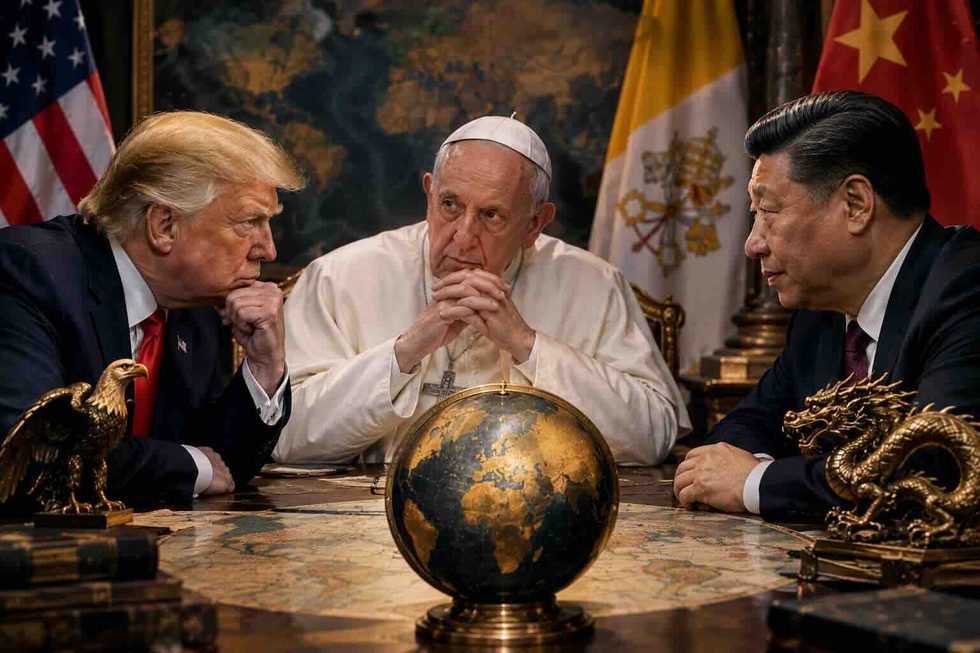
The world saw a short-term truce and long-term reconciliation within hours. The US and China broke new ground by setting aside some differences; the Pope ended a two-century-old cultural war.
America, which a year ago was supposed to overwhelm China with a barrage of tariffs, today sent its President Donald Trump to the airport to personally welcome Chinese President Xi Jinping: a gesture that speaks louder than a thousand words about the profound shift between the two countries.
America did not get down on its knees to straighten the red carpet for Xi, as other eloquent images had shown, lingering on American Marines smoothing out creases and preventing any potentially embarrassing stumble by the guest from Beijing. But the US certainly hasn’t backed China into a corner.
It didn’t just secure a ceasefire, as had happened in Beijing in May — what we may be seeing now could be a genuine truce. How things develop from here remains to be seen. What’s certain is that international politics and the markets could expect a period of relative calm between the two superpowers, at least until the Chinese Communist Party congress next autumn, and perhaps even through the ’28 presidential election.
At this summit, beyond the surface pageantry, some real substance seems to be emerging. Nothing specific or precise yet, but openings look significant and could be filled in over the next year or two. One involves a consensus against Iran’s nuclear rearmament and in favor of reopening the straits of Hormuz and Bab el-Mandeb. Another involves a possible reduction in bilateral tariffs. The two sides may also have agreed to revalue the RMB.
Then there are the truly innovative and delicate matters on which China was initially reluctant. One is opening a dialogue on artificial intelligence; the other is agreeing to prepare a memorandum to open talks between the American and Chinese militaries.
Mil-to-mil
This last point matters most. For years, the Chinese rejected American proposals along these lines because they feared that establishing codes of conduct between the two navies and air forces in the contested South China Sea and around Taiwan could amount to recognizing the American presence in those zones and to scaling back Chinese claims.
A Chinese opening on this extremely delicate issue, which touches on Chinese territorial sovereignty, may signal that China has recognized how dangerous an incident that’s hard to control could be and that its territorial claims must also account for the territorial claims and needs of others.
Indeed, if an incident occurred between the Chinese and American navies, escalation would need to be contained. First and foremost, escalation between two nuclear powers is inherently dangerous, but even if it were solely a limited military clash, China would struggle to control the narrative.
If China won the confrontation, it would be seen as a real tiger — and thus something to be contained and besieged. If it lost, it would be seen as a paper tiger, and all its neighbors might want a piece of it. In other words, a military clash would be politically damaging for China either way.
The Chinese military, confident in its power in the system, may once have opposed these talks more strongly, perhaps to maintain leverage over its own president. Perhaps the recent purges have weakened the military’s hand in internal political dynamics. Xi may now be able to take fuller control of the situation and frame the dialogue around broader political ideas rather than purely military and territorial ones.
Moreover, this is not just a bilateral issue but one that deeply involves the rest of the world. The Japanese Prime Minister Sanae Takaichi traveled to Washington just hours before Xi’s arrival and called Trump soon after the Chinese departure. The US rapprochement with China shouldn’t mean creating new distances with allies, and that also shows how delicate a new balance will need to be. Some 30 years ago, China had good ties with its neighbors; now they are in tatters, and true reconciliation with the US will be impossible without mending fences with the neighbors, and vice versa.
Of course, these are only statements of principle for now. Over the coming days and weeks, we shall see how these agreements take concrete shape. The first real tests will likely come with Iran. If China helps America bring Iran to heel, reopen the straits, and drive down the price of oil, Trump will have a month to show his electorate that he’s brought the dramatic cost of gasoline back under control, and thus hope to cash in an electoral dividend in the midterm elections.
The Enlightened Pope
In the very same hours that American and Chinese diplomacy was walking a tightrope between peace and war, the Pope was stirring things up in France.
Pope Leo, 237 years after the French Revolution — militantly anticlerical as it was — seems to have reconciled France’s two souls: the one born of the Enlightenment and the one of combative devotion that sparked the war in the Vendée. These two souls didn’t just split France apart; they split all of Europe and the entire Western world.
Pope Leo seems to have brought them together by explaining that faith is not opposed to Enlightenment reason. The explanation isn’t rational or Aristotelian, but emotional and human. Man, in his weakness — the profound equality among human beings who, as he said, are born frail and defenseless, in need of care and protection — stands at the center, with no contradiction between reason and faith.
This reconciliation won’t have effects tomorrow, or even the day after, but it could set in motion deep tremors that may eventually reach even America and China, which today are negotiating peace on a razor’s edge.