


Thirty years after their landmark 1996 document, Hungary’s Catholic bishops have issued a new pastoral letter addressing the country’s social, economic, cultural and spiritual challenges. The text is wide-ranging and at times strikingly self-critical. Yet it remains conspicuously silent about the Church’s relationship with Viktor Orbán.
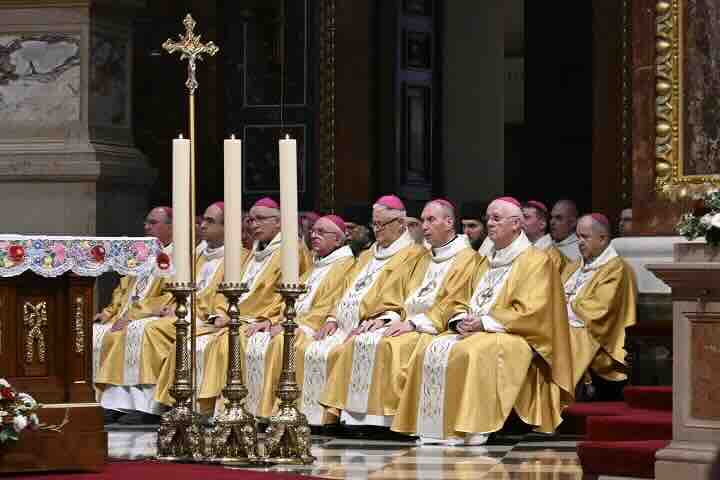
On 19 October, the Hungarian Catholic bishops published a major pastoral letter entitled For a More Just and Fraternal World: Thirty Years Later. The title echoes that of a document issued in 1996 (see Regno-doc., 19/1996, p. 608). Running to approximately sixty pages and divided into eight chapters and 146 numbered paragraphs, the new letter seeks to guide the Church in the years ahead, following the profound political changes brought about by the recent Hungarian elections.
The document addresses a broad range of issues, including family life, the economy, education and culture, politics, young people, and the spiritual renewal of society. It draws extensively on the recent social encyclicals of Popes Leo XIV and Pope Francis, as well as the Compendium of the Social Doctrine of the Church, the teachings of the Hungarian Church, and major studies produced by Hungarian state institutions.
The letter is the result of a collective effort involving several episcopal commissions. Its central purpose is to reaffirm the Church’s proclamation of the Gospel while tackling some of the most pressing challenges Hungary faces today.
Thirty Years Later: The Same Title
The pastoral letter tries overall to strike an optimistic tone while examining the challenges facing Hungarian society. In addition, two significant developments stand out: the explicit acknowledgment of sexual abuse within the Church and the extensive treatment of environmental issues.
Yet the document also has a major weakness: it fails to confront the Hungarian Church’s decades of acquiescence with Viktor Orbán’s illiberal political project.
The bishops reaffirm the central importance of the family, while identifying several pressures they believe threaten it. These include gender theories, declining respect for marriage as an institution, low birth rates, abortion, and the widespread availability of pornography.
(translated from Italian by Alberto Borda Rocca, first published on Settimananews.it https://www.settimananews.it/informazione-internazionale/ungheria-vescovi-la-lettera-silenzi/ )
On the economy, the bishops acknowledge the considerable progress Hungary has made over the past three decades, particularly in GDP growth, employment, and household incomes. At the same time, they draw attention to persistent structural problems: unemployment, regional inequalities, the marginalization of the Roma minority, the neglect of older people, and persistentcorruption.
The themes of education and culture receive substantial attention, including an important new discussion of the prominent role that Catholic and other privately run schools now play in Hungary’s education system.
Responding to frequent accusations that Church-run schools neglect disadvantaged communities, the bishops point to ongoing efforts to promote inclusion. They recognize the challenges posed by an educational environment increasingly shaped by digital technologies and social media. Significantly, they also acknowledge that the Church’s extensive presence in the education system has often not translated into the successful transmission of the Christian faith to younger generations.
One of the strongest chapters of the letter concerns the protection of creation.
The bishops argue that no part of Hungary remains untouched by environmental disruption, whether in air and water quality, land management, or agriculture. Climate change is already affecting family life, public health, employment, and access to essential resources.
The depletion of the country’s natural resources is particularly alarming: “Every year, we lose a volume of water equivalent to that of Lake Balaton, while the water regimes of our rivers and lakes become increasingly unfavourable.”
Both respect for future generations and humanity’s responsibility before the Creator demandsubstantial changes in our lifestyles. The letter calls on Christians to heed both the cry of the earth and the cry of the poor.
Young people are another central concern. The bishops identify the changing circumstances of younger generations as one of the defining “signs of the times,” requiring the Christian community to examine why so many young people have drifted away from worship and Church life. They also recognize that digital technologies are profoundly reshaping how younger generations understand fundamental questions, including truth, human relationships, and the meaning of life.
As the letter puts it:
“Young people are searching for a vision of the future worth living for, struggling for, and making sacrifices for. The Church’s mission today, therefore, is above all to reveal anew, in Christ, the beauty and dignity of human life and its ultimate, eschatological horizon.”
Generous in Its Vision, Reticent About Its Past
The challenges described in the letter call for spiritual renewal, both within the Church and throughout society.
Within the Church, the bishops urge believers to “rediscover the strength of a personal relationship with God and the joy” of faith. They also emphasize the importance of cultivatingChristian communities capable of sustaining their members and proclaiming the Gospel with renewed energy.
For society more broadly, they advocate a renewed commitment to dialogue, mutual forgiveness, and mercy.
One of the document’s clearest and most courageous passages concerns the Church’s responsibility for the sexual abuse of minors.
The bishops declare:
“We affirm that all forms of abuse against minors, and particularly sexual abuse, are unacceptable wherever they occur, especially within the Church. We will oppose them by every possible means.With profound sorrow and solidarity, we address all those who suffered serious abuse at the hands of Church personnel during their childhood. We ask forgiveness from the victims and their families, including on behalf of those responsible for the abuse. We also ask forgiveness for those Church authorities who failed to take the necessary measures to prevent such abuse.”
This willingness to acknowledge institutional failings is evident elsewhere in the letter.
Reflecting on the Church’s reluctance to fulfil its mission of evangelization, the bishops insist: “We must follow the path of repentance, examination of conscience, and renewal.”
They are equally candid about the Church’s shortcomings in bearing witness to the Gospel: “It is painful to recognize how far we have departed from this ideal. Yet only by following this path can we restore trust in the Church among those who, because of our mistakes, can no longer recognize the truth of the Gospel.”
Such passages demonstrate a genuine capacity for self-criticism. Yet that capacity appears to reach its limits precisely where the Church’s recent political history is concerned.
The document’s most serious weakness is its silence about the Hungarian Catholic Church’s subservient relationship with Viktor Orbán’s illiberal political project.
Nowhere does the letter offer a specific examination of that relationship or of the Church’s responsibilities during the years of Orbán’s rule.
When the bishops urge Christians not to silence their consciences, or when they call for an end to political polarization, their language remains abstract. These appeals could apply to virtually any political situation, without requiring an honest reckoning with Hungary’s recent past. Indeed, certain passages appear to reproduce elements of Orbán’s own political rhetoric, particularly in their treatment of migration and national sovereignty.
Equally striking is the absence of any explicit defence of the independence of democratic institutions and the separation of powers. Perhaps acknowledging the importance of these principles would also mean admitting the Church’s culpable silence as democratic safeguards were progressively dismantled.
Hungary’s place within the European project is simply taken for granted. There is no acknowledgment of the anti-European and pro-Putin orientation that characterized the country’s political leadership in the previous decades, nor of the Church’s failure to challenge it. This omission risks undermining the bishops’ credibility when they criticize other governments, whether present or future.
This tension is captured particularly well by the theologian András Máté-Tóth, writing on the Catholic website Szemlélek.net on 20 October. In his assessment, the pastoral letter has a dual identity.
On the one hand, it is prophetic and self-critical. It condemns incitement to hatred, emphasizes responsibility for the natural environment, and acknowledges serious failings within the Church.
On the other hand, it remains confined within a predominantly national perspective. Its interpretation of Hungary’s economic and social circumstances is selective, and it does not sufficiently explore the Church’s own responsibilities in the country’s recent political and civic history.
The result is a document that is well researched, conciliatory, and pastoral in tone, but also constrained by what it leaves unsaid.
The significance of the letter will largely depend on how the Hungarian Church receives and responds to it. The challenge now is to move beyond the letter’s limitations while drawing fully on its considerable potential.