


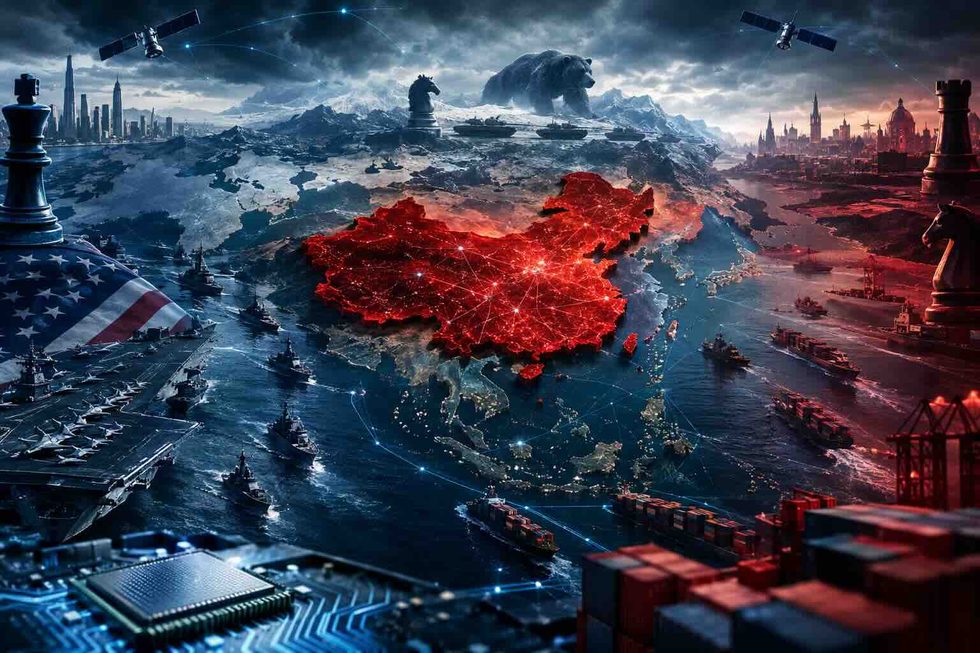
The present historical moment may seem oddly similar to that of 80 years ago. Then the dispute was how to handle the USSR; now it’s about China.
Toward the end of 1949, two momentous events – the Russian nuclear test and the triumph of the Chinese revolution – compelled Washington to rethink its international strategies. Well aware that his predecessor, the late Franklin Roosevelt, had a superior grasp of such issues, in 1947 President Truman set up a Policy Planning Office in the State Department directed by the highly-regarded Russia expert George Kennan.
Though adamant about containing the Soviet Union, Kennan chose to step down in May 1949 when his initiative for meaningful dialogue with Moscow was rejected. A more militant Paul Nitze replaced Kennan as Director. In January 1950 Truman asked his Policy Planning Office to analyze and report on the new situation in Russia and China. Nitze foresaw an uphill battle for his proactive rollback policy choices.
The main writer of NSC 68, Paul Nitze, had been a wealthy Wall Street investor who aspired to a career in public service. In 1940 he moved into the White House under James Forrestal and became a high-level strategist after World War Two ended in 1945.
The report, National Security Council (NSC) 68, was delivered to the president in April 1950 and immediately classified Top Secret. According to Nitze’s NY Times obituary (Oct. 20, 2004), Kennan “found the language of N.S.C.-68 to be dangerously melodramatic and unhelpful,” which may partly explain its Top-Secret label. For Nitze however overstatement was necessary: he anticipated resistance from the American public and the British over the costs and world-wide scope of his plans.
In 1975 Henry Kissinger declassified NSC 68 presumably to show Beijing and Moscow how far from Cold War thinking Washington had come while hinting that Moscow was a common adversary. In 1972 Nixon went to China to mend fences and launched a different triangular relationship among the US, Russia, and China.
The surprise event that prompted the report was Russia’s detonation of a nuclear device on August 1, 1949; four months earlier NATO had already been created designating Russia an enemy. The second event, which over time would prove far more momentous, was the establishing of the Peoples Republic of China (PRC) October 1. Yet, the Chinese revolution was barely mentioned in NSC 68 in order frame global politics so that Moscow stood starkly polarized with Washington in a duel to the death.
A China governed by the Chinese Communist Party (CCP) did disturb Washington and far more than London, but since British agents were working closely with the State Department policy planners in the Joint Intelligence Committee (JIC) the Chinese revolution was simply treated in the report as an extension of the Kremlin’s reach, not as a separate problem.
In 1949 the new leaders of China agreed to leave Hong Kong under British control so long as it did not serve as a base for subversion. Britain recognized the new Chinese government on January 6, 1950 and broke relations with the Nationalist regime on Taiwan. London also had to be mindful of PM J. Nehru’s working relations with the new Chinese government.
Washington however embargoed China, bombed the coast, and fought anti-China wars in Korea and Indochina for two more decades before reaching an understanding with Beijing (officially recognized in 1979).
Even on the nature of the Russia threat the British and the Americans did not always agree, at least at first. Differences between British and American intelligence officials’ approaches to Russia are analyzed by Matthew Perl in a Spring 2003 article in Intelligence and National Security entitled “Comparing US and UK Intelligence Assessments in the Early Cold War: NSC-68, April 1950.”
In essence the British intelligence community by and large demurred from Nitze’s view that a Russian threat was imminent and strictly ideological but drew closer to that assessment in January 1951 because of the Korean War, assumed to be sponsored by Russia. Kennan’s views remained nuanced however, leaning toward a defensive stance: he condemned the North Korean invasion but opposed taking the war to the north, across the 38th parallel, a bold move by MacArthur that brought China into the war.
Nitze’s superior and predecessor, George Kennan, was being diplomatic when he called NSC 68 “dangerously melodramatic and unhelpful.” While the report could be read as a projection of Washington’s own global ambitions, and a denial of America’s own failures, there may have rather been a bureaucratic motive behind Nitze’s extreme rhetoric. Like Acheson’s “clearer than truth” argument, Nitze felt he had to dramatically simplify his case, reducing the complexities of geopolitics to an apocalyptic duel. How else convince Congress, the bureaucracies, the public, and allies to undertake the huge costs implementing the report was bound to entail. Years later though Nitze showed considerable flexibility, especially in arms control negotiations with Moscow.
Nitze’s arguments for an expansive rather than defensive Cold War dynamic are explained in depth in a book chapter “Coalition Policy and the Concept of World Order,” published in Arnold Wolfers, Alliance Policy in the Cold War, the Johns Hopkins Press, 1959. This article contrasts containment with rollback.
“The sounder position – maintains that United States foreign policy . . . should be positive and not merely negative and defensive. It maintains that United States interests and United States security have become directly dependent on the creation and maintenance of some form of world order . . .
The school of thought [I hold to] proposes that today the fundamental issue in the international arena is not merely that of United States security; it is the issue of who it is that will construct a new international order . . . to take the place of the one that was shattered in the two world wars.”
It’s useful to look into NSC 68 at this time because a similar extremist mindset concerning Russia afflicts most European leaders today and much of the American deep state bureaucracy as well. Consider a few samples from the text:
NSC 68 background of the present crisis
i.“The Soviet Union . . . is animated by a new fanatic faith, antithetical to our own [fanatic faith?], and seeks to impose its absolute authority over the rest of the world. Conflict has, therefore, become endemic [thus involving both sides?]. . . On the one hand, people yearn for relief from the anxiety arising from the risk of atomic war . . . any extension of the area under the domination of the Kremlin [puts] . . . this Republic in deepest peril.”
The curious ambiguity of Nitze’s choice of words borders on mutual if not self- incrimination. After all, it was Washington that waged atomic war, and not only to defeat Japan but also demonstratively to threaten Russia, given Truman’s hint to Stalin at Potsdam July 24, 1945. Still, there was high-level opposition to using the A-bomb. Admirals Leahy and Halsey as well as General Eisenhower opposed dropping the bombs and so did the 70 scientists who signed the Szilard Petition. One wonders whether Roosevelt, who had died in April 1945, would have allowed the bombs to be used.
ii. fundamental purpose of the United States
The United States has purposes, the Kremlin has designs. Drawing on the Preamble of the Constitution, Nitze proclaims the benefits that he intends Washington to bestow upon the world, including Russia: “Justice, domestic tranquility, the blessings of liberty.” He adds for good measure “a firm reliance on the protection of Divine Providence.” Lest anyone doubt where God stood on the looming Cold War, in March 1946 Winston Churchill framed the issues as a struggle between “Christianity and Communism” when he spoke before Truman at Fulton, Missouri; Churchill turned less militant only after Russia’s 1949 nuclear test.
iii. fundamental designs of the Kremlin
Nitze usually refers to the Kremlin, not the Soviet Union. “The design, therefore, calls for the complete subversion or forcible destruction of the machinery of government and structure of society in the countries of the non-Soviet world and their replacement by an apparatus and structure subservient to and controlled from the Kremlin,” suggesting that even China was under Stalin’s thumb.
Later in the lengthy text (the whole runs 60 pages or so) Nitze speaks of the confrontation of a “free society and a slave society,” and “how the absence of order among nations . . . imposes on us . . . the responsibility of world leadership. . . to bring about order and justice by means consistent with . . . freedom and democracy.”
What explains the inordinate length of this report? Why does it seem so over-argumentative and repetitive? Doth Nitze protest too much and thus betray latent qualms about the accuracy and veracity of his accusations and allegations? If “the free society values the individual as an end in himself,” is he in denial about the plight of black citizens or women? When he speaks of “hospitality even to anti-pathetic ideas” has he forgotten the Smith Act prosecution and the jailing of American communists?
Finally, has NSC 68 not in fact proved in hindsight to be a projection onto Russia of Washington’s own exorbitant ambition to build a world economic order? Does it not now read as a diagnosis of American political pathology applicable to NATO’s war against Russia in Ukraine currently underway, in particular the perverse Russophobia that prevents the European and Ukrainian leaders from initiating positive meaningful dialogue to negotiate with Moscow, instead demonizing Russia’s leadership while cruelly indifferent to the suffering of the Ukrainian people.
Such is the contemporary relevance of Nitze’s report, but the preceding history too, dating back at least to the mid-nineteenth century Crimean War, is part of the even larger story of western imperialism. Interestingly, in 1997 Nitze and Kennan along with some fifty foreign policy officials signed a letter opposing NATO expansion eastward. One would think that such expansion, widening the network of allies, fulfilled the purpose of a proactive foreign policy. But these officials correctly sensed that over-expansion could jeopardize alliances and thus security.
Today three decades later we witness the ruptures of Washington’s relations with a wide range of countries, friends as well as adversaries. The Chinese have duly noted the perils of over-reaching for world-wide dominance and drawn their own conclusions, closer to Kennan’s insistence on recognizing limits.
We conclude with a reflection on the Soviet role in World War Two and a quick look beyond. Russia lost close to 30 million as the war in the east was more brutal than in the west; and yet the heavy lifting in the defeat of Germany must be credited to the Soviet Union, which also played a small but not insignificant role against Japan, since the Russo-Japanese non-aggression pact of April 1941 looked precarious enough to compel Japan to maintain large forces in the Mongolian-Manchurian area.
Despite the efforts of western propaganda to inflate the roles of Britain and the US, to glide past France’s wartime stint as part of Hitler’s Third Reich, and to minimize if not ignore (whenever possible) Russia’s contributions to the Allied campaigns, such as overlooking Bagration by hyping D-Day, the facts remain firmly in place. To the Russians It was utter betrayal for the west to turn on Russia after its wartime sacrifices, framing its occupations in Eastern Europe simply as illegitimate expansion rather than recognizing and dealing with Moscow’s anxieties about Eastern Europe providing Nazi invasion routes.
Not only in WWII but even in WWI, tsarist armies fought on the side of the Entente for three years until the military burdens they bore led to revolution in October 1917 and a truce with Germany, setting world history on a new trajectory.
One supposes that for the Russians these memories reemerge more sharply today as the crisis-ridden European states and the EU bureaucrats revive the failed conquest fantasies of earlier times. It could even be that Nitze, who showed flexibility at important moments, suffered from a touch of chagrin over his and Washington’s role in the betrayal of the principal victors over fascism. It only remains to ask if the large-minded Roosevelt would have treated the heroic Russians as shabbily as Truman and Churchill did.
Stalin died in March 1953 and the Korean war armistice was agreed in summer. Khrushchev came to power in September. Chinese forces had fought the Anglo-American army to a stalemate in Korea. An embittered Washington proceeded to turn its full wrath on China while exploring détente with Moscow. In this context, the Eisenhower administration, with JF Dulles as Secretary of State, began planning to replace France in Indochina, extending a war by two more decades that in the end led to US-PRC handshakes, toasts, and banquets, proving yet again that no one outsmarts history.
https://asiatimes.com/2019/04/rethinking-us-sinophobia/