


When will an eruption occur in China? Is Beijing more similar to Vesuvius or Etna? A flow of questions and maybe some advice for Trump – you’ll get what you want without much effort.
What’s brewing in China? Many ordinary people, who see the value of their homes sliding, their children unemployed, or who have dim prospects for the future, are unhappy and complain. But what does all that really mean? Maybe very little in the short term, although certainly much more in the long run.
The unhappy folks who lost so much money don’t vote, and they don’t have a voice. Mid-level officials also hate being pressured from above and have no room to make side money (like they did before). Young people graduate from universities but often struggle to find jobs, and so on.
All this adds up to people lying flat, “tan ping,” letting it rot away, “bai lan“—the idea that people don’t spend and save because they’re scared of what’s coming. So, domestic consumption shrinks, entrepreneurs don’t invest, and growth is driven by infrastructure spending that balloons internal debt—leading to all sorts of inefficiencies. And the cycle goes on.
Against Opposition
But does all this mean there’s opposition within the Central Committee (the body that could vote out President Xi Jinping)? No. Because these officials believe that to deal with the problem, they’d have to change the big man. But that’s a dangerous move—tried a few times, maybe, and always ended badly. It’s what brought down the rebels in the past.
There’s also a broader calculation. The system is built around the emperor; if you bring him down, will the system survive? If it doesn’t, the officials lose their positions along with the emperor. So, as a matter of self-preservation, they defend the emperor no matter what. Nobody managed to bring down Mao or Deng, although many tried. With Xi, it wouldn’t be easier.
The middle class is in a similar boat: their homes have lost half their value, and their savings are partly gone. But losing half is better than losing everything—this could be the case in a revolution. They still have a lot to lose, and revolutions are fought by people with nothing to lose but their chains. In 1989 at Tiananmen, people showed up with bicycles, left them unlocked in a corner, and grabbed the first one they saw on the way out. They didn’t even own bikes. Same in 1999 during the anti-American protests after the Belgrade embassy bombing.
They had nothing to lose—and everything to gain—from a revolution. Now, most have something to lose, and the gains are uncertain.
What’s the result? No active opposition. So, Xi now has more power than ever.
Can this last? How long? What will be the tipping point? These are questions for the future. But North Korea also serves as a warning. The Pyongyang regime survived 80 years of isolation and failing economic policies.
Volcanic China
Still, Xi holds all the power, but he’s sitting on a volcano; it’s only a matter of time before it erupts. In theory, China could be like Vesuvius—waiting thousands of years for a big blow. Or it could be more like the Etna: constantly rumbling, periodically burning houses and fields with lava, but no destructive eruptions.
Unlike North Korea, it’s much larger, more integrated into the world, more diverse, and has been open for decades. It also has a history of periodic, sudden outbursts. We know it, and Xi knows it. So, he can either try to hold off the next eruption and delay it for a few years or attempt to implement a systemic solution. Even without a revolution, a major power struggle at the top is only a matter of when—not if—because no one lives forever.
If we think this way, he and his people probably feel the same and are groping for answers. But what kind of answer? That’s a key question.
Next Months
The following 12 months could be important as a new domino effect has been set in motion (see here). Iran has been defeated in 12 days by Israel in a rare long-distance fight without any boots on the ground. Its regional proxies have been decapitated (Hamas in Gaza and Hezbollah in Lebanon) or annihilated (Syria’s Assad regime) or crippled (Yemen’s Houthi or Iraqi Shiite). The same Tehran regime is wobbling, unsure whether the elderly and frail Supreme Ayatollah Khamenei will survive the blow.
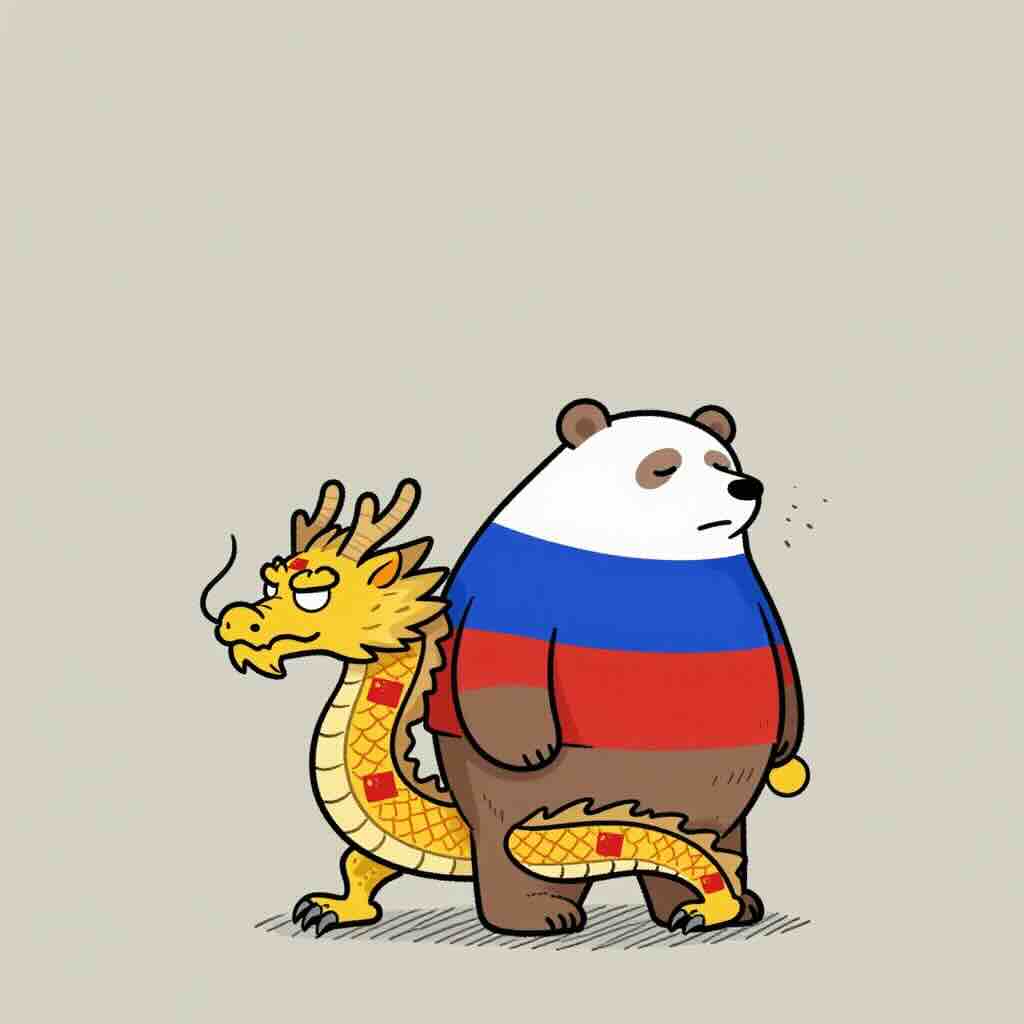
President Vladimir Putin in Russia is more isolated. His summer offensive isn’t producing any breakthroughs, and his generals may want to decide whether they have a better chance of survival with or without him. Putin himself could become more open to a compromise in a fight where he grows lonelier by the day. Against this backdrop, China could consider hedging its bets and refraining from being drawn further into a war that Russia can’t win.
In other words, in about 12 months, US President Donald Trump, by biding his time, following the flow, shunqi ziran (see here), and just indulging the difficulties of America’s strategic adversaries, may have won two conflicts and reshaped the outline of half the world with little or no effort. Here, perhaps, is a more general lesson. Maybe Trump should stop trying too hard and pushing everything and everyone around. He did it to gain power, but the ways to maintain power are different from those used to acquire it.
This, in turn, could place China in a different context. Beijing may rightly claim it is not affected, because it has distanced itself from Iran. However, the new reality of the world may cast a new, altered shadow on Xi and his government.