

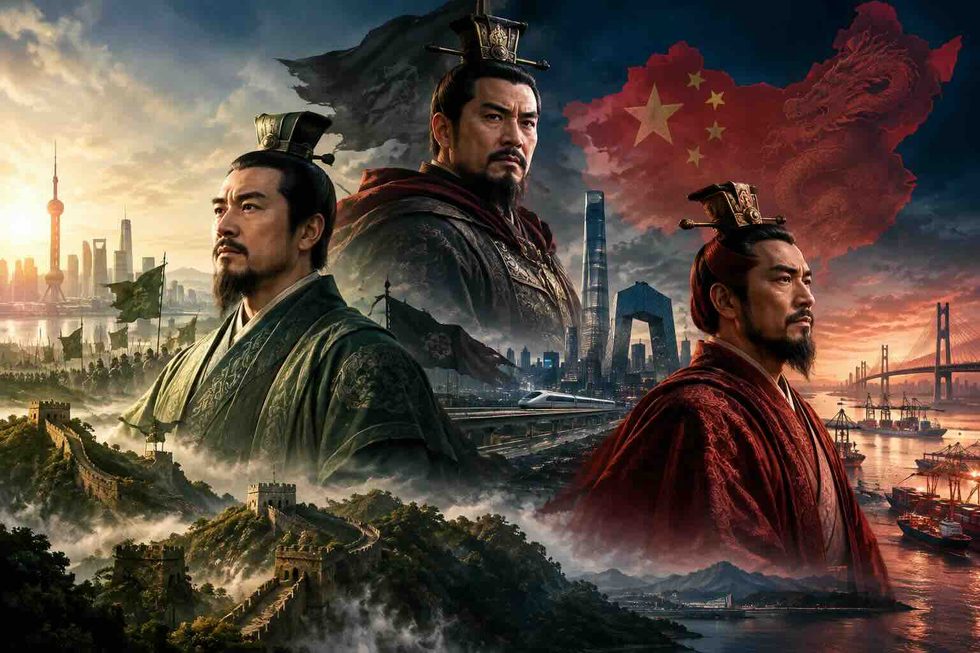
The English translator of the Chinese epic, Moss Roberts, retells the points of the story and its importance for present-day China
(This is an edited version of an interview that Professor Roberts had with Joseph Harmer of the Anglo-Chinese Friendship Association.)
After I graduated and came to NYU, I began playing around with translation. I had done a few things earlier, but an editor I knew at Pantheon approached me about doing an abridged Three Kingdoms. So (my first translation) came out in 1976 and eventually led to an invitation from the Foreign Languages Press i in Beijing. That was a kind of halcyon moment in US-China relations, and so culture became a prominent bridge. I began doing the work.
I went there in 1983 and began working on the translation, and a few months later an editor from the University of California came by and wanted to do a joint publication. So that’s what eventually happened.
Relations between America and China were friendly. Ostensibly friendly, since tensions and conflict stretch back two hundred years. It was a very good period to be working in China. Later, after the final publication came out, I was fortunate to get a full-page review in the New York Times and a lot of favorable comments, even within my own tiny academic sphere. That led to two more offers from the University of California: first to translate the Daode Jing of Laozi, and then the Analects of Confucius. I’ve done three translations, written many scholarly articles, and, from time to time, written commentary on current events.
I was first in China in 1972. The Cultural Revolution was ending. I noticed something when I was there. I was there with a group, the Concerned Asia Scholars, an anti-war, anti-Vietnam War group. When I was there, I noticed a postage stamp with a picture of Mao staring up at a bookcase. I knew what that meant. It meant the Cultural Revolution’s hostility to education was over, and China was going to embark on a complete reversal of almost everything it had done. And education was going to be a big part.
We’re seeing today the fruits of that shift, a very important, very dramatic shift leading to the achievements of the Chinese economy, over which the Americans privately and publicly freak out and don’t need to.
I think you could look at the Cultural Revolution as an exaggeration of a certain logic. The Mao leadership was saying: go into the countryside, learn from the peasants, don’t think that your elite education and credentials are enough. They didn’t want you to be an elitist.
Also, the Cultural Revolution tracks very closely in terms of timeline with the Vietnam War. The Americans and the Chinese have agreed to ignore that critical detail. But it was very much about the Vietnam War. It was about mobilizing the country, not only against the very likely possibility that the Vietnam War would advance into the north and then into China, which was their main anxiety, but also Russia.
China was having so many arguments with Russia. They came to blows with Russia in the middle of the Cultural Revolution. It was about an extreme form of national mobilization, with a distinct military aspect to it. During the war, I think the Chinese told the Americans: if you send land forces into the north, we’re gonna come in and we’re gonna do to you what we did to you in Korea. The Americans, thank God, had enough sense not to send land forces into North Vietnam to try and conquer it. Because the Chinese just didn’t want a hostile neighbor.
Whether it was North Korea back in the 1950s or Vietnam in the 1970s, they wanted to preserve that buffer, North Korea, North Vietnam.
So going back to the Three Kingdoms, when an editor at Pantheon Books approached me about doing a translation, I decided to give it give it a try. I wanted to make an edition that was short enough to use in my classes on Chinese literature.
Disunity Phobia
The Three Kingdoms is really about how the Chinese are phobic about disunity. In the opening line it states the main dynamic, the overall pattern of history: long united will divide, long divided will unite, It’s been that way on and off for almost 3,000 years, periods of unity followed by periods of disunity, and they regard unity as normal. That’s what they want, and they regard disunity as abnormal, particularly because it makes the country vulnerable to external aggression.
The Three Kingdoms for the Chinese holds a moral lesson about how the greatest of all dynasties, the Han Dynasty, the dynasty that gives them their ethnic name, 400-year plus dynasty, comes apart, falls apart into three kingdoms.
The Three Kingdoms only lasted 60 years, and then there’s a brief one generation of unification, and then once again the country is divided north and south until the Sui and Tang dynasties. It’s a kind of manual of political science.
It’s about the failure of the unification, the failure to restore the Han Dynasty. That’s the main theme. In the end it fails. It’s probably the closest thing in China to a Shakespearean tragedy. It’s tragic for the Chinese that Liu Bei or his advisor Zhuge Liang, Kong Ming, who happens to be named after Confucius, were unable to restore the dynasty.
Three Kingdoms also narrates the abdication of Liu Bei’s son, who refuses to fight hard to fulfill or to continue his father’s mission. He had no interest. Stuck out in the western province, he had no interest in reconquering the central plains and the northern kingdom, which eventually became a separate kingdom, the Kingdom of Wei, or the Cao Wei dynasty.
I think that’s the why it’s so compelling to the Chinese. Some sinologists compared it to the to the Iliad. I’m not sure I totally agree, but I don’t really disagree either.
JH
The world of the Iliad seems a lot more foreign to Westerners than maybe the issues that are at play in the Three Kingdoms might feel to Chinese people. For example, the big fear of division and the big focus on unity is still a live issue in China, whereas what should we do about ‘my slave girl being stolen by my leader? (the initial chapter of the Iliad) that is less of a key live issue for Westerners.
MR
The Three Kingdoms had an enduring status because the founder of the Ming dynasty presented himself as an avatar, as a second coming of the founding of the Han. The Ming was looking to the Han as a model that it was hoping it could reestablish.
The Ming is coming right after the Mongol conquest when a foreign power had finally taken not just a piece of China, but the whole. So they were looking for an ancient model and that was a Han.
The first edition that we have is around 1590-ish. And of course, there had to be manuscripts. So, I would date it to the mid-1500s, mid-1600th century. But nobody knows. But the striking thing is that if the founding emperor of the Ming Dynasty, Ming Taizu, was looking for the Han Dynasty as a model, why did the author of Three Kingdoms write this gigantic novel about the fall of the Han Dynasty? He’s at the opposite end of the timeline.
And I always took that to be a warning that the Ming Dynasty was gonna fall, like the Han Dynasty. so that’s your model? Why don’t you follow it? Instead you’re headed for trouble.
So you have to wonder. Remember, the Ming Emperor was captured by the Mongols in 1549 and held captive for about a year. I’m wondering if that might have incentivized the author to think about the fall of the Han Dynasty and then, as the Chinese often do, to write his novel as a warning to the authorities that they’re in big trouble, using an ancient example.
JH
The great novels of Chinese literature seem to be set at like, kind of at the end of the eras. It’s kind of similar with The Water Margin in my feelings, where you can see that the Song Dynasty is coming to an end when you read the text. Even the Dream of the Red Chamber. Even though that was written while the Qing dynasty was still doing well, you still get the sense of impending collapse.
It’s interesting to see when the great works of Chinese literature emerge or are set.
MR The Dream of the Red Chamber is to sex as the Three kingdoms is to history. In other words, it’s really revolutionary. The dream of the red chamber is really the last tableau of China prior to the opium war attacks. So that’s written in the later edition is 1790, and the build-up to the opium war really starts in the 1800s, when after the British had kicked the French out of India (1763) and seized the opium monopolies.
The Title — Yanyi
MR
The title yanyi. Yan is like an unfolding; it’s used in the word evolution. It’s an unfolding of the historical significance. The word Yi is complicated because it can mean the meaning of something, or it can have either a historical or a moral meaning or lessons. Maybe for the Chinese, morality and history aren’t really separate.
It’s an unfolding of the historical and moral significance or lessons of the Three Kingdoms.
The bigger question is: what do the Three Kingdoms mean? And everybody has missed the point of that, and it has to do with the discrepancy of the timeline in the novel. The novel is 120 chapters. Eighty or two-thirds of the chapters, are devoted to the fall of the Han Dynasty. Only the latter 40 chapters, which are the less interesting chapters, are devoted to the Three Kingdoms period.
So what does Sanguo, Three Kingdoms, really mean? The problem is that guo, which shows a perimeter with an armament inside of it, has another meaning, a related meaning. It can mean governance. Then it could mean tri-divided or triply divided governance. That could apply to the first 80 chapters, which show how the political power of the Han dynasty begins to break apart into three kingdoms. And then it’s followed by the Three Kingdoms. So, the title covers both. It covers the breakup of the Han and the subsequent history when the kingdoms are actually formed.
That’s how I look at the title.
JH
They’re not just different dynasties; they’re quite different models of government, in a way. You’ve got Liu Bei, who’s kind of like the perfect model of virtue, and you’ve got Cao Cao, who’s the perfect Machiavellian, and then you’ve got Sun Quan, who I suppose is the third one.
MR
Liu Bei’s character description comes largely from Mencius. There are all kinds of touches.
He cries. The modern writer Lu Xun wrote about him and said he was a kind of crafty or devious moral hero, which is probably closer to the truth. But I think for many readers, they take it on a simpler level, just that he had the moral qualifications to rule, because what are your qualifications for a dynasty? You know, you got territory, you got lineage, or you got virtue.
Now virtue is a big deal for Confucian historiography. That’s why you have 25 different dynasties: one dynasty lost its virtue, another came along, was virtuous, and got the Mandate of Heaven.
Japanese look at this and say, we only have one dynasty. We come from the sun goddess, but look how corrupt the Chinese are. They have too many dynasties. The Japanese don’t accept the idea of virtue as a key qualification for ruling.
JH
I always think Liu Bei is a much more interesting character than he’s sometimes given credit for. At the start of the book, he’s making sandals and selling mats. Although he is technically a member of the ruling dynasty, he’s an incredibly distant and impoverished relation. He doesn’t have the guile of Cao Cao, or at least not Cao Cao’s ruthlessness, certainly. He doesn’t have Sun’s power and land, but he’s still able.
The book is attributed to the fact that his virtues- well, my reading of it was that, in the book, his virtues were able to attract the right people to him. Whereas Cao Cao repels others. Even when Cao Cao tries to be virtuous, his kindness always seems to have an instrumental purpose. Whereas for me, Liu Bei always seems to come across like he’s doing virtue for the sake of virtue. But it’s hard to tell when you’re at such a distance from these characters.
When I read the book, I’m always fascinated by how it switches between pages of this general who fought against that general and conquered such and such a city, and then you suddenly get these very vivid and intimate portraits of human interactions, like Liu Bei dropping his chopsticks because he’s so nervous while speaking to Cao Cao.
MR
You can’t really manage all those things with chivalrous unambiguity. He had that quality that is mentioned in the opening of the Odyssey, poly tropos. He can twist and turn and he had to undergo twists and turns of fate, to manage so many dangerous, tricky situations. I think Liu Bei and Odysseus have something in common.
Further away, going home means restoring the Han Dynasty. Not just returning to Penelope, but there is a homecoming aspect to the idea that Cao Cao is so evil because he usurped and he’s plotting to dethrone the Han and that’s actually done by his son and to place his own family in power. So it’s a dynastic transition that Cao is planning. Possibly analogous to Penelope’s suitors.
Of course, the same thing will happen to Cao Cao’s descendants when in turn one of his descendants is replaced by his Prime Minister basically in the same way Cao Cao was supplanted.
The model for the book is something called Sanguo Pinghua. I wrote footnotes, about a thousand footnotes, and then a long afterward, and I compared different editions, or in this case Pinghua is a kind of predecessor. It’s only a hundred pages, but the timeline is much longer. It doesn’t cut off in 280 as the current Three kingdoms does. Pinghua goes a couple of decades into the 4th century, just to show the rapidity with which the Caowei dynasty fell to the Sima family only to abandon the north in 317 and move south and divided a dividing the land for centuries.
The reason that the author stops at 280 is that he wants to stop at a reunification. He doesn’t want to show the fragility of that reunification.
Chinese Mata Hari
MR
So then as to characters, the Chinese, when I was in China they would ask me, what are you doing? So we get into a conversation in the taxi cabs, and they’d say, Who’s your favorite character? Which character do you like? Expecting me to say, Zhuge Liang or Liu Bei. I would say, no, it’s Diao Chan.
And they would be very indignant about that, that I picked a lady instead of a male as the most important character in the novel. But then I would explain to them that Diao Chan was the only character in the novel who fulfilled her mission. All the men were failures. And so they were a little taken aback, but they had to concede the point.
JH
For people who haven’t read the book, Diao Chan is a 16-year-old girl. She’s basically sent on a mission to go undercover and make two men, two of the most dangerous and powerful men in the kingdom, fall in love with her to turn them against each other. When you really think about what that would mean for a girl like that, it’s an incredibly scary experience. Because these people are having people tortured to death at the drop of a hat. And she’s been dispatched by her stepfather on this unbelievably dangerous mission.
She comes across as very compelling, and it’s very easy to see why Lubu and Dong Zhuo both fall in love with her when you read the book.
MR
You could read it as a crypto feminist novel. But very few Chinese do that. They’re not ready for that.
Let me say a word about that opening poem. The opening words are gun gun, which I translated as “on and on.” The great river rolls. Of course, water is feminine. So the idea of the river sweeping away all these great heroes and leaving nothing. Really, it says in Chinese, all of a sudden: nothing, kong, kong, which is a Buddhist term for nothingness. Anyway, the first words of the poem, gun gun, can be a curse in Chinese; if you say to a Chinese person, gei wo gun, it means get the hell out of here. So roll, roll yourself away from me. I don’t wanna be in your presence. But look at the graph. The graph has water on the left, then clothing, top and bottom; then the phonetic in between, which is the word gong, a senior male of authority.
If you take the graph for water away and you just have the right-hand part, the graph means something like the court dress, the way the officials dress when they come to court, official costume. If you put all that together, you see the high and mighty great officials are being rolled away in the river, the river of time, the river of history, which is female, because water is female. Mountains are male; water is female. Everything in China has a gender. Every landscape shows you mountain, water, mountain, water. So the idea of the water sweeping into oblivion, Kong, sweeping away all these high and mighty officials, is what the book is about. And I think that fits my view of Diao Chan as the most important hero.
Water gets its feminine symbolism from the Daodejing.
There are feminist touches there.
JH
Also, there’s the mother who hangs herself. One of Liu Bei’s advisors is: his mother is hauled off to the capital by Cao Cao, and a letter is forged on her behalf, asking this advisor to come to the capital. Liu Bei thinks this guy knows quite a lot of our plans because he’s our top military advisor. Eventually, he thinks he can’t keep a son away from his mother if his mother’s asking him. That would be very unfilial of me. And so he lets him go off. Then his mother arrives and says, “Hello, Mum, I’ve got your letter.” She says: “You idiot, you worthless piece of dirt. How dare you not read my letters, not realize it was a forgery.” She goes and hangs herself while her son’s still waiting for her to come back. Like so many of the scenes, it’s incredibly harrowing.
MR
Liu Bei says to the advisor, I hope you serve your new master well. And he says, I will never serve Cao Cao. And then he rides off. And he disappears. Liu Bei says, “Cut down the trees. I want to see my beloved advisor. But all of a sudden, the advisor reappears on the horizon and gallops all the way back to Liu Bei. And says, “You know, I almost forgot to mention. I know I was a good advisor to you, but I know somebody much, much better. And that’s this guy, Zhuge Liang. And here’s his contact information. Here’s his email.”
When I explain the scene in class, nobody gets it because my students aren’t cynical enough. They’re too young. But what really happened is that the advisor, knowing how much he knew, knowing how valuable he was, expected to be murdered.
And when he finally got past the tree line and was out of sight and safe, he realized: I’m not going to be murdered. Okay, he’s a man of virtue. I’m gonna go back and give him Zhuge Liang’s email, and I’ll make up for my loss. That’s the meaning of the scene, but it’s very tricky to explain to young people.
Characters
The work has completely permeated the population. Zhang Fei is interesting because Zhuge Liang slowly educates him. He gradually improves his violent temper.
But the most important one is Lord Guan, who, for example, turns up as a god of war in the Mongol period. You can see statues of Lord Guan on one side and Confucius on the other side. So, you have the Wu and the Wen, the martial and the civil, as equals, but of course, civil is more important. Anyway, Lord Guan is a character with very little coverage in the original history, the Sang Guo Chi by Chen Shou, dating around 290, I think, but in the novel, the character of Lord Guan is very much built up and is almost 90% fictional.
There’s some philosophy behind it. I mean, Zhuge Liang is really a Taoist who is seduced by Liu Bei’s morality into becoming a Confucian advisor. And he’s warned at the beginning, no matter what you do, it ain’t gonna work. But he defies fate or prognostication. He defies it and leaves. He’s a refugee, he’s a recluse, hiding from the bad government of the Han Dynasty, the end of the Han Dynasty. And he doesn’t want to leave.
For him, it’s an enormous risk. When that man I mentioned escapes safely from Liu Bei and then returns to give him Zhuge Liang’s contact information, what happens after that? He goes riding on, and he comes to Kong Ming’s house, and he bangs on the door, and Kong Ming appears.
He says, “Listen, I just met this guy, you know, and I recommended him to you. And Zhuge gets into a big huff, flaps his sleeves, turns around, and slams the door. What are you doing to me? I’m trying to save my life in Daoist seclusion. I spend my time playing chess. I don’t want to go back into the world.” This sets the stage for the famous three visits that Liu Bei makes to him.
The first time he goes, he’s not home. Is he home? Of course he’s home. He goes again. And then the brothers get angry and they say, I’ll pull that wisecracker out of his house. And Liu Bei says, “No, we can’t do that. He’s a sage man. So his immediate appearance in the first case is set off comically by his non-appearance when Liu Bei comes. Zhuge doesn’t come to the door.
Then, in the final third visit, the three visits to the thatched hut. On the third visit, Zhu Geliang is home.
But he’s sleeping. Is he sleeping? No, he’s not sleeping. But his back is turned. And Liu Bei is standing behind him. And the brothers say, “Wake this guy up, for God’s sake.” And Liu Bei said, No, no, we can’t do that. And finally, Zhuge Liang stretches; he yawns; he turns around. My goodness, we have this visitor here. I must apologize. What’s going on here?
What’s going on is another theme of Mencius: that the minister is more important than the ruler. And that’s a theme in Mencius.
And you know it’s an important theme because there’s a very interesting moment in the Mencius when one of the disciples says to him, Are you arguing that the minister is more important than the ruler? And Mencius says, no, no, no, I would never, I would never advocate such an inversion of authority relations. That’s exactly what he’s doing.
The whole Mencius is about that. The opening. He goes to the king on the first page of the Mencius. And the king says to him, ” You’ve come such a far way to profit my kingdom. And Mencius begins by giving him a tongue-lashing.
Don’t you talk to me of profit. I come up to you with the virtues of humanity and righteousness, Ren, and that’s all. So right there on page one, you have a minister rebuffing a ruler. And that’s a covert theme of the entire Mencius. And that’s what’s going on. Zhuge Liang wants to make sure that he has Liu Bei’s ear. I want you to listen to me, not those scamps, your brothers, who are merely good fighters. Zhuge Liang never fights. He only uses one weapon. Fire, right? Which happens to be the symbol of the Han Dynasty. He doesn’t even ride a horse. He’s carried around in a carriage or a cart or something. He’s drawn by an animal; I guess it’s either an ox or a horse. He’s drawn around; he never walks; he never lifts a weapon.
Never uses a weapon, but he’s a fabulous strategist. There are all kinds of stuff going on about masculinity and femininity. The novel has a lot of facets.