

Chronicles of wars and the search for broad theories converge on the US difficulties in striking tariff deals and the march to the Chinese Party Congress, where Xi could accrue more power than Mao
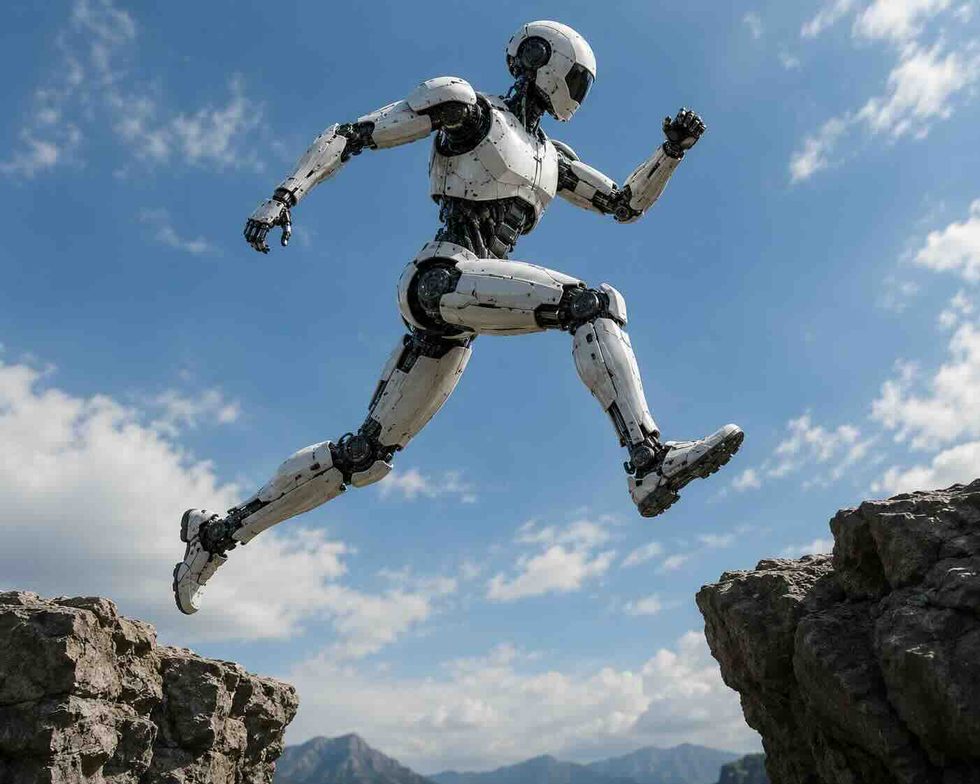
The 2nd World Humanoid Robot Games opened in Beijing on August 22 and will run through August 26. The numbers alone tell a story of acceleration: 666 teams, 2,056 humanoid robots. Participants from 16 countries across six continents. It is more than four times the robot count of the inaugural 2025 edition, which drew 280 teams and just over 500 machines.
Of this year’s field, 641 teams and 1,975 robots are Chinese, representing 157 companies and 200 universities and research institutes. The rest come from the United States, Germany, Japan, Brazil, and a dozen other countries. New this year: long jump, weightlifting, tug-of-war, table tennis, and a tightened rule that most track events, including the 100 meters, must now be completed fully autonomously.
The events force thousands of engineering teams to solve the same problems, in public, on a clock, in front of the world’s cameras, once a year, with the shame of last place as a spur no seminar room could replicate. China is building a national development program and calling it Olympics.
The wager is stark: the future battlefield, and increasingly the future workplace, will belong to whichever country first masters embodied artificial intelligence. Soldiers, workers, and clerks will be largely replaced by machines. Wars and industrial programs will be won and lost by robots. Human beings will be rendered largely redundant on a scale greater than during the first industrial revolution, some 200 years ago.
China has decided not to be left behind this time. The technological gap between China and European countries is blamed for the national defeat and ‘humiliation’. According to the official historical narrative, the ‘national humiliation’ lasted until the Communist Party (CPC) came to power in 1949. There is irony in this. Europe, which gave the world the Industrial Revolution, is largely behind in this AI-robot revolution.
America’s unexplained victory
China believes that grand political visions guide grand technological projects, and this could be the focus of the CPC congress next year. A grand vision has been missing in the world since the end of the Cold War in the early 1990s.
When the Cold War ended, the American assumption was that a natural order had been unleashed. Democracy and liberal economics would now simply spread because, in some sense, they were the default setting of human affairs once ideological obstruction was removed. The US no longer needed the theory of liberty and freedom that had driven the allies against the communists during the Cold War.
But there was nothing natural about it. The post-Cold War liberal order was a cultural and political achievement, deliberately built, defended at cost, and sustained by institutions, habits, and a shared story about what the West was for.
When that order triumphed in 1991, America owed the world — and itself — an explanation of what had actually happened and why. It never quite provided one, perhaps because it never fully understood the mechanism behind its own success. Victory was taken as proof of a natural law rather than examined as the product of particular political choices, sustained by hard work over two centuries.
Possibly, because the new order didn’t provide a comprehensive explanation, the old instincts crept back in once the initial euphoria faded. Nationalism, racism, and the exhausted vocabulary of the 20th century were repurposed for 21st-century problems.
Also based on this, it is possible, as people in Moscow or Beijing do, to argue that the US didn’t actually win the competition with the USSR. It falsely led the Soviets to believe they had failed. Without Gorbachev, his gratuitous ‘surrender’ to the US, America would have had bigger troubles and might have failed by now. This diagnosis of the past leads to a prognosis about the future: do not trust America and its lies.
But is this itself a lie, or is it the truth? The US shouldn’t let this issue hang around unanswered. It leads to a growing number of people believing in it.
Surrenders?
I do modestly believe that the USSR didn’t “surrender”; it caved because the system didn’t work at all. Soviet citizens were barely surviving while their Western counterparts were thriving. They hated their system more than foreign anti-communists. This doesn’t mean they hated their nation, but socialism was rotten and doomed.
Communism failed essentially because of a basic gnoseological problem, as Hayek saw in the 1930s: a wise, overpowering state doesn’t know how to distribute goods and services as well as a well-oiled market mechanism. Freedom knows better than a monopoly of knowledge.
What actually happened in the world after the Cold War is possibly better described in older Chinese terms. It was the triumph of the Tao, the Way, of non-action (wuwei), in its Chinese sense — the way, the underlying order of things — that had become incarnate in the market.
The wuwei is the free market of information, wealth, and choice made flesh: the free, largely self-regulating circulation of goods, capital, and ideas that emerges when a great many independent agents pursue their own interests without a controlling hand crushing the exchange.
This same freedom, this same diffusion of knowledge and liberty, had been growing and blooming in the West since the Reformation of the 16th and 17th centuries broke the monopoly of a single religious and political authority over truth.
This has driven the first industrial revolution and also started the second in the US, although China is evidently catching up quickly and wants to surpass the US soon.
Hanfei Zi and the standards beneath the Tao
There is an old Chinese thinker who understood something that modern market champions have often forgotten: Hanfei Zi, the great theorist of the Legalist school in the Warring States period (3rd century BC). Hanfei Zi was the first commentator on Laozi’s Dao De Jing, the Classic of the Way and the Virtue.
He grasped, before almost anyone, the power of the wu wei, or “non-action”: the idea that the wisest ruler governs least, that a well-designed system runs itself, and that too much intervention corrupts what should be left to find its own equilibrium. This is, in essence, the philosophical seed of the free market, which Adam Smith clothed in economic vocabulary.
Yet Han Fei Zi understood equally well that wu wei is not the absence of rules — it is the product of rules so well-crafted that they no longer need to be enforced every moment. A market cannot function on freedom alone. It needs common standards: how heavy a kilogram is, how long a meter is, what counts as a fair unit of labor, what a given material should reasonably cost, and what a contract actually obligates two parties to do.
The present war of tariffs, the conflicts in the Middle East or in Ukraine, and the frictions with China all stem from the lack of common, accepted standards. Unlike after WWII, the US didn’t establish new institutions to guarantee the permanence of the new order. It tried to revamp the United Nations, but the reform failed. It launched the WTO (World Trade Organization), replacing the old GATT (General Agreement on Tariffs and Trade), but it didn’t work either.
Without shared, trusted, and enforced standards of measurement — literal and figurative — exchange collapses into fraud. Freedom collapses into the choice of the strong to cheat the weak. The market is wu wei, resting on a foundation of exacting, deliberately engineered law. Non-action at the top depends on rigorous action below.
This is the piece that has gone missing from the post-Cold War order. The world needed, and still needs, grand politics that tells us what fair trade is and what fair information is about.
It is a deliberate, articulated vision of what the rules are for and why they bind everyone equally. It is not merely deal-making, and not merely old ideas from the 20th century dusted off and relabeled for a new set of adversaries.
Deal-making without a grand vision produces exactly what we have seen: transactional relationships that shift with every election cycle. Alliances are treated as protection rackets, and hegemons that cannot explain, even to their own citizens, what their power is actually for. Yet grand visions need strong material foundations to spread.
The new is already here, unexplained
Adam Smith and Karl Marx, for all that separated them, agreed on one thing: theory is grounded in reality. Smith did not invent the division of labor; he watched it unfold in a pin factory and named what he saw.
Marx did not invent industrial class conflict; he watched capital and labor collide in Manchester and gave it a grammar. Both understood that the new order of their age was already alive in the world, in shipyards, mills, and ledgers, long before anyone had found the words to describe it fully.
The same is true today. The American-built system — open markets, the dollar, the internet, satellite constellations, streaming platforms, mobile computing, and now the first faltering steps of humanoid robots — works and continues to spread, whether or not Washington understands the deeper mechanism that makes it work. US politics may fluster, but the American ‘world vision’ is stronger than ever. (see https://www.appiainstitute.org/articles/america/the-myth-of-american-decline/)
That is the paradox at the heart of American power in 2026: enormous, still without rival, and still largely unexamined by the country that wields it.
But without a grand political understanding and an awareness of what is happening, it will be hard for America to explain what it’s doing and what it wants. It will become reliant solely on brute force, provoking counteractions and chaos.
Reality
Without a grand plan, reality marches on incomprehensibly, producing chaos, making everyone’s moves difficult.
For instance, at the end of August there’s been a de facto regime change in Iran after all. A seven-man military junta is consolidating power in Tehran. The old clerics are seemingly out of the picture. It’s a different ball game. Will the new junta be better or worse than the ayatollahs?
Certainly, a team of seven, without a clear head, means more moves are coming until one remains on top. Nobody knows who the winner will be. But if the top leadership in Iran changes, so will the Middle East, thereby also influencing Russia and China. Is America ready and preparing for it, aside from the day-to-day dispute over the Strait of Hormuz?
Here, China has a long- and short-term strategy. The long term is about building a new grand theory for itself and the world, banking on ancient philosophy (Hanfei zi, first of all) and advanced technology.
China doesn’t have elections, but it has Party Congresses every five years. They ‘report’ to the party in terms of the past history and thus have to project the party into future history; the longer, the better. The next one in 2027 will be crucial.
President Xi Jinping will bring to power a whole cohort of people younger than him by at least a decade, who owe their entire careers to him. It will be very different from the past 15 years, when he had pushed his role to the head of the table among people of his age who owed most of their careers not to Xi but to some of his predecessors, mainly former President Jiang Zemin.
In Beijing, the possibility is that the world will go bust in those decades. From Beijing, the trend is clear. First came COVID, then the war in Ukraine, then Gaza, now Iran, then the US withdrawal from alliances, and President Donald Trump’s impromptu behavior, etc. Is that all? Maybe not, but for China it’s enough to pause until October 2027. Beijing will try to sail through chaos without trying to stop it. It’d be too risky.
It’s unclear what the US plans to do in the following year.