


Gallagher’s mission to Russia marks the Vatican’s diplomacy coming of age. It may need permanent structures to fill the void left by the UN’s weakening.
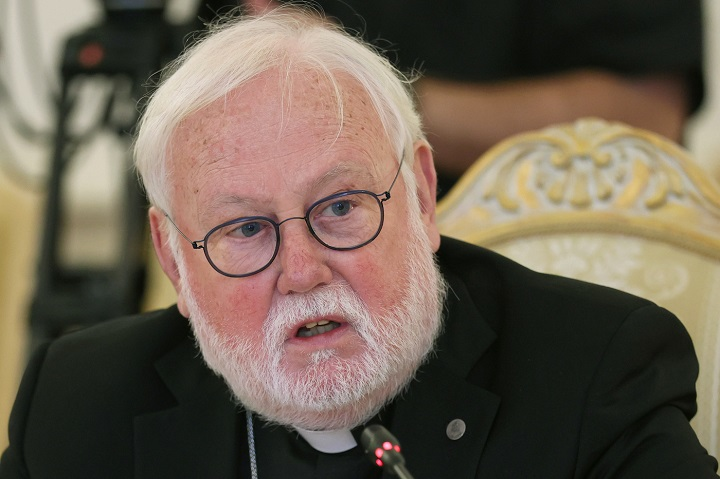
The visit to Moscow by the Secretary for Relations with States, Bishop Paul Richard Gallagher, is a turning point in the history of Vatican diplomacy. Since the start of the war in Ukraine, when the Holy See recognized Ukraine as the aggrieved party, it has consistently engaged with the Russian authorities in a manner they deem constructive and balanced. Foreign Minister Sergey Lavrov’s acknowledgment of this diplomatic stance at the press conference following his meeting with Gallagher represents Russia’s recognition of the Holy See’s reliability and trustworthiness.
The presence of CIA Director John Ratcliffe, who landed in Moscow shortly after Gallagher and Lavrov’s meeting, was a significant indication of the potential for a new global dimension to Vatican diplomacy. Ratcliffe’s brief visit reflects the United States’ confidence in the Holy See’s role in negotiating.
The Holy See seeks to open the door to new relations between Russia and Ukraine. Gallagher clearly expressed the Holy See’s awareness of its diplomatic mission in a world order devoid of neutral third parties. In light of the UN’s waning effectiveness as a global negotiating forum, Gallagher stated that his visit to Moscow signals the Holy See’s willingness “to do what others are not doing at this time.”
This reflects the Holy See’s decision not to shirk its responsibility for this burdensome yet decisive task of representing the global Catholic Church.
A return to the world order of the past is no longer possible. The Holy See might need to transform its “emergency” vicarious diplomatic activities into a stable framework. This would usher in a new era of Vatican diplomacy, as there are no longer any truly neutral third-party institutions to which states can turn for solutions to potential conflicts.
***
In his 1965 address to the UN, Pope Paul VI identified this institution’s purpose as offering “a form of coexistence that is extremely simple and fruitful” to the many states that can no longer ignore each other.
“You sanction the great principle that relationships between nations must be regulated by reason, justice, law, and negotiation and not by force, violence, war, nor by fear and deceit.” What the world—its peoples and nations—needs are bridges that allow us to meet, though sometimes this is only possible halfway. Paul VI chose this image to define the UN’s mission: “You exist and work to unite nations and bring states together. Let us use the phrase to bring them together. You are an association, a bridge between peoples, a network of relations between states. In a way, this characteristic reflects what our Catholic Church intends to be in the spiritual order: one and universal.”
This affinity between the Catholic Church and the UN’s intended purpose, as envisioned by Pope Paul VI, serves today as the basis for a new phase and mandate for Holy See diplomacy.
Today, the Vatican’s “tiny and practically symbolic temporal sovereignty” could become decisive for constructing the world order to come. This sovereignty guarantees those who deal with the Holy See that it is “independent of any sovereignty of this world.” The Holy See is the only third-party, neutral institution present on the global stage today. The task now is to fully embrace the affinity that Pope Paul VI expressed in clear and far-sighted words in a completely changed global context since those years.
The issue is not replacing the UN with the Holy See’s diplomacy, but rather finding ways to ensure the Holy See can exercise its diplomacy effectively in light of the UN’s failure to fulfill its original mission. To achieve this, the Holy See must remain true to its nature while realizing the affinity identified by Paul VI in the absence of the UN’s material support.
Ultimately, as Paul VI said, it is a matter of giving material substance to the spiritual in the Holy See’s diplomatic activity. However, “giving material substance to the spiritual” is central to Christianity—the religion’s uniqueness arising from the Incarnation of God. For this reason, Vatican diplomacy must transform, committing to concrete, material solutions to the world’s conflicts that fulfill its spiritual mandate within human history. It must become political without distorting its nature, just as the God whom the Catholic Church venerates came to dwell forever within the polis inhabited by men and women.
To achieve this diplomatic and theological goal, the Holy See’s diplomacy must transform its organizational structure and cultivate a new mentality and approach for the sake of the whole world. The Vatican’s diplomatic efforts have been commendable, but they are no longer sufficient given the new conditions in which it operates.
Fidelity to the historical dynamic of God’s incarnation requires the Holy See’s diplomacy to take a step forward. Its independence from any worldly sovereignty — a guarantee no other global institution can reliably provide — should carry political weight and bring concrete, viable ways to resolve conflict to the negotiating table. There is no other way to give material substance to the spiritual desire for peace, which is at the core of the Holy See’s diplomacy.