

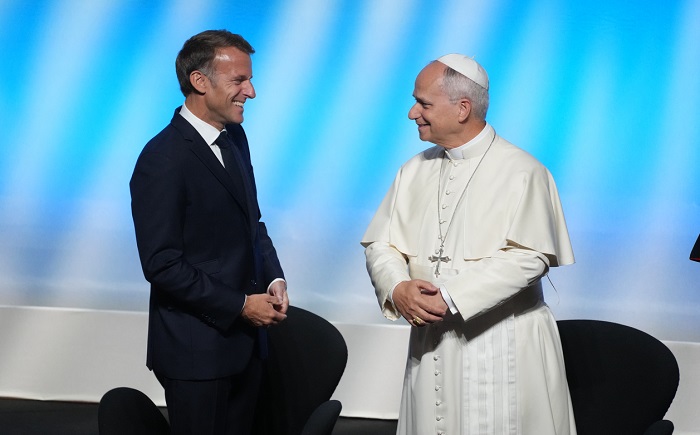
Multilateralism is in crisis, yet the world needs it. The Pope and his Secretary of State reach out for a better Europe.
Pope Leo’s visit to France and Secretary of State Cardinal Pietro Parolin’s attendance at the opening general debate of the 81st UN General Assembly must be viewed as a joint initiative by the Holy See in response to the current crisis in international relations and world order.
Despite the different contexts in Paris and New York, the Holy See has laid the groundwork for a process of institutional and relational reform among states and peoples. Pope Leo outlined this method when he referred to the unique dynamism of Europe as a socio-cultural historical process rather than merely a geographical entity.
«Europe must therefore be understood as a cultural and historical reality before a geographical one. Over the centuries, its contours and definitions have changed, undergoing periods of growth, profound crises and new beginnings. One constant however can be observed throughout its long and turbulent history, namely that Europe has flourished and progressed when it has been able to draw on the best aspects of its past and reinvent them in new and creative ways through encounters with others.» (Pope Leo, Metz, September 28)
The crisis and collapse of the global governance system inherited from World War II and the Cold War demands political, diplomatic and cultural creativity. This requires wisdom to transform the best aspects of that system, equipping it with the innovations necessary to address rising global tensions. Currently, these tensions are managed through force and war rather than dialogue and compromise.
This was the approach adopted by Cardinal Parolin in his address to the UN General Assembly: «Multilateralism is in crisis. Yet the crisis of multilateralism does not diminish its importance. As in every crisis, it is ultimately a question of will: the will to uphold justice rather than resort to violence; the will to uphold the rule of law rather than submit to domination; the will to choose peace over destruction. The United Nations was born from the ashes of global catastrophe with that very determination to prevent future ones, to safeguard peace, defend fundamental human rights, and promote sustainable development. Eighty years later, it must be adapted to contemporary realities while remaining faithful to its founding purposes. It must become more focused, more efficient, and more oriented toward the unity of the human family rather than allowing ideological divisions to prevail.» (Cardinal Parolin, New York, September 26)
The Holy See’s diplomatic, educational, spiritual and religious efforts are clearly aimed at rebuilding trust, which is fundamental to human, social and political relations and essential for establishing a just order in international relations.
«Every international institution, beyond its legal framework, requires mutual trust among its members to be effective. Moreover, trust is an ongoing process. It is fostered through mutual respect and dialogue, and requires a relentless commitment to the values of human dignity and justice on which multilateral institutions are founded. Regrettably, international relations today are characterized by a growing lack of trust among actors, especially through the disregard of the principle pacta sunt servanda.» (Cardinal Parolin).
Trust, therefore, must be the driving force behind the process of creating a new and different world order—one centered on the inalienable dignity of every human being, on the sense of global brotherhood and sisterhood that flows from it, and on the beauty of freedom, which—according to Pope Leo—is called «justice.»
The current crisis facing international institutions is, above all, a crisis of mutual trust. Without it, the world is destined to succumb to the law of the strongest—those who think only of themselves and believe they can separate their destiny from that of the global community.
«These institutions are experiencing a crisis of effectiveness, especially in situations where dialogue is seen as an obstacle to action rather than a resource for peace, a charade rather than an opportunity to seek the common good together. In this case, we see the urgent need to promote a virtue that seems as greatly desired as it is rarely found, namely the virtue of trust. Trust that differences do not necessarily constitute a threat; trust that honest dialogue can bring about a greater good than what individuals could achieve on their own. (…) This is not to embrace a naive optimism that ignores difficulties, but rather to persevere in the hope that the desired good is always attainable.» (Pope Leo, Paris, UNESCO, September 25).
The long process that led to the establishment of the European Union shows that this vision is more than just a hope; it is an institutional, political, and sociocultural reality. This reality was built through a difficult, step-by-step process of fostering trust that had previously seemed impossible. «Schuman understood Europe to be based on respect for international law, which, unlike national law, cannot be enforced by one State through force, but rests on the universally recognized principle of pacta sunt servanda. (…) International law and multilateralism emphasize the genuine equality of States in their relations and constitute the best antidote to the desire for domination, which lies at the root of every conflict. Today, relations between individuals and States are becoming increasingly uncivilized. The value of keeping one’s word is dismissed; instead, people boast of lies and deceit. Europe can help to break this cycle through the respect for others that it has learned to cultivate and preserve. Over the past eighty years, Europe has amply demonstrated that it is possible to articulate divergent opinions, claims and interests through encounter rather than conflict.» (Pope Leo, Metz)
As religions and faiths seek recognition within national and international legal systems, they are also expected to promote trust among people, within society, and in institutional relations: «An authentic secularity, then, consists not in excluding religion from the public sphere or from education, but in striving to ensure that the State and religious institutions maintain dialogue and join forces in the service of the common good, that the world may have life. In this regard, I express my appreciation for the work being carried out within the framework of the Dialogue Forum between the Holy See, the Catholic Church in France, and the French Government. The contribution of the Catholic Church, through its network of activities and institutions, is surely praiseworthy and beneficial to society as a whole. (…) In this, we see an eloquent testimony of how culture and faith serve as pillars supporting efforts to foster harmony between different peoples and religions in the service of peace and in mediating between individuals and communities.» (Pope Leo, Paris, Elysée Palace, September 25)
The Holy See’s diplomatic efforts could be the catalyst needed to launch a process of reshaping the world order. This new order would be marked by the active participation of peoples and would address global challenges that no single state can resolve alone.
«Authentic multilateralism requires agreement on the meaning of words. When language is emptied of content or deliberately distorted, dialogue becomes impossible. It requires a shared commitment to international law, including humanitarian law. It requires the humility to recognize that no nation, however powerful, can face alone the challenges of food insecurity, migration, technological disruption, climate and environmental degradation, or the threat of nuclear or autonomous weapons. Above all, it requires the recovery of trust — trust that agreements will be honored, that the weak will not be abandoned, and that the common good will take precedence over the pursuit of unilateral advantage. The Holy See remains committed to this patient, often unglamorous work of bridge-building. It does so because the human family is one, every person bears an inviolable God-given dignity, and peace is possible when truth and justice are given their rightful place.» (Cardinal Parolin)