

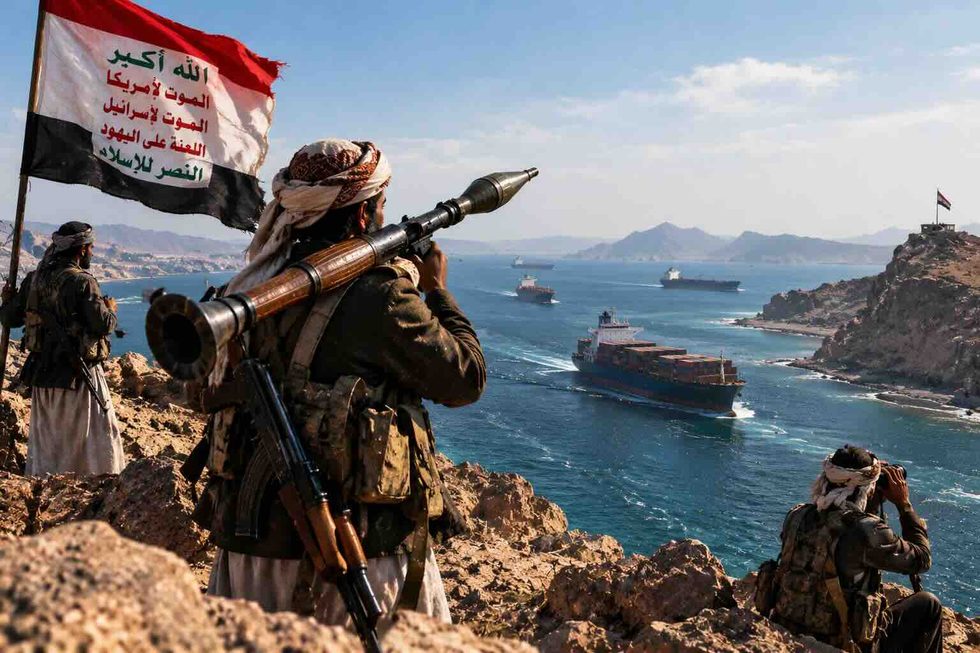
The Radical group from Yemen is not simply Iran’s proxy, like others in the region. It’s a new defiant challenge that has created new ties with Russia and China, bypassing Tehran.
As a clear sign of their ideological inclinations, Houthi leaders appointed Beraas Shams al-Din Muhammad Sharaf al-Din as a new mufti in April 2017 to serve as the leading religious authority in Sana’a. Sharaf al-Din was educated in Iran and is believed to be one of the most important links between Iran and the Houthi movement. And here is the most important element in the Houthi hierarchy: Shams al-Din is not the highest religious authority in the Houthi system.
Abdul-Malik al-Houthi’s ideological roots stem from a blend of Jaroudi Zaydism, the legacy of the Believing Youth (Shabab al-Mumin) movement, founded by his brother Hussein Badr al-Din, and the revolutionary model of Iran’s Wilayat al-Faqih.
Based on his speeches, ideological texts, and regional analyses, Abdul-Malik al-Houthi, the present leader of the movement, views himself as a divinely appointed spiritual and military guide tasked with leading a holy war against Western and Zionist tyranny. A Descendant of the Prophet (Sayyid): Drawing on his Hashemite lineage, he claims direct descent from the Prophet Muhammad. In his view, this lineage gives him an intrinsic, religious right to absolute spiritual and political leadership over the Muslim community. The Supreme Guide and Reformer, mirroring the status of Iran’s Supreme Leader. Defender of the Palestinian Cause. Defiant Warrior.
Knowing he is a prime target for foreign intelligence services, his reclusive lifestyle (operating entirely from hidden safe houses and communicating only via screens) has fed into a self-image of a disciplined, resilient commander enduring a holy “siege” alongside his people.
Interestingly, during the attacks against Israel and the Israeli responses, the Mufti Sharaf al-Din appeared on the internet as a simple soldier training for the defense of the country – a sign of how his standing is different from Abdul-Malik’s.
Abdul-Malik viewed Hassan Nasrallah with immense reverence, considering him his greatest ideological mentor, a supreme model of regional resistance, and an older brother figure. Within the “Axis of Resistance,” the relationship between the two leaders was exceptionally close, built on decades of Hezbollah’s foundational guidance to the Houthi movement.
Following Nasrallah’s assassination, al-Houthi’s perception of his own role within the Axis of Resistance shifted significantly. With Nasrallah gone and Hezbollah temporarily off-balance, al-Houthi sought to honor his mentor’s legacy by stepping into the void, aiming to position himself as the most aggressive, defiant, and operationally independent vanguard leader left in the regional alliance.
The Houthis are, indeed, a proxy of Tehran, but not like Hezbollah. They have strengthened strategic ties with the two great powers, above the heads of Iran’s leaders.
The Houthis’ relationship with Russia has shifted from diplomatic neutrality to a deep, clandestine security alliance.
Relations with Beijing are more complicated, balancing extensive under-the-table procurement with public diplomatic friction over energy security.
Abdul-Malik al-Houthi views these relationships as proof of his growing status as a major global player. His inner circle openly brags that “major powers are now knocking on Sana’a’s doors,” allowing the movement to exploit Russian and Chinese resources to systematically challenge American influence across the Middle East.
After the killing of Hassan Nasrallah, the Houthis and their leader Abdel Maleq have become the most important asset of Tehran, because of their resilience and now the control of Bab-el-Mandeb, perhaps more important than Hormuz. But I would not be surprised that if the Islamic regime in Iran crumbles at some point, Abdel Malik al Houthi, if he survives, will rise as the leader of a new Shia axis.
It is interesting that the IRGC has threatened Israel with a large-scale military response if it destroys the underground complex beneath the Ali al-Taher Ridge in southern Lebanon. IDF proceeded with the operation and announced the complete destruction of the underground infrastructure on September 10–11, 2026. There was no Iranian response, but there was a major Houthi operation to take control of the Bab-el-Mandeb Strait. Coincidence, or strategic priority decision, and disinformation/manipulation of the regional and global players.