

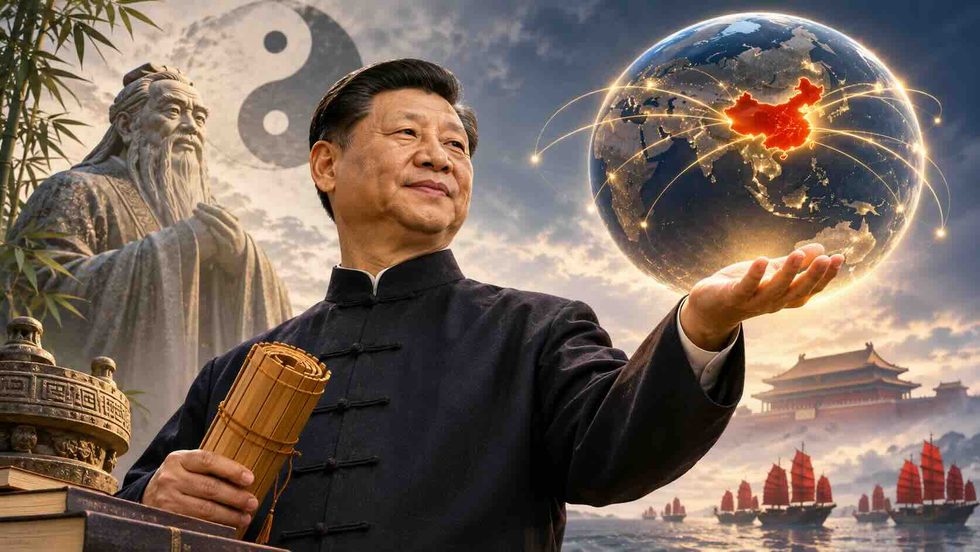
Beijing’s confidence is rooted in a tradition of strategic virtue. A new deglobalization is underway: geopolitics trumps economics, yet economics remains the harder reality and demands harder choices.
The imperial pageantry on display at the recent APEC meeting in Shenzhen, with President Xi Jinping and his wife at the center, flanked by Donald Trump on one side and Vladimir Putin on the other, revealed a new China: poised, confident, and emboldened by recent events around the world.
That confidence runs deeper than the spectacle suggests. The Chinese tradition, as rendered in classic novels such as Shuihu zhuan (Water Margin) and Sanguo yanyi (Romance of the Three Kingdoms), holds that victory rests on three assets, and that nothing else truly counts: righteousness, the conviction of being morally in the right; the strategist’s cunning; and luck, Heaven’s blessing, which confirms that the cause is just.
When the cause is just, the decisive task is to find a chief strategist who can lead it to victory. In Shuihu, that man was Song Jiang; in Sanguo, Zhuge Liang. The outlaws of Liangshan collectively chose Song Jiang as their leader, while Liu Bei, the would-be emperor, sought out Zhuge Liang to serve as his chief strategist. In both stories, the strategist led the fight and secured the triumph. In both, true to the Mencian tradition, the gifted strategist had to be implored to lend his services.
The rise of the Communist Party fits the same narrative. Mao was chosen as party chief only after a long series of defeats and setbacks. The Party picked him, and he led it to victory. Luck, Heaven’s blessing, is the tangible proof that the strategy is sound.
Is Xi the right chief strategist? He may claim to be, on the evidence of his luck and his results.
In 2020, the United States failed to strangle China during the Covid pandemic. Given the experience of SARS in 2003, the world, led by the US, might have sealed China off, throttling its economy and causing it to implode. It did not. China weathered the storm and emerged scarred, but knowing that its system could endure isolation and, therefore, a foreign siege.
In 2023, after Prigozhin’s uprising, the US failed to stop Russia or to win the war against it, an outcome that would have encircled China. Nor did it prevent the October 7 attack, which ignited another war in the Middle East and further distracted the world from China.
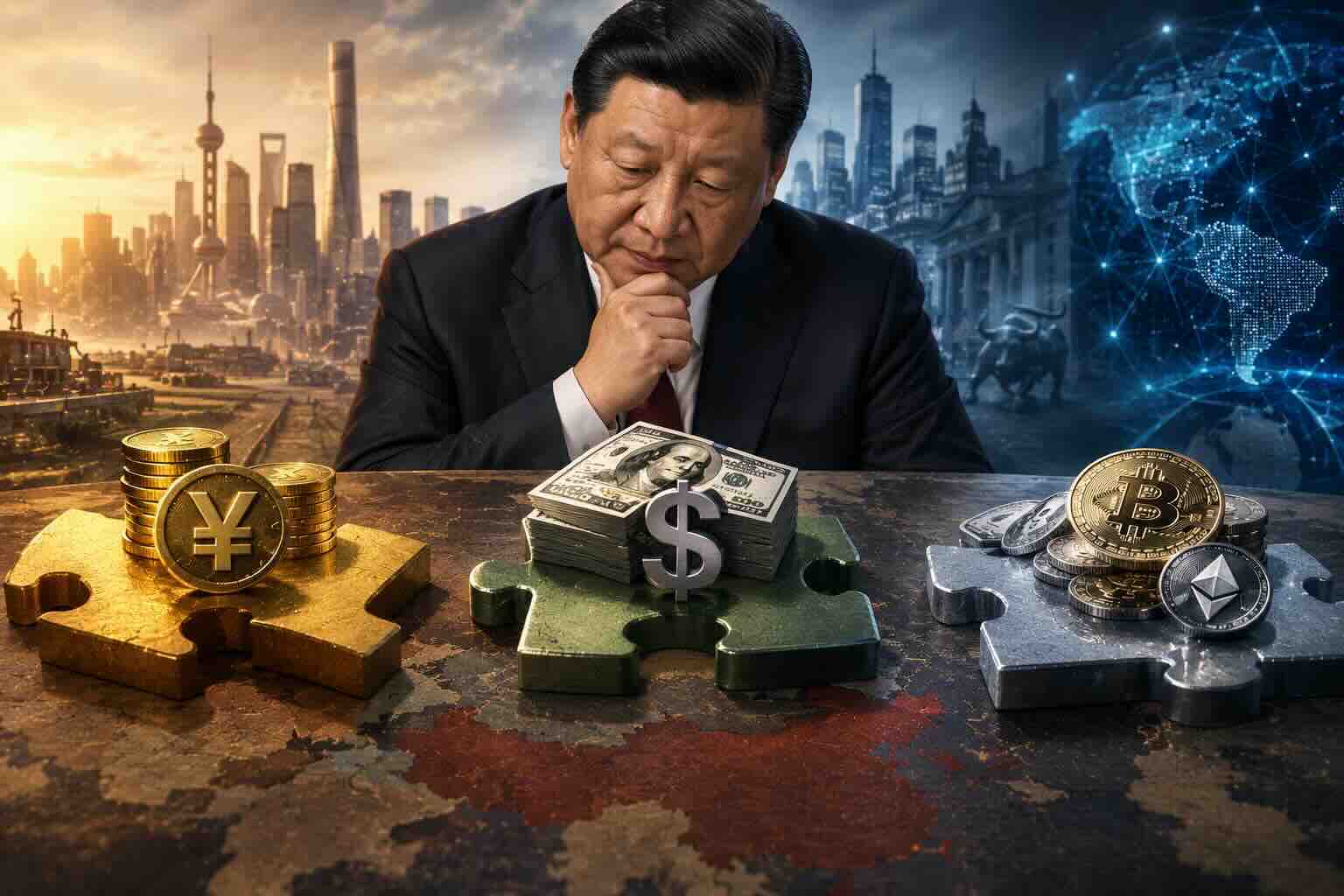
In 2025, Washington confronted China with a tariff war and was rebuffed; Beijing had prepared and answered by threatening to restrict rare earth exports, forcing the US to retreat.
In 2026, the US became mired in a war with Iran that it cannot end on its own, and now seeks help from its adversaries, Russia and China, to resolve it.
The lesson Beijing draws from this is that the United States has no brain and no luck, and that Heaven no longer smiles upon it. Heaven now smiles upon China. Chinese leaders conclude that, whatever its difficulties, China will prevail. That conviction makes China confident and unwilling to change course.
Right about being right?
Are they right? Perhaps not. Not every revolution succeeds; indeed, most fail. Mao was the exception, not the rule. And what does it mean to be “right”? China has its own understanding of what is right, while the world may hold a very different view and may be persuaded otherwise.
The outlaws of Liangshan and Mao’s Communists felt righteous, and they were seen as righteous within an environment of shared values and culture. But China is now embedded in a world with different values, where what feels right to one side can look wrong to another. Even so, its present worldview, stemming from its history and culture, will make Beijing hold fast to its chosen path. The issue remains whether Chinese history can really help navigate the present.
What, then, should the United States do to meet this attitude? That may be the real question. China, too, might want to think twice. It may run out of luck, and despite its present controversial president, the US has a history of being perceived as more righteous than China. Things could turn in the blink of an eye, and Beijing would then have to show whether it is ready.
Deglobalizing
Meanwhile, a new international order is rising. The globalized world order that the US had pushed discreetly since the 1980s, and more decisively after the end of the Cold War, is falling apart.
Free trade does not work when trade can be withheld on political grounds and used for political rather than economic ends, as when Russia threatened to halt oil exports, and China threatened to cut rare earth exports.
In this era of two major wars, free trade is being curtailed for its political implications. It pressures countries into behavior at odds with some leaders’ political aims. Those aims concern territory and power: Ukraine in Russia’s case; Taiwan and the South China Sea in China’s. More broadly, both seek dominance over Europe or Asia.
The current terms of free trade tell them: give up territorial claims and get rich. If Russia abandoned its ambitions over Ukraine, billions would flow back into the country, and its economy would boom. But Moscow would rather be poor than give up its territorial ambitions.
Yet without a functioning economy, military muscle alone will not carry the day. Napoleon, for all his military and political genius, was worn down by England’s more efficient finances. It is an old lesson. Tiny Venice stood up to the mighty Ottoman Empire because it had better finances. Tiny Genoa was pivotal in creating the Spanish Empire, which stretched across the globe, and puny Florence helped build France’s power against the Holy Roman Emperor. What they had in common was sound finances.
Today, power is not pure military dominance but economic development. That economic clout comes from the free market, high consumption, and technological innovation, which in turn draws more investment. American stock markets make up about 60% of global markets; American technology is the only one that, in the past 50 years, has produced revolutions and massive breakthroughs; and the US is the largest consumer market.
As Deng Xiaoping put it in 1992, “development is the hard truth” (发展才是硬道理). After the 1989 Tiananmen crackdown, reform had stalled, and the 87-year-old leader set it in motion again. Cunning and righteousness, it seems, can carry a country only so far if its system does not run as efficiently as its rivals’.
Backfiring blackmails
China’s use of trade as political leverage against the US-centered market order is now provoking the opposite of what Beijing intends: a determined effort to free that order from dependence on Russian or Chinese exports. Many countries are scrambling to produce their own rare earths and to rebuild supply lines beyond China’s reach.
Chinese exports are still rising, to be sure. But the alarm Beijing’s political blackmail has set off (try to impose free-market rules, directly or indirectly, and I will not sell you rare earths or capital goods) is reshaping priorities in markets worldwide.
Meanwhile, the wars in Ukraine and Iran are redrawing the political and economic map at an accelerating pace.
The shift has reached a scale that did not exist a decade ago, when Mr. Trump first announced his policy of decoupling from China. At the time, decoupling had not begun. Now countries other than the US are planning to decouple, too. Then China, the main driver of globalization since the 1980s, might become the main driver of a new, highly risky deglobalization process.
China’s economic and political system did indeed need an overhaul after the unfettered liberalization of 1992. Unregulated, unprepared free markets opened the floodgates to organized crime and corruption on an unprecedented scale, eating the country from within.
Mr. Xi’s decisive anti-corruption campaign and reforms, begun when he took office in 2012, were needed to restore social and economic order. But the world, and China with it, has now entered a different phase. Corruption has been curbed, and rules against it are in place. Nothing like that existed in 1992.
This calls for a strategic decision. Having put its market in better order, does China want to isolate itself or join the world? Either choice carries costs and risks. China, being China, will try to straddle the two, but doing so will grow ever harder and costlier.
Living standards are declining, and economic expectations are plummeting. The strain may be bearable in the short term, but it will be far harder to sustain over the long term, as the Covid experience has shown.
To compound these difficulties, the geopolitical game is rapidly changing, and the US is no longer the only player.
Since the war in Ukraine, there have been growing political difficulties in coordination between the US and its allies. As a result, Europe, Canada, and Asia are going their own way, not necessarily aligning themselves with the US, but also creating a greater distance from China. Europe, once free of geopolitical friction with China, now sees China as the main supporter or enabler of its two enemies, Russia and Iran.
These elements are creating an unprecedented cluster of interests around the EU, once declared defunct. Dozens of agreements have been signed or are being discussed between European countries and Asian countries, excluding China [1]. Canada wants a special arrangement with the union, and the UK is inching toward a soft rejoin. This trend binds the two sides of the Eurasian continent closer around Russia and China.
Moreover, whereas the US comes from an experienced history of a patchy relationship with China, Europe is new to the game and might be even more sanguine than its transatlantic ally.
Can China recover the ties? Can the US? A price for both is giving up on Russia or Iran. It’s easier for America, especially with a new, more pro-EU Congress in January; harder for China.
Then, whatever the United States’ day-to-day mistakes, a deeper question remains: can a Russian-style system prevail in today’s world? It is a question for the leaders of Russia and China to answer.
- [1] Here is a partial list of those that have been somehow finalized: Trade and economic
- • UK-India free trade agreement (July 2025)
- • EFTA-India TEPA, covering Switzerland, Norway, Iceland and Liechtenstein (March 2024)
- • UK accession to CPTPP (2023), linking it with Japan, Singapore, Vietnam, Malaysia and Brunei
- • UK-Singapore Digital Economy Agreement (2022)
- • EU-India FTA: negotiations concluded in early 2026; check signing and ratification status
- • EU-Indonesia CEPA: political deal reached in September 2025; check signing and ratification status
- Digital and technology partnerships
- • EU-Japan Digital Partnership (2022)
- • EU-South Korea and EU-Singapore Digital Partnerships (2023)
- Defense and security
- • UK-Japan Reciprocal Access Agreement (2023)
- • GCAP fighter program treaty (UK, Japan, Italy; 2023)
- • EU-Japan Security and Defense Partnership (2024)
- • EU-South Korea Security and Defense Partnership (2024)
- • Ukraine-Japan bilateral security agreement (2024)
- • France-India Rafale-M naval jet deal (2025)
- • Poland-South Korea K2 tank, K9 howitzer and FA-50 contracts (2022 onward)
- • UK-Turkey Eurofighter deal (2025)
- • France-India Horizon 2047 roadmap (2023)
Trade and economic
• UK-India free trade agreement (July 2025)
- • EFTA-India TEPA, covering Switzerland, Norway, Iceland and Liechtenstein (March 2024)
- • UK accession to CPTPP (2023), linking it with Japan, Singapore, Vietnam, Malaysia and Brunei
- • UK-Singapore Digital Economy Agreement (2022)
- • EU-India FTA: negotiations concluded in early 2026; check signing and ratification status
- • EU-Indonesia CEPA: political deal reached in September 2025; check signing and ratification status
- Digital and technology partnerships
- • EU-Japan Digital Partnership (2022)
- • EU-South Korea and EU-Singapore Digital Partnerships (2023)
- Defense and security
- • UK-Japan Reciprocal Access Agreement (2023)
- • GCAP fighter program treaty (UK, Japan, Italy; 2023)
- • EU-Japan Security and Defense Partnership (2024)
- • EU-South Korea Security and Defense Partnership (2024)
- • Ukraine-Japan bilateral security agreement (2024)
- • France-India Rafale-M naval jet deal (2025)
- • Poland-South Korea K2 tank, K9 howitzer and FA-50 contracts (2022 onward)
- • UK-Turkey Eurofighter deal (2025)
- • France-India Horizon 2047 roadmap (2023)