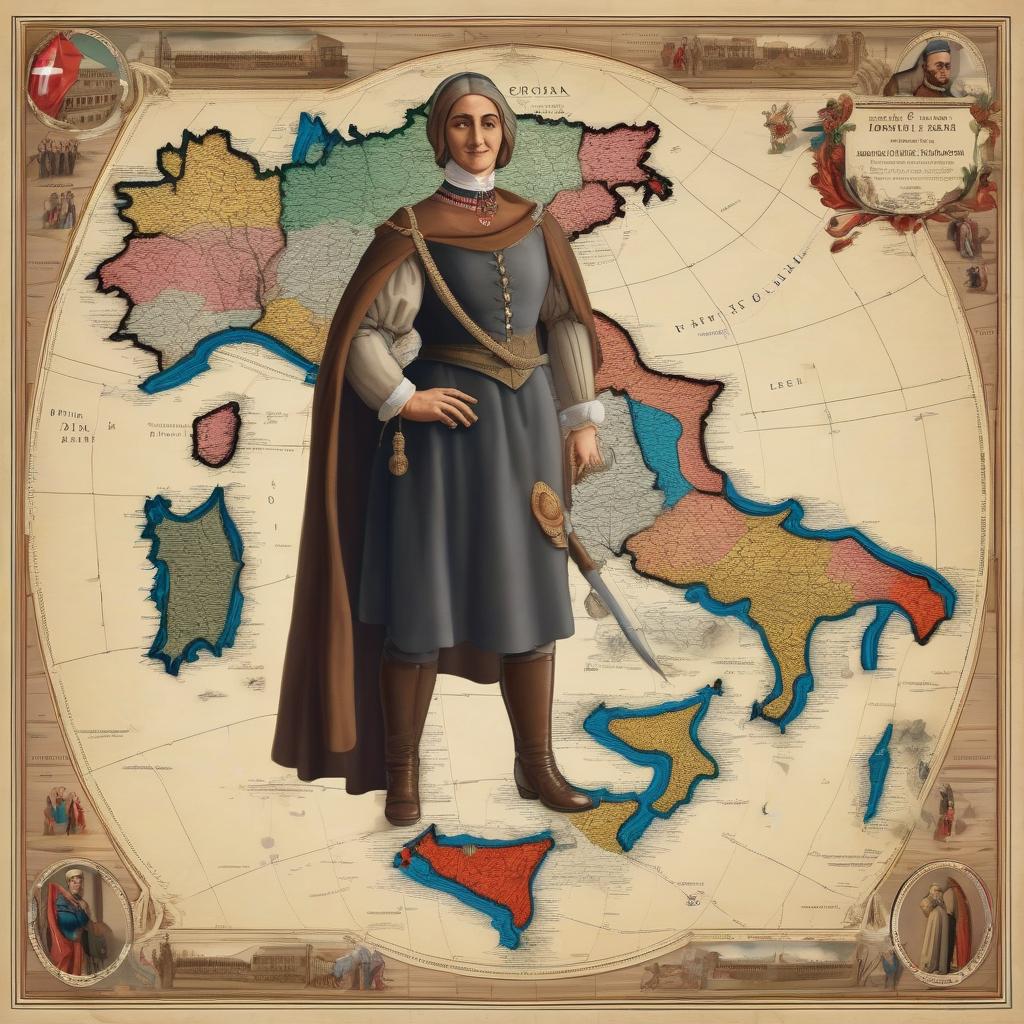




Between Ukraine, the Mediterranean, and the Middle East, Rome is being called on to choose a strategic direction that its politics keeps putting off. It’s the real crux of the country.
In Italy, the debate these days centers on the electoral law—controversial and complicated. Perhaps it’s flawed because it grants whoever reaches 40% a crushing majority bonus; perhaps it’s sound because it avoids backroom horse-trading.
For both the majority and the opposition, perhaps the point is to move past the substance of the issue at hand. Both want to open an ideological battle that, as with the earlier referendum on the judiciary, presents Italians with a clear, simple issue capable of uniting each camp.
According to the opposition, the question is: “Are you for or against an electoral ‘democratorship’?”
“Are you for or against a stable government able to work without being hamstrung by backroom schemes?” according to the government.
Beyond the parliamentary process, the issue is fueling public disputes, just as it did during the judiciary referendum. Then, as now, there was a question of trust in the ruling political parties. Then it was: Do you trust judges or politicians? The Italians chose the judges.
Today it is: do you trust giving more power to the government, or do you prefer the intrigues that file down and dampen potential authoritarian drift? Given the widespread distrust of politics and of governments in general—borne out by very low turnout—the answer seems easy.
And yet perhaps the real issues facing the country do not lie here but in a taboo question that almost no one is willing to confront seriously.
+++
History is marked by conflicts and wars, which define nations. Even the need to avoid them requires taking conflicts and wars very seriously indeed.
The history of political Italy, from the mid-1800s to the present, unfolds in two phases and two appendices.
The first phase, from the mid-1800s unification to 1919—the end of the First World War—saw political Italy shaped in the service of a continental political project. It was necessary to eliminate the two millennium-old pillars of European politics: the Papal States (seized by the Piedmontese in 1870 but not recognized as lost until 1929) and the Holy Roman Empire, beheaded and dismembered in 1918. Both occupied parts of the peninsula.
As these two pillars fell, two other constants in the wider Mediterranean’s history collapsed with them: the Tsar in Moscow and the Sultan in Istanbul, both of whom had proclaimed themselves heirs to Byzantium, the Roman Empire.
Italian unity served the new European protagonists of the time (France, Britain, and Prussia, all of whom had, in turn, been allies during the Italian wars of independence). Italy won its unity at the cost of millions of lives over some sixty years.
The second phase runs from the end of the Second World War to the collapse of the USSR, this time as part of a global project. A politically unified Italy served as a bulwark against the communists, who were on the verge of overrunning all of Europe from every direction and who stood just across the Adriatic in Yugoslavia and Albania. Italy did not fight open battles, but it became the theater of the era’s bloodiest and most poisonous civil war. Communist, fascist, Arab, and mafia terrorisms were intertwined in a knot that could have blown the country apart and dragged down the West with it.
With the end of the first unitary phase in 1919, Italy found itself without a purpose and drew on its warlike drift from the recent past. After the expansion driven by the pursuit of political unity, Mussolini’s Italy sought to become the Roman Empire once again. For centuries, that empire had had at least three heirs (in Vienna, in Istanbul/Constantinople, and in Moscow), and now it was orphaned. Mussolini tried to maneuver through the complicated European politics of the time but lost the thread. Italy’s expansionist ambitions served merely as a fig leaf for Berlin’s far more serious and solid expansionism.
After the collapse of the USSR in the early 1990s, Italy once again found itself without a purpose—that is, there was no longer a power dictating a line, as America had done until then.
Italy tried to insert itself into the European game, but at the moment of the euro’s creation, it chose France and Germany over Britain and the seasoned US ally. It then drifted somewhat aimlessly, maintaining good relations with everyone but marrying no one.
This was also possible because the Cold War in Italy was the first and only war that political Italy truly won in its own right. It did so without surrendering to authoritarian turns and while preserving democracy. Every other war Italy lost on the battlefield and won only at the negotiating table, through the right alliances. Even in the First World War (celebrated as a military triumph), it broke through the front only after Austria had already given way. In the Second World War, it lost on the battlefield and chose the wrong alliances as well.
After the end of the Cold War, Italy had more room and more credibility than others to decide its foreign policy without heavy constraints. However long a vacation may be, it eventually ends—and this one has been over for at least five years now.
Since Russia’s seizure of Crimea in 2014, Moscow’s expansionism has gradually emerged with clear progress. Italy was asked—offered the chance—to intervene in Libya to stop the Russians, but Rome declined. The offer was instead taken up by Turkey in 2019. The Turks arrived and stopped the Russians.
A year later, the Turks intervened in Syria against forces backed by Russia, and a few months later, in the same year, the Turks backed Azerbaijan against Armenia, which Russia likewise supported. In all these cases, the Turks pushed back the Russians, encouraged by the Americans. Turkey has thus established a sphere of influence stretching from the Caucasus, through the Middle East (Syria), to Libya—partly because Italy chose not to act when it could have.
At this point, what other initiatives can Italy pursue in the Mediterranean, for itself and for potential allies? Does it want to align with Russia against a pro-American Turkey?
Meanwhile, the focal point has shifted north, around Ukraine. Here, every European country that matters is grouped along a neo-Hanseatic axis running from the United Kingdom to Germany, with the Scandinavians, Poland, the Baltic states, and France in support. Even here, Italy lacks the enthusiasm shown by the others.
The country has launched the Mattei Plan for Africa, but the Sahelian belt is a battlefield where the French are in retreat, and the Russians are advancing. The Americans are preparing to return there. What does Rome want to do—get actively involved or watch from the sidelines?
Now that the conflict over the Strait of Hormuz has flared up again, Italy has been asked to take part in a way that other Europeans are unwilling to offer and that Turkey does not—and it is right that Turkey does not. But the Turks and other Europeans are already engaged, at various levels, in actively containing Russia. That is, they are already making a defense contribution. Italy is not.
What does Italy actually want to do? Play Switzerland? Line up with Russia and Iran? Stay in NATO? (see also https://formiche.net/2026/07/conte-salvini-vannacci-russia-nato-sisci/)
In a democracy, every choice is legitimate—so long as it’s made. But without choices, what use is Italy? Useful to whom? If it is useful to no one, it is entirely useless. Either you give yourself a reason to exist, or you have no reason to exist. This is always true, and it becomes urgent in times of war.
The inability to confront the heart of the matter—which, whether one likes it or not, is the country’s geopolitical role—shows that the country today risks far more than it did under Mussolini. But whatever the answer, it must be decided on defense: either strengthen it or dismantle it. As things stand, to borrow a vulgar Chinese expression, it’s a case of “occupying the toilet without using it” (站着茅坑不拉屎).
The fact that Italians are turning out to vote in national elections in ever-smaller numbers shows that the ongoing debate holds no interest for them. It serves no purpose for them, nor for anyone else. What is needed is economic growth capable of generating development for the country and funding whatever geopolitical choice is eventually made. Neither the right nor the left is offering answers.
Everything seems focused on the effort to hold on to one’s own position of power, one’s own seat, regardless of the country’s fate. It calls to mind the situation of those workers in the 1970s who demanded to keep their jobs even after the company had gone bankrupt.
Back then, there was the idea that, one way or another, the state—an entity superior to the company—would take care of them, or of the company. Today, who is supposed to take care of Italy, regardless? The EU? America? Russia? All of them together, in a consortium to save the ruins of the Colosseum? But the Colosseum can be saved quite independently of the fate of political Italy.
It didn’t work for workers fifty years ago, and it works even less for the country now. As has always been the case, a state saves itself starting from its borders. If Italian politics continues to dawdle, talking about matters incomprehensible to most people, then it is of no use—neither to Italians nor to non-Italians.
Defense is a highly thorny subject because it has been psychologically repressed for almost forty years and set aside altogether over the last five, avoiding a direct look at the war in Ukraine or in the Middle East, recounting them only as humanitarian problems rather than as existential geopolitical questions for Italy.
But if no party is willing to confront the geopolitical question head-on, everything falls apart.
(published on Formiche https://formiche.net/2026/07/italia-geopolitica-posizione-forse-politiche-sisci/#content and translated with permission)