


The movement’s electoral victory sheds new light on Moscow’s ideological reach and sets back the Russian Orthodox Church’s efforts outside Russia.
The victory of the students’ list in Serbia’s recent parliamentary elections is particularly remarkable: receiving 52% of the vote and winning 140 seats (out of 250), with voter turnout approaching 70% of those eligible to vote, the representatives chosen by the students will be able to reverse the autocratic tendencies of the country’s leader, the pro-Russian Aleksandar Vučić. Vučić’s party, by contrast, failed to receive 40% of the vote.
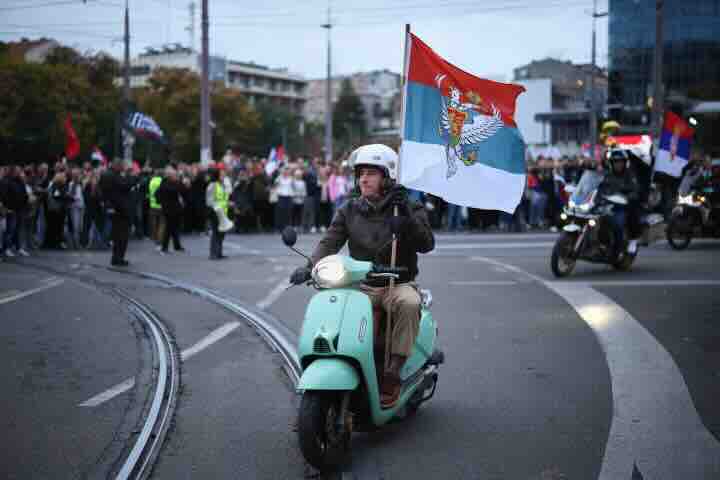
This success is the culmination of an unprecedented democratic process that began following the deaths of 16 people when a canopy collapsed at Novi Sad railway station (1 November 2024). The student protests that emerged as a consequence of that event spread from universities to schools across the country, drawing in professionals and farmers, professors and workers. (SettimanaNews)
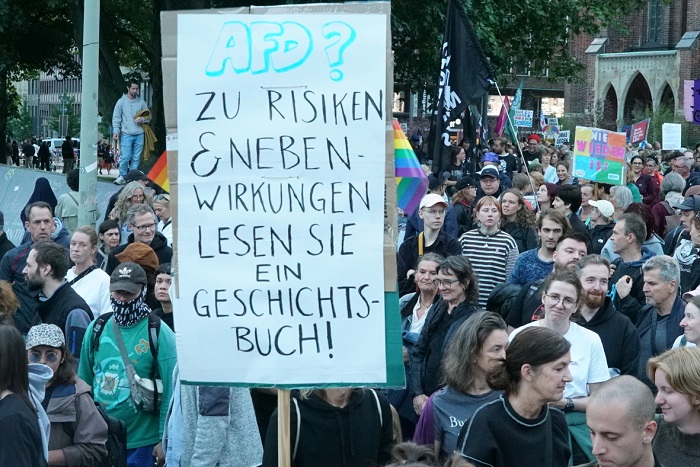
Using the tools of assembly-based and direct democracy, without leaders and without a detailed political program, the students filled public squares, marched through cities, won the support of ethnic and religious minorities, and eventually traveled by bicycle all the way to the headquarters of the European Union. Their efforts offer a lesson in democracy whose full significance has yet to be understood, and which now faces the test of government in Serbia. With six and a half million inhabitants, Serbia is a Slavic country that serves as a bridge between Central Europe and the Balkans, and between the West and Russia.
The protest movement, born out of widespread outrage at the corruption of the previous government and inspired by demands for transparency and respect for constitutional values, has been able to overcome restrictive regulations, police control, ridicule from pro-government media, the indifference of European public opinion, and the political hegemony of Vučić, who has been in power since 2014.
A Defeat for the Orthodox Church?
These developments have negative implications for the Serbian Orthodox Church, whose leadership has aligned itself with the government, the interests of the Patriarch of Moscow, and the Russian government, while benefiting from funding and privileges associated with its role as an interpreter of Serbian history and national identity.
The Church has often acted as an uncritical exponent of nationalist sentiments, most notably by opposing the adoption of the United Nations resolution commemorating the ethnic massacres of the Balkan conflicts of the 1990s (24 May 2024).
It was also willing to endorse the recurring dream of a “Greater Serbia”, reformulated as the “Serbian World” in parallel with the doctrine of the “Russian World”. This vision was expressed in the so-called Sabor (a medieval-style assembly), convened on 8 June 2024 with representatives of Serbian minorities from neighboring countries.
The Church was also prepared to denounce the students’ movement as an anti-state revolution during a meeting in Moscow between the Russian and Serbian patriarchs and Vladimir Putin (April 2025). As a consequence of all of this, the Serbian Church finds itself today in a deeply difficult position.
Nonetheless, theology students and some of their professors distinguished themselves by supporting the protests from the outset. Some, like Professor Vukašin Milećević and the theologian Vladan Perišić, faced immediate threats of expulsion. The monastic community of Visoki Dečani (Metohija, Kosovo) was reprimanded; Bishop Justin of the Diocese of Žiča was removed; the repeated appeals in support of the students made by Orthodox Bishop Grigorije of Düsseldorf were ignored. All these signs of dissent were disregarded, and the students’ actions were read exclusively in an unfavorable light.
The distance between the Church and the student’s movement became clear during the meeting in Moscow, which brought together the Serbian Patriarch Porfirije (accompanied by his mentor and principal supporter, Bishop Irinej of Bačka), the Patriarch of Moscow, Kirill (assisted by Bishop Anthony of Volokolamsk), and President Vladimir Putin.
When Porfirije, supported by Irinej, described the student uprising as a “color revolution”, he evoked in his interlocutors the perceived threat of the “color revolutions” in Georgia and Ukraine (and the subsequent military interventions), as well as denunciations of Western decadence. When Kirill commented on the Serbian Church’s position as a bridge to the Western world, he remarked that from the West “one can probably receive many useful things in the scientific and cultural spheres, but what is happening today with human morality, with morality in the West—and I say this openly, without censorship—is that it is in a diabolical state”. ( SettimanaNews).
This interpretation is entirely consistent with that of Aleksandar Vučić, who has likewise attributed the election results to dark foreign and Western forces. This alignment has prompted Vladimir Veljković to denounce the increasing confessionalization of the state:
“Since the election of Patriarch Porfirije (2020), there has been no barrier between the patriarch and President Vučić. They are in complete symbiosis. I prefer to use this term rather than the theological concept of symphonia, because the latter would suggest that the present situation is acceptable. This symbiosis has been further strengthened since Russia’s aggression against Ukraine. We are witnessing an accelerated process of de-secularization in Serbia and the manipulation of religious sentiments for political purposes”. (SettimanaNews)
A Neo-Orthodox Project of Hegemony
The angry and resentful reactions to criticism of the Church (not all of it necessarily justified), together with the construction of cultural and symbolic narratives, all point to a project of ideological hegemony developed by Bishop Irinej of Bačka.
Last July, a civil court in Ljubljana (Slovenia) ruled against the patriarch over alleged abuses of power involving an Orthodox priest, Željko Lumbarda, from the diocese previously led by Porfirije himself. The Serbian Synod reacted furiously, describing the proceedings as “yet another senseless lawsuit” and a “defamatory media campaign” (10 July).
The immense popular devotion surrounding the Marian relic known as the Belt of the Virgin Mary, brought on pilgrimage last June from the Monastery of Vatopedi (Mount Athos), prompted some liberal media outlets (among the few that remain) to question the political significance of an initiative that might overshadow the students’ marches and demonstrations. Porfirije responded by calling them “idiots”.
Even more consequential is the Church’s connection with political power through the public funding of the enormous Cathedral of Saint Sava. An agreement with the government dated 28 June provides for an additional €6.5 million on top of the €88 million already allocated. Vučić commented: “By building this church, I believe we have accomplished a great work for our people and for our holy Church, without which neither our people nor our state could survive.”
On the cultural front, Bishop Irinej of Bačka has been particularly active in promoting the establishment of an Orthodox university, free from the requirements of pluralism that apply to secular universities (which also include a faculty of theology). On 8 May 2026, a memorandum was signed for the foundation of Saint Sava University, an institution that “would essentially serve as an alternative to Serbia’s oldest and most prestigious higher education institution, the University of Belgrade” (according to Mirjana Nikolić, rector of the University of Arts and newly elected member of parliament).
The patriarch’s personal position is more nuanced than these observations might suggest, as can be inferred from his appeal for participation in the elections, made public on 25 October, in which he urged mutual respect and acceptance of democratic processes.
Will this be enough to prevent hostile reactions towards the Church? Possibly, provided its most reactionary tendencies are contained, and the religious dimension among the protesting students is recognized and valued. In a recent survey of their religiosity, measured on a scale from −2 to +2, the students scored 1.25, indicating greater openness to religion than among older generations.
(published on https://www.settimananews.it/politica/serbia-lezione-degli-studenti-sulla-democrazia/, translation by Alberto Broda Rocca)