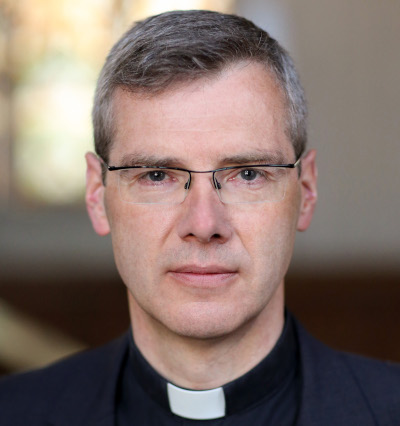




Saturday, November 8, in the closing session of the conference “Europe’s loneliness: the Churches and the Union” (see on SettimanaNews), devoted to perspectives on Europe and from Europe, Mons. Heiner Wilmer, Bishop of Hildesheim and delegate of the German Bishops’ Conference to COMECE (Commission of the Bishops’ Conferences of the European Community), also spoke. Below is his speech entitled “The social question: the heart of the Church and the test of democracy in Europe.”
Good morning, and thank you for the invitation. I am very grateful, and it is a special honor for me to speak at this meeting.
When we speak today about the social question, we are speaking of the very heart of faith. Where human dignity is threatened, where people are exploited, forgotten, or neglected, it is decided whether the Gospel is merely preached or truly lived.
The German Bishops’ Conference put it this way (1980): “The social question is a matter of faith. It concerns the human being as a creature of God and society as a place of mutual responsibility.” The social question is therefore not a secondary issue. It is the center, the concrete proof of our belief in God made man.
Origins: from Leo XIII to Leo XIV
The social question did not arise in academies but in the streets of the 19th century, in factories, in workers’ homes, in their labor and their misery.
Pope Leo XIII saw this suffering and, in 1891, wrote the encyclical Rerum Novarum, a text that changed history. He asserted that man can never be reduced to a means of the economy or profit. He has a dignity that no one can take away. He spoke of just wages, of solidarity, and of the state’s responsibility for the common good.
With this, Leo XIII laid the foundations of the Church’s social doctrine. On this basis, an entire tradition developed:
- Quadragesimo Anno (1931, Pius XI)
- Mater et magistra (1961, John XXIII)
- Populorum progressio (1967, Paul VI)
- Laborem exercens (1981, John Paul II)
- Caritas in veritate (2009, Benedict XVI)
- Fratelli tutti (2020, Pope Francis)
Pope Francis speaks of a “culture of fraternity” and invites us to build an economy of life rather than one of exclusion. This line, from Leo XIII to Francis, today finds spiritual continuity in Pope Leo XIV. He places at the center the inner dimension of the social question: the vulnerability of the human person, the spirituality of responsibility, and the link between spiritual life and social life.
Leo XIII defended workers, Francis advocates global justice, and Leo XIV today calls us to a mystique of responsibility: a way of life that transforms the world socially because it first understands it spiritually.
Thus, a great arc is drawn: from the 19th-century factory to the spiritual conscience of 21st-century Europe.
The social question today: Europe needs a soul
Europe is at a decisive moment. We have peace, prosperity, and democracy, but we feel that something has cracked. The German Bishops’ Conference writes in Europa – gestalten und verantworten (2014): “Europe needs more than institutions and markets. It needs a soul. This soul is born from respect for human dignity, openness to God, and awareness of mutual responsibility.”
Europe must not be merely an administrative community but a community of values. Democracy does not live only by procedures but by deep convictions.
Pope Benedict XVI told the Bundestag (2011): “Democracy does not live only from majorities but from criteria that are greater than man himself.” I add: a democracy without God becomes totalitarian. A democracy without transcendence, without openness to heaven, becomes radical because it loses measure. But the reverse is also true: democracy can abuse God. We have seen in Europe and the United States how religious symbols have been instrumentalized, with the cross becoming a sign of power rather than peace.
The German Bishops’ Conference warns (2014): “Where religion becomes an instrument of power, it loses its peace. But where it stands in the responsibility of freedom, it becomes a blessing for the community.”
Europe, therefore, needs a new spiritual balance: God as a source of freedom, not as an instrument of power.
A new attitude: humility and listening. As Church, we must learn a new way of speaking and listening. Once we were sure, we knew what was right. We told people what they should or should not do. We indicated to politicians how they should act. Sometimes with zeal, sometimes with presumption.
And yes, there were times when the Church got too close to political power, losing its prophetic freedom. Today we need something else: humility, sobriety, listening. Pope Francis and Pope Leo XIV both insist: synodality is not a structural reform but an attitude of the heart.
The German Bishops’ Conference speaks of a “culture of listening” (2023): “The Church is at the service of the world, not above it. It is called to translate the Gospel into the concrete questions of society, respecting everyone’s freedom.” For this, we must ask two questions. First, what do people need today — in their loneliness, fears, hopes? And second, what does the Gospel ask in this time?
From the encounter between these two questions arises the mission to the world, not from power or preaching, but from relationship.
From knowing to asking: a spiritual process
For too long we have known too well what is good for others.
We explained it, preached it, and sometimes imposed it. But we asked too little.
Today is the time of questions. This is not a sign of weakness but of maturity.
Democracy feeds on dialogue. When voices stop talking to each other, society weakens. The Church can help rediscover listening as a virtue that preserves coexistence.
A Church that listens learns. A Church that learns becomes credible.
The social question: a spiritual question
Ultimately, the social question is not economic; it is spiritual.
What image do we have of man? The German Bishops’ Conference states in Gemeinsame Verantwortung für eine gerechte Gesellschaft (1980): “Human dignity arises from being a creature. From this dignity derive rights, but also duties: mutual responsibility, solidarity with the weak, defense of life in all its stages.” This means: social policy is theology. It is incarnate faith. Whoever believes in God cannot ignore the human person.
Pope Leo XIV said in one of his speeches (2025): “The justice of faith does not consist in being right but in creating a relationship.” This is the heart of social doctrine today: creating relationships between rich and poor, between man and nature, between heaven and earth.
Conclusion: Europe needs soul, truth, and listening
The social question remains the decisive test of the Gospel.
Europe needs a Church that listens, not one that dominates.
A humble but also courageous Church. It needs Christians who take responsibility — not to command, but to unite.
And it needs a democracy that does not lose its soul — that remains open to the sky, to God, to the mystery of the human person.
The German Bishops’ Conference states (2014): “Europe will have a future only if it remains conscious of its spiritual roots and recognizes in them the foundation of its freedom.” Therefore, I say: a democracy without God loses measure. A Church without humility loses credibility.
But where we know how to listen — to people, to the Spirit, to God — a future is born. Then faith becomes responsibility, responsibility becomes justice, and justice becomes peace.