


The US has many faces and souls. The recent vote has underscored one face, but another could reemerge. Europe should seize the fleeting moment to negotiate better terms with the transatlantic ally.
Across much of the world, the result of the recent midterm elections in the United States was greeted with joy and sincere relief.
The end of President Donald Trump’s almost uncontested dominance over nearly every sector of American politics and administration was taken as proof of how deeply rooted democratic values really were, and therefore how binding they were, for the mass of the American population.
According to the collective interpretation, it was clear evidence that the structure of the US might appear deficient in the short term but still contained the control mechanisms that would kick in at the right time to put the situation back on track.
Consequently, there was a great collective celebration and a widely shared feeling that, after an interval of madness, the United States had definitively gone back to being, above all for Europe, the benevolent and generous Big Brother that we all knew… or at least that we deluded ourselves into thinking we knew!
Nothing could be more mistaken: this election shows only that, in the reality across the Ocean, two, or perhaps even three, different Americas coexist in constant conflict, each ready to exploit any weakness of its opponent to take away the power the opponent may have enjoyed until then.
It is an internal conflict that, on the one hand, is made infinitely more serious by the position of absolute prominence, though perhaps no longer of absolute primacy as in the past, that the United States still occupies on the world stage.
All this also fits into the overall picture of a global paradigm that is changing rapidly, though its contours remain unclear. From this arises a state of total collective uncertainty, generating a sense of global insecurity that is hard to counter when the world order lacks a fundamental pillar such as the American one, as during the Trump era.
It is even more serious that this is happening while a struggle, in many respects an underground one, is underway between “Westphalian” states and the great concentrations of capital that aspire to replace them, even if not in an immediately perceptible way, in the actual exercise of power.
This struggle has its most visible theater in the United States, where Trumpian America had, until yesterday, played an extremely ambiguous role because it was unclear which side it was on.
It was, in other words, a sum of factors that led the second America, the non-Trumpian one, to triumph over the MAGA sector of the US and therefore, and this is what one hopes for the future, to bring the great country back to depending more on the ideology of law than on that of force.
This happened, however, thanks to a shift in votes among a large bloc of centrist voters (the third America mentioned earlier), who moved from the ideology of the sitting President to that currently advocated by a Democratic Party that is itself undergoing a radical transformation.
An extremely fluid scenario appears, conditioned by the decisions of this “third America,” which, just as it abandoned Trump in these elections, could return tomorrow, under changed conditions, to reward him with unconditional support.
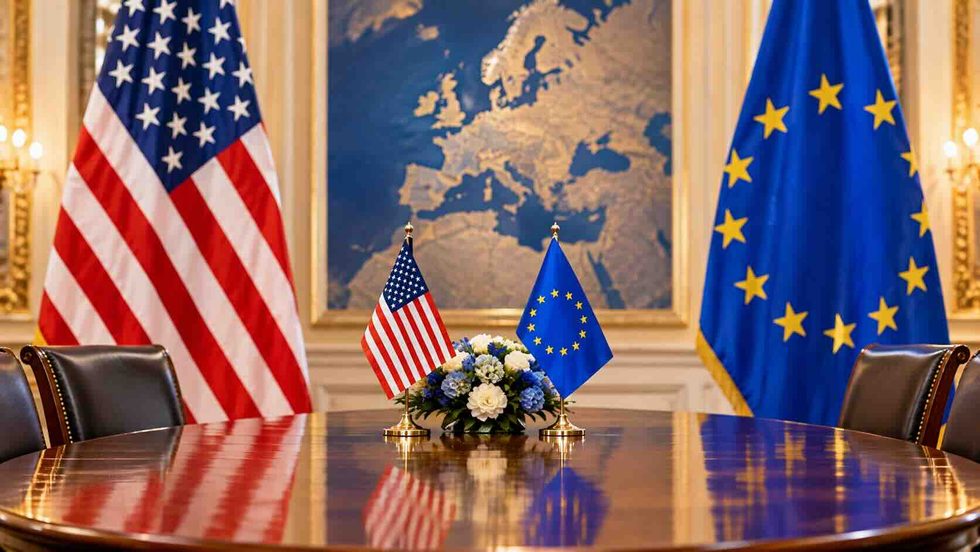
Europe should not make the mistake of thinking that everything has gone back to normal and that its relations with the Big Brother across the Ocean are destined, from now on, to remain idyllic or nearly so. Among other things, despite his apparent political incoherence, President Trump has frankly put on the negotiating table a whole series of problems in relations between Europe and the US that remain open and awaiting an adequate solution.
Incidentally, if they could be resolved now by negotiating with the majority produced by elections across the ocean, their solution might prove much easier than with (or against?) a possibly renewed Trumpian America tomorrow.
Europe should therefore not lull itself into complacency and inertia; it should give the election result only the value it really has: it is an episode in the history of a country that is openly showing it has many souls, some of which, moreover, are not particularly favorable to Europe.
Then, by all means, let’s rejoice in the fleeting moment while trying to enjoy all the advantages it can offer our continent, particularly our European Union. But let us constantly remember that it can have, toward us, like the god Janus in other times, two very different faces… and perhaps even a few more.