



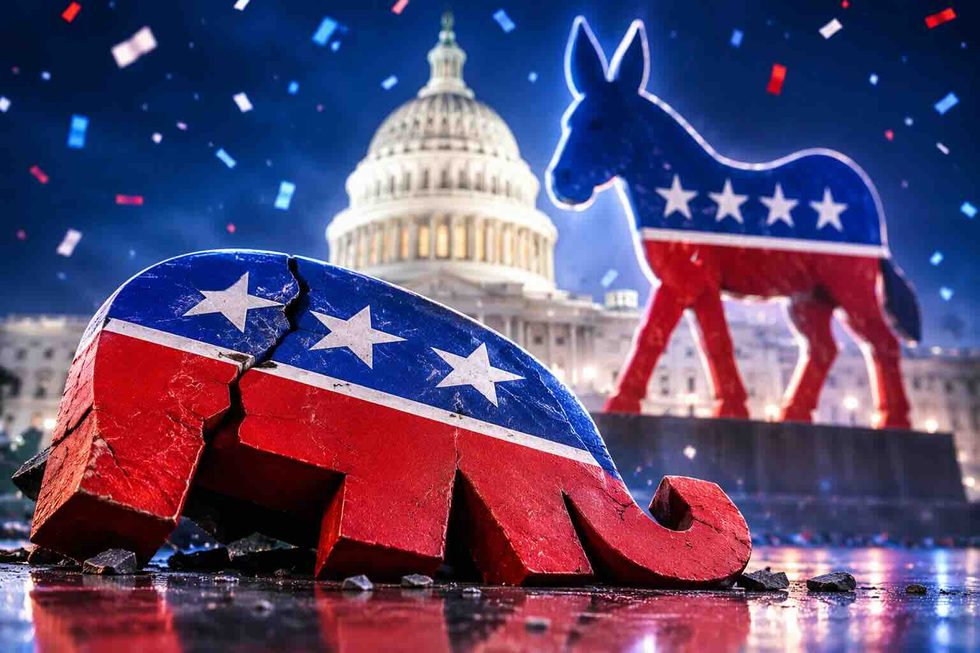
Tuesday night’s midterm elections in the United States delivered as clear as a result they could. The Democrats won a resounding victory in both the House and the Senate, far exceeding expectations. For President Donald Trump this has been the strongest defeat in Congress since his first election as president in 2016 and the toughest Republican setback since Nixon’s Watergate scandal in 1972.
In the House, Democrats are projected to gain more than 40 seats, bringing their total to a majority of more than 250 of 435. In the Senate, the situation is even clearer: Democrats have flipped between 7 and 9 seats, meaning they will reach a 54- or 56-seat majority out of 100.
That Democrats would gain the House was to be taken almost for granted: the Republicans held a very slim majority and, in midterm elections, the party that holds the presidency usually net loses a few seats (notable exception being the 2002 election, when, in the aftermath of 9/11, the country rallied behind Bush’s Republican Party). However, the sheer magnitude of the victory is remarkable. This could be the biggest Democratic majority in the House since 2008, the election season that chose Barack Obama President for the first time.
In the Senate the winner was less predictable. Many of the seats that were up for reelection were in conservative states, which until very recently one would have considered safe territory for the Republican candidates. However, the Democratic candidates swept the board and are currently running ahead even in one of the most conservative states of the Union, Mississippi.
Overall the size of the Republican loss in the House is the worst they’ve suffered since the midterm elections of 1974, in the middle of the Watergate scandal, when they lost almost 50 seats. In the Senate, the loss hasn’t been this bad since 1986; even more strikingly, to find a Republican loss this bad across both chambers simultaneously, one has to go all the way back to 1958. Then the country turned against President Eisenhower, the WWII hero. It shifted the political landscape and paved the structural groundwork for the major domestic reforms of the 1960s.
Trump’s unpopularity (38% approval per the latest CNN poll) had a lot to do with the Republicans’ defeat. Among the issues that concerned the voters most the economy and prices, especially gas prices, are up on top. The Iran War, especially given its effect on these very same problems, played an outsized role in this election, in a way that foreign policy issues rarely do. Another widely discussed issue during the campaigns was AI regulation and the construction of data centers.
Some Republican candidates (among them a notable example is Texas Senate candidate Ken Paxton, with a history of various scandals of adultery and corruption) were also very controversial.
Cultural and religious resonance
A significant piece of the Democratic strategy was an unusual emphasis on many of their candidates’ religiosity: as reported previously by RNS, the Democrats fielded among their candidates an unusually high number of pastors, former pastors and seminarians, nine nominees in total, between the House and Senate. The two Senate candidates, seminarian James Talarico in Texas and pastor Adam Hamilton in Kansas, both came out on top by significant margins (by double digits and roughly 5 percentage points, respectively).
It’s unclear how much their traditional Christian religious affiliation was a key ingredient to their victories. Certainly, they both leaned in on it, with the hope that their efforts would give a more culturally conservative aura to their image than the one typically associated with Democratic politicians.
Part of this strategy involved also moving somewhat away from the left on some cultural issues. Talarico, who was attacked by Paxton during the campaign for comments he had made in 2021 claiming God was non-binary (a term used by gender theorists to designate gender identities that don’t fit in the sex binary), was especially vulnerable on this front. He countered this criticism by coming out in favor of a federal bill that would outlaw gender-assignment surgery for minors and by opposing participation of biological males in female sports when fairness or safety are threatened. While less explicitly, Hamilton followed in Talarico’s footsteps.
At the same time, both candidates also interpreted their faith in ways that best fit some of their progressive political ideals. Appealing to Christianity became a channel to emphasize Jesus’ message of love for the poor and the weak as a political message of social justice in topics such as the economy and immigration. Hamilton went on to employ the Gospel’s message to decry the enormous loss of civilian lives in the recent Israeli campaign in Gaza and in the Iran War.
In his victory speech, Talarico again invoked a biblical reference while addressing his supporters. “You were my slingshot. The people of Texas were my slingshot. And tonight, tonight, we defeated Goliath” proclaimed Talarico, with the crowd cheering along.
The Pope’s role
Another unusual religious presence in these elections has been that of the Pontiff. Leo, the first Pope from the United States, became the first in history to vote in an American election by sending a mail-in ballot as the US citizen Robert Prevost. The Pope and most of the US Catholic Church have been critical of Trump’s administration’s policy on immigration and the Iran War.
In a general audience yesterday at Saint Peter’s Square, the Pope made a passionate speech on the role of politics in the pursuit and preservation of the common good. At the end of the speech, he quoted Pope’s Francis’ encyclical Fratelli Tutti on the immoral and destructive nature of warfare and offered a vision of hope in a politics that takes care of wounds and of those suffering injustices.
Foreign policy issues
A foreign policy issue, the Iran War, played an unusually big role in this election. Trump’s military campaign in Iran, according to a recent Harvard/Harris poll, is approved by only 35% of the public and disapproved by 65%. Even one of Trump’s most vocal supporters and one of the most hawkish voices on Iran on TV news, Sean Hannity, conceded this point.
The Iran War is linked to rising costs, especially gas prices. Alongside his tariff regime, this issue remained the clearest way to blame Trump for inflation. It also appeared to many voters as a betrayal of Trump’s promise in his last presidential campaign to stay out of conflicts in the Middle East.
The broader topic, the US-Israeli alliance, also showcased in at least one race, the Senate race in Michigan, the changing demographic and social reality of the United States. The Democratic candidate, Abdul El-Sayed, who categorically expressed opposition to any military funding of Israel, became the first Muslim senator in the history of the country in a state with growing Muslim and Arab populations.
Regarding Israel, he stood in marked contrast to most of his other Democratic colleagues, who supported defensive military aid to Israel. Israeli issues have become strongly divisive between younger and older generations, in some cases even within Jewish communities themselves.
Future prospects
The relationship between the US and Israel is critical to defining the United States’ geopolitical position and identity moving forward. But the US seems tired of incumbent Prime Minister Benjamin Netanyahu, who lost an absolute majority in the October 27 elections. It’s unclear who will form a majority. But the Democratic victory could boost the opposition leader Gadi Eisenkot’s chances.
How Trump will deal with this hostile Congress is also difficult to predict. This time, in contrast to 2020, when he denied defeat, Trump, while avoiding responsibility, conceded the loss and said he intended to work with Democrats to pass legislation. Whether the two sides will be willing or able to cooperate remains to be seen. There might be some orderly cooperation between the President and Congress, as the former Speaker of the House, Newt Gingrich, Trump’s confidant and guru of the Republicans, has said in recent tweets.
It’s unclear what will become of the political leverage of the tech billionaires who seemed so powerful during Trump’s first two years. They poured millions into these elections with little to show for it. Even MAGA’s loud support for the radical right in Europe is now in question. With Republicans fighting to preserve their legacy, they may be less inclined to risk their fortunes by aiding controversial European parties.
The war in Ukraine could be the first foreign policy test. A stronger Democratic voice in Congress could push for a stronger commitment against Russia.