



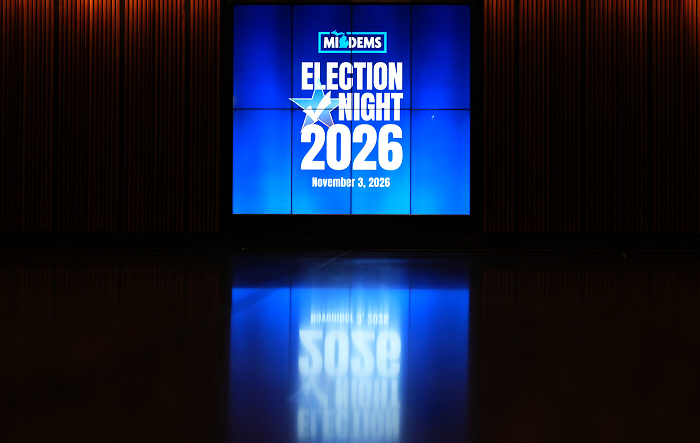
Will the President clash with Congress, or will they find a way to work together? Will institutions restore their democratic processes soon? Some signs suggest they might not.
President Donald Trump’s quick turnaround from his disappointment over the midterm election results may foreshadow what lies ahead for the nation over the next two years. This is evident in his statements, ranging from 1) «I’m still the president» to 2) «the possibility of working with Democrats,» 3) as well as his appointment of Stephen Miller as White House chief of staff.
1) This seems to reaffirm Trump’s vision of the supremacy of an executive branch which feels being immune to popular opinion when it dares to differ – with all due respect to Lincoln’s vision of a «government of the people, by the people, and for the people,» which he saw as the essence of the American democratic experiment. 2) Dealing just with the majority party (whichever it may be) also renders Congress more and more irrelevant as an autonomous institutional and political entity. 3) Clearly, Miller’s appointment is intended to reaffirm the core ideological framework of the second Trump administration—as presidential direct reaction to the will of the American people as expressed through the ballot box.
These few indicators alone should temper the jubilation of those who hailed the midterm election results as a clear affirmation of the people’s power against presidential authoritarian tendencies that undermines the nation’s democratic foundations. Beyond the United States, it’s evident that democracy can spontaneously devolve into the authoritarian system it opposes. However, it can also attempt to repair the damage it has caused, albeit with great difficulty and over a long period of time.
What democracy has not yet demonstrated is its ability to transition out of authoritarian tendencies in a non-authoritarian manner. In this regard, the institutional and constitutional crisis currently unfolding in Poland should serve as a stern warning to all who praise the invincible vitality of the democratic system.
***
Shifting from voting against Trump and his vision for rebuilding the nation—as well as the broad MAGA electoral base that won’t disappear in two years, although it could have slightly shifted with the midterms—to a government of, by, and for all represents the true litmus test for what it may become a new democratic experiment in the United States and beyond.
At the institutional level, the new Congress, with its large Democratic majority, which will take office on January 3, 2027, has the primary task of renewing the democratization of political processes. However, restoring the legislative branch’s power, including its role in scrutinizing and overseeing the Trump administration’s executive decisions and strategies, cannot be achieved by relying solely on majority votes against what remains of the Republican Party nor by fostering a retaliatory resentment toward the President.
Rebuilding cooperation among members, beyond their party affiliations, and addressing the widespread social unrest that perhaps drove the dramatic shift in the balance of power during the midterm elections requires Congress to take a new approach to its autonomy as a distinct institutional political entity.
Conversely, Congress has a constitutional duty to question, evaluate, and judge the executive actions of the government and those responsible for them, if necessary. The new Democratic majority will need to determine how to fulfill this crucial role within the system of checks and balances that characterizes American democratic institutions. Many sectors of the Democratic Party could be tempted to engage in a final showdown with the Trump administration, but doing so could be a fatal mistake. Miller’s appointment as White House chief of staff suggests that Trump may be seeking precisely this outcome. For sure, it indicates the current administration’s antagonistic stance toward a Congress which represents a rejection at least of some of its policies.
***
In this regard, the next Democratic Speaker of the House—who is expected to be Hakeem Jeffries, making him the first Black to hold this position—could play a crucial role. In the immediate aftermath of the election, Jeffries sought to represent not only his own party but also the sentiments of Americans as a whole. «We hear you. We see you. We feel you. House Democrats are committed to making life better for you. This is not a partisan moment. This is a patriotic one. We’re going to fight for small-town America. We’re going to fight for urban America. We’re going to fight for suburban America. We’re going fight for the heartland of America. We’re going to fight for Black and brown communities all across America.» This can be achieved by highlighting the primary objectives of developing social policies to lower the cost of living in the country and bringing accountability to the alleged corruption inflicted on the nation by the Trump administration.
One might say that Jeffries is a classic Democrat—more inclined toward negotiation than confrontation and toward building consensus over achieving immediate, spectacular results. He is not entirely comfortable with the social activism and thirst for retribution that characterize much of the new Democratic majority in the House of Representatives.
This may make him well-suited to reestablishing Congress’s institutional political identity, yet vulnerable when managing internal Democratic Party divisions and dealing with a White House that seems to preparing for an all-out battle. For this reason, in addition to the frank and open internal conversation among Democratic representatives that Jeffries has announced, the new Speaker of the House should also establish a reliable backchannel of communication with the Trump administration. This could involve Secretary of State Marco Rubio, with whom Jeffries is said to have a friendly, mutually understanding relationship.
***
The outcome of the midterm elections suggests possible scenarios that, while perhaps even bipartisan desirable, may remain just that. In any case, restoring a fully democratic structure to the American institutional system may not be easy or achievable in the short term. The Supreme Court has strengthened, expanded, and justified the discretionary use of executive power by the U.S. president—in this case, Trump.
Second, even with a Republican-majority Congress, Trump has built his presidential image on the strength of executive orders rather than the legislative legitimacy of Congress. If Trump were to further force the hand of the national government through executive orders in the face of a large Democratic majority in Congress, the result could be an overt institutional clash and perhaps an almost complete stalemate in domestic politics, which would have repercussions on foreign policy as well. Every executive order would likely be challenged in court, and some cases could reach the Supreme Court.
It’s important to note that the Supreme Court has already imposed strict legal limits on nationwide/universal injunctions in Trump v. CASA Inc., ruling that federal judges cannot, in principle, block the executive branch’s nationwide policies in favor of parties not involved in the proceedings.
***
Therefore, the risk is not only that a U.S. president might become a lame duck, but also that the entire U.S. institutional system might become paralyzed by a deadlocked standoff with no way out. For this reason, perhaps we should exercise more caution in hailing the outcome of the midterm elections as a victory for liberal democracy.
Rather, the elections represent a decisive test—and likely a point of no return—for the launch of a second American democratic experiment. However, this could only be possible if the «better politics» Pope Francis spoke of would be able to weave the fabric of a new American constitutional pact over the next two years. This pact should be capable of integrating all the necessary tools for a democratic system into the constitutional foundation of a country that is no longer what it was 250 years ago.