



If short- and long-term actions are not taken, perceptions of past US mismanagement of COVID and of China’s rising trade surplus could result in a volatile combination in a few years.
COVID’s failure
The year 2020 may have been crucial for US-China relations. Indeed, contrary to what Beijing expected at the onset of COVID, America did not sever all relations and contacts with China, unlike in 2003 with SARS.
In 2020, as the epidemic was spreading through China and, soon after, around the world, the US administration spent months downplaying COVID as a serious threat. The US was acting like local Chinese officials at the very beginning of the epidemic in late 2019: they had denied the existence of COVID for fear of an economic slowdown. Those local Chinese officials were later bitterly criticized by President Xi Jinping.
The US didn’t implement either strict containment or quarantine measures, which could have stemmed the epidemic’s spread and saved many lives. In the meantime, China had put a strict domestic lockdown, limiting exchanges between provinces and with other countries, the only real measure against an epidemic before a vaccine was available. A quarantine around China, because of COVID, would have effortlessly enforced the US-announced policy of decoupling—separating the Chinese economy from the rest of the US-led world. China saw a paradox: it imposed a lockdown on itself, while the US, with its vaunted decoupling, didn’t.
America did not press China. It preferred to chase an economic growth that, anyway, was halted by the epidemic. It thus proved to China that America had no genuine determination to stop it. It was all theater to accommodate some American interests. Or simply that the US had no political determination transcending short-term interests, driven by the daily vagaries of the stock market. China could therefore exploit these American weaknesses to spread its wings and extend its sphere of influence.
Trade and Sentiments
It may not be a coincidence that in that climate, between late 2020 and 2021, Russia grew more confident about putting pressure and eventually attacking Ukraine. Moscow was apparently sure that America would do nothing, that Europe would buckle, and that NATO would fall apart. At that point, with Ukraine conquered, Taiwan could have been brought to its knees — virtually or effectively through a military invasion. Everything else would follow.
That things turned out differently is a testament to the bizarre nonlinearity of history. It is evidence of the complexity of open liberal systems, which do not blindly follow the whims and gyrations of their leaders but move according to deep mechanisms.
An underlying resentment, suspicion, and hostility toward China and Russian President Vladimir Putin had grown over the previous decade or two. These sentiments shaped Western reactions to China and Russia, despite some leaders’ plans.
These sentiments are worth more than the orders of a head of government. If they do not change, they could lead to a merciless clash with China. To change these sentiments, it is not enough for the two presidents to shake hands, although that’s useful.
What is needed is to convince Western public opinion that China is a tolerant and open society, not merely “non-warmongering.” For now, there is little or no evidence of this, while there is abundant proof to the contrary. It’s substantial, not just a feeling. Trade is moving feelings.
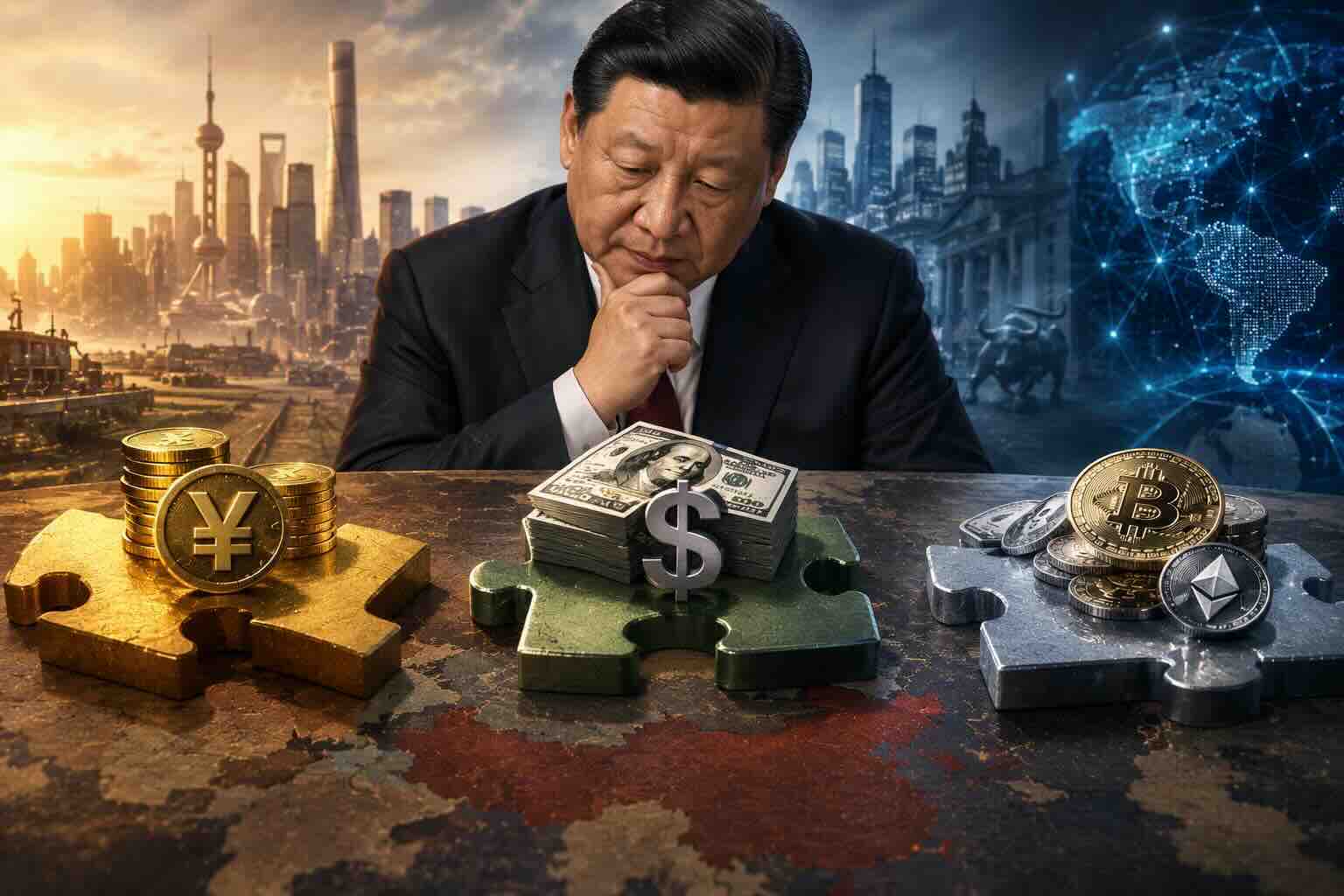
In 2025, China had a $1.2 trillion trade surplus on about $25 trillion in global commerce, almost 5% of the total. China has a surplus with all its trading partners, but it’s concentrated with the G7 countries, either directly or indirectly through third countries.
The US had a $2 trillion deficit, of which a de facto $1.2 trillion (China’s surplus) doesn’t balance out basically because the Chinese RMB is not fully convertible. Importing countries are debt-ridden and issue debt to pay for everything, and ultimately for Chinese goods. If China’s surplus widens, how can countries pay for it?
China doubled its surplus in about four years. In another four years, it could double again to about 10% of total trade. The whole world would have to pay China by issuing more debt. As a result, millions of jobs have moved and will continue to move out of G7 countries and into China. The trend will be further enhanced by AI, which will shed millions of jobs on its own.
Meanwhile, to maintain its competitiveness, China lavishes subsidies on its industries and holds down wages, suppressing domestic consumption and further distorting global commerce.
China fears that if the RMB were fully convertible, capital flight could crash the economy, as in Indonesia during the 1998 financial crisis. China has about $1,000 bn in US T-bonds and holds unreported quantities of gold, oil, and other reserves as a cushion against possible shocks.
It suppresses consumption – Chinese spend 40% of their disposable income, compared with 80% in developed countries. Its real estate, the main driver of growth for almost three decades, has crashed.
Growth is driven by exports and infrastructure, financed by private savings (Chinese save about 50% of their income due to the lack of a welfare system and a perception of insecurity). Private savings are captured by the state banking monopoly, which effectively taxes them through a large spread between deposit and loan interest rates.
The total debt-to-GDP ratio could exceed 300%, and the yearly budget deficit is rising faster than the official 5% economic growth rate. The combination of low consumption and subsidies is driving deflation.
China’s own troubles
Plus, China began using trade as a form of political leverage in trade talks with the US and other countries. Some foreigners called it “weaponizing” its monopolies over REE, primary industries, and capital goods.
It has the best price-to-quality ratio for almost all capital and consumer goods and has almost 50% of all global industrial capacity. It’s a historically unprecedented trade-political challenge in the world as it stands.
The basic reasons to suppress domestic consumption are as follows:
- Chinese products are not the best on the market — they offer better value for money. If workers are paid more and the final price rises, Chinese products could become uncompetitive, causing factories to close and triggering an invasion of foreign goods into China. This could lead to unemployment and inflation.
- But even if that were not the case, there is a second risk. To raise wages, taxes must also rise. With higher taxes, a political problem looms: people who are taxed may want to know how their money is spent. Democratic pressure increases. Tax-paying citizens may seek political representation. The monocratic power of the Chinese Communist Party could be shaken.
Faced with these two challenges, the Chinese leadership — rational and reasonable — considers continuing on the current political and economic path the least risky short-term choice. As for the foreign pressure on China, in the medium- to long-term, the Chinese may hope for upheavals that change the broader foreign environment.
However, short of a major international upheaval, rising surpluses and corresponding increases in deficits in Western countries could bring tensions to a head in a few years. As its trade surplus grows, jobs migrate from developed countries to China, anti-Chinese sentiment around the world could grow, regardless of any agreement between heads of state. Things could spin out of control.
Offsetting
Of course, China can buy more from abroad to offset its excessive trade surplus. But this could further strain its finances. The population won’t consume these imports, which often would be too expensive for the ordinary Chinese salaryman, but the state will use them. Or they will be of low value, like animal feed, unlikely to compensate for other surplus.
The reality is that China has built a system that, out of fear of political dependence on imports, requires little from abroad. And this creates new troubles.
China may now resemble late 18th-century China, which bluntly told English Ambassador MacCartney: “We do not need to buy anything from you.” A few decades later, it was caught in a vise between fear of threats from the north after the long wars against the Dzungars (supported by the Russians), and pressure from the south, from the English banging to open trade. The 1840 Opium War changed everything.[1]
History doesn’t repeat, but it may rhyme.
China is not fighting anybody now, but it has been supporting the Russian war efforts in Ukraine for almost five years. Now it may also back Iran. All supports have real commercial returns. China may not lose cash from these war efforts; it may actually earn. Still, these choices have poisoned Chinese ties with both Europe and the Middle East, which have grown suspicious of both Russia and Iran. Both regions were less sanguine about China than the US was.
Copying well
In 1973, Mark Elvin[2] argued that the Chinese were always worried about the barbarians, who, for most of history, were in reality the Central Asian peoples, the Manchus, the Mongols, and, before them, the proto-Huns, the Xiongnu. They would conquer China by first stealing and appropriating Chinese technology, science, and techniques, and end up using them against China itself.
In some ways, the Chinese today may be using this technique, or are consciously or unconsciously considering using it against the West. In a sense, they are “stealing” Western technologies, appropriating them, to then surpass the West itself. Possibly, they see Japanese development somewhat in this light. Japan, as well as Korea, Taiwan, and many other Asian countries, first adopted Western technology and then, in some cases, surpassed it, becoming better.
Naturally, the West itself did this copying. “Made in Germany,” for instance, was a label invented by the British, who resented the Germans for copying British technology. The Americans copied British, German, and other technologies. The practice of copying, of emulating those who are successful, is then normal.
The problem for China today arises with its copying. They don’t copy everything — they don’t copy wholesale, but they cherry-pick what they like. In the 19th century, the Japanese copied everything, including liberal democracy, the parliamentary system, and an independent judiciary. From the mid-19th century onward, the Japanese fully adopted and adapted the Western system.
China adopted communism from the West at the start of the 20th century, based on the belief that it was the West’s most advanced political system. Rather than copying democracy, China copied communism, which seemed poised to defeat and destroy liberal capitalism. Even then, however, Mao won control of the party against the pro-Soviet elements, emphasizing that it was socialism with “Chinese characteristics” and distancing his party from the foreign model.
Then, when Deng Xiaoping’s opening came in the 1980s and the formal communist model was abandoned, the copying was also piecemeal, never wholehearted, and never complete. Adopting democracy was considered and rejected. Perhaps that may be the problem for China.
China today finds itself having copied, and still copying, things from the West perhaps without fully absorbing them, and what emerges may be a lopsided, fragile system.
Xi or Trump
This may be at the heart of China’s present troubles. Donald Trump is the most controversial president in recent American history — perhaps the most controversial ever. He quarrels with his main partners, who, for over a century, have been Europe and the West. He has uneasy, strained relations with almost all of his neighbors, including Canada, which is certainly not America’s great enemy.
Yet despite all these difficulties, China cannot make significant headway in the world order. It cannot replace America, nor can it convince the world that, despite this controversial president, China is a better alternative.
This may not be because Xi Jinping is personally worse than Trump — he may even be a better human being. The problem is not personality. The problem is the system, which is very self-referential, good for China, but then for whom else?
How can the world’s economic, social, and political systems sustain the enormous Chinese surplus with all its consequences? On the other hand, if China does not open up as a market and an economy with a freely exchangeable currency, what does it really have of interest to buy from outside?
These should be vital questions for China, determining multilateral ties. But they apparently aren’t high on China’s agenda. It shows that the Chinese system — rational, reasonable, run by people who are certainly decent, who quite rightly seek to hold their country together, and who are not evil or ideological — follows a logic that seems miscalibrated. It’s because, from the start, it did not fully copy the Western system.
Now it is caught in the middle of the ford. It may still make it, thanks to other countries’ failures. But that is not the point.
If China had taken the step of democratizing 20, 30, or 40 years ago — even a managed democracy, something like a Singapore-style democracy — then China’s international position would be very different today. It would be a free economy with a fully convertible currency and a press that could engage with the rest of the world’s press. Today, however, none of this exists, and the Chinese economy and system are completely different and isolated in a corner.
Ge Zhaoguang explained a root of this failure[3]:
“The alteration of traditional Chinese worldviews ties closely with modern China’s international environment, which historically rendered them reactive. The traditional notions of a central world empire remain fundamentally unaltered even to this day. Ancient Chinese thought and knowledge matured early and were systematically systematized, making any reform a challenge that required holistic adjustments, unlike in countries like Japan, which readily adopted new knowledge, as described by Lu Xun’s idea of “taking in” foreign ideas for national benefit. This explains why understanding traditional Chinese tendencies to discuss ‘essence-use(ti-yong)and ‘logos and utensils(dao-qi)’ indicates a necessity for comprehensive and systemic comprehension to fuel changes in ideas, thoughts, and knowledge.”
Over the last 10 to 20 years, Chinese resistance to full adaptation has contributed to the dismantling of the global system built after World War II.
Then came Trump, then came the clash on Hormuz, the concerns over the straits and global communications, the existential systemic problem of migration, which frightens the entire West[4]. And here we are in a situation where, as one might say, there is no saint to turn to, and everything has naturally become very risky.
Westerners’ disbelief in themselves
Some Westerners are concerned about the constant self-deprecating criticism of the West, and some Chinese may see it as proof of Western decadence. If Westerners say they are declining, some Chinese may infer that it must be true. Yet if they so believe, they may misread the situation.
Self-criticism has been one of its great driving forces in the West. Self-criticism is the gateway to improvement. Augustine, the father of Western Christianity, called his reflections “Confessions,” and they guided the Western world into a new historical phase. The present Pope is an Augustinian. In China, a self-criticism or confession is the acceptance of punishment. This subtle and profound anthropological difference might lead to deeper misreadings.
The Western world has lived through these contradictions, evident in ancient Greece and Rome — the clashes between the Senate, historians, and various emperors. These have been powerful forces that have periodically jolted the system and pushed it forward. Trump might be the latest incarnation of these old contradictions. It is a delicate matter; certainly, when it crosses a certain threshold, it can seem fatal, and historically it has been, but there is truly a great element of vitality in this.
And there is something else.
During the Cold War, all things considered, there were two countries, the USA and the USSR, that were waging this war, but neither wanted a real war. Moreover, both were capable of managing their allies, who were more or less vassals. True, the Soviets didn’t fully manage the Chinese or the Yugoslavs, and the Americans didn’t fully manage the French or the British — but broadly speaking, there was a capacity for centralized management.
Conversely, now, China’s supposed allies are not true allies. Russia barely follows China’s lead, and Iran pursues its own policy with some passive backing from China. There is no global strategic direction behind China’s actions, nor can China fully manage the highly dangerous North Korea, which in turn may trigger a rearmament race in Japan and South Korea that China does not want.
There is more confusion than during the Cold War, and a growing element of confrontation that did not exist during the first Cold War — namely, this out-of-control trade surplus and deficit.
The combination of these elements is very dangerous because it is difficult to control and manage. The world needs a system to first manage these social contradictions and then, possibly, fully resolve them. Otherwise, the possibility of an explosion increases. It’s also because the atomic bomb, unlike 80 years ago, is now in the hands of almost every Tom, Dick, and Harry, and anyone can make one, increasing the entropy.
The US political leadership seems to be in disarray, with many running their own schemes. China is very focused, but it’s only about China. Not enough to replace the USA, but it could be enough to upset the cart.
A massive rethinking should be necessary. China apparently has a long-term plan, as Michael Pillsbury wrote a decade ago. The US and the rest of the world also need one.
[1] See Charles Horner Rising China and Its Postmodern Fate, Volume I: Memories of Empire in a New Global Context (University of Georgia Press, 2009) and Volume II: Grandeur and Peril in the Next World Order (Brill Academic Pub, 2015)
[2] The Pattern of the Chinese Past: A Social and Economic Interpretation (Eyre Methuen, 1973; Stanford University Press, 1973)
[3] https://www.appiainstitute.org/articles/china/twists-and-setbacks-in-traditional-chinas-understanding-of-the-world/
[4] See https://www.appiainstitute.org/articles/america/blowing-up-the-world/





Credibilità tradita e calpestata: Putin e Trump