


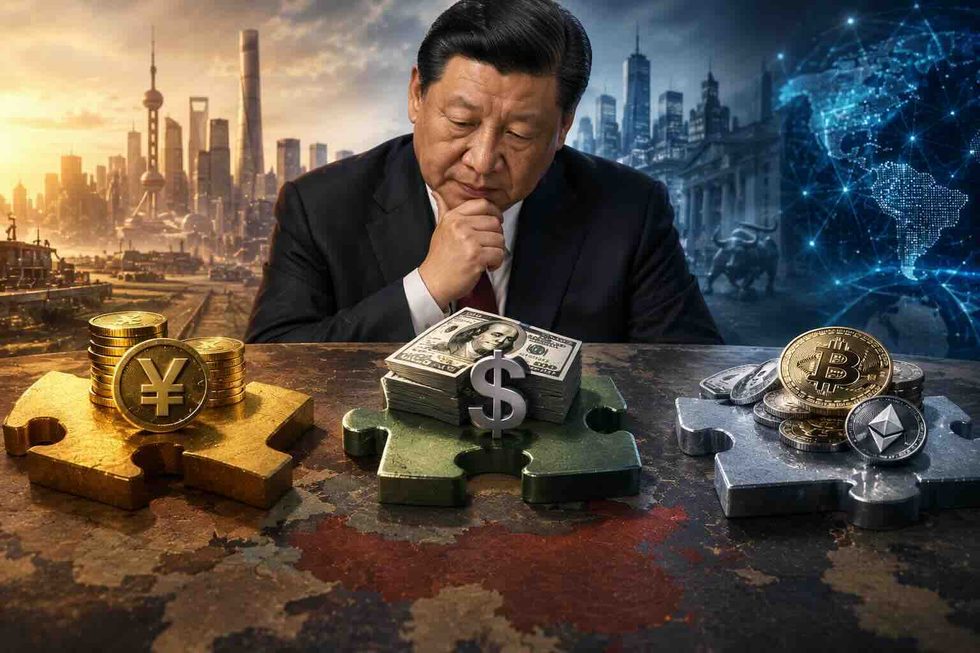
The global market: conquer it, banish it, or integrate it. Modern times impose an unprecedented trilemma on China. Beijing may want to fudge it, but there is no way around it.
The Chinese Communist Party, like the Holy See, meets challenges from a broad conceptual standpoint. Currently, its currency is not fully convertible, whereas all other major currencies are. This creates a difficult problem for the world and for China.
The party wants to maintain full control of its exchange rate, which it considers integral to its power.[1] Yet this isn’t just a Chinese Communist Party quirk. It’s part of the Chinese imperial tradition.
The origins of exchange, markets, and prices appear to differ between Ancient China and the Mediterranean world. Here is a brief, AI-supported dive into their comparative histories. These histories will shape the world’s future.
The impatient reader can skip it all and go to the last part, which deals with the Chinese trilemma.
Starting from Hermes
In the West, the oldest theory-myth of exchange centers on Hermes, the Greek god of trade, translation, thieving, cheating, boundaries (to be crossed), and messaging.
Its origins point to a layered history rather than a single source.
It may have Pre-Greek/Pelasgian roots (the original population of the Aegean before the arrival of the Indo-Europeans). Herodotus claimed the Pelasgians worshipped Hermes and that the Greeks adopted that imagery. The name may come from herm — a squared stone pillar topped with a head (usually bearded) and featuring an erect phallus, placed at crossroads, property boundaries, and doorways across the Greek world from a very early period. It is also linked to pastoral traditions of Arcadia, where shepherds led grazing flocks.
There may be connections between Hermes and Near Eastern trickster or messenger figures—for instance, the Semitic-Phoenician god Baal’s associated messenger deities or aspects of the Egyptian god Thoth. These figures were associated with writing, measurement, and mediation between the divine and human realms.
It points to a world of seafarers, the Minoans and the Phoenicians, as well as shepherds, all wandering people crossing borders. They had to understand and mediate among different locations and earn a living by using their superior information vis-à-vis other parties.
Before Hermes
Before Hermes, both Mesopotamia and Egypt had their own divine figures and myths associated with exchange, measurement, and economic order.
Mesopotamian economies (Sumerian, Babylonian, Assyrian) were largely organized around temple and palace redistribution rather than open markets — grain, wool, and other goods flowed into central storehouses and were reallocated by priestly and royal administrators. The mythology reflects this: a divinely guaranteed order, honesty, and correct measurement.
- Shamash/Utu, the sun god, oversaw justice, oaths, and contracts. The god appears at the top of the stele of King Hammurabi’s law code. The code includes extensive regulation of prices, wages, and trade.
- Nanshe, a Sumerian goddess associated with social justice, canals, fish, and — significantly — weights and measures, was sometimes described in hymns as auditing the year’s accounts and ensuring that measures of grain and other goods were honest.
- Enki/Ea, god of wisdom, fresh water, and craftsmanship, appears in the Sumerian myth “Enki and the World Order” as the deity who organizes institutions, including trade routes to the semi-mythical lands of Dilmun, Magan, and Meluhha (likely Bahrain, Oman, and the Indus Valley). Here, trade is framed as part of the cosmic order Enki establishes — a divinely sanctioned network that binds distant lands.
- Nabu, the Babylonian god of writing and scribes, patronized the record-keeping — tallies, contracts, and accounts — that underpinned Mesopotamian commerce; temples often functioned as proto-banks, holding deposits and making loans.
Mesopotamian mythic thrust favors honesty, accurate accounting, and divinely witnessed contracts. But this also shows, in contrast, how rife deceptive trade must have been and how ancient empires sought to stamp it out.
Egypt: Ma’at, the Scales, and Cosmic Balance
Egypt’s economy was even more centrally redistributive than Mesopotamia’s. The Nile’s annual flood was collected and reallocated through a state and temple bureaucracy, and the economy relied on barter, with values set against standard units such as grain or copper weight (deben).
- The central Egyptian concept of exchange is Ma’at—the personification of cosmic and social order, truth, and balance.
- Thoth, god of writing, wisdom, and measurement, records the verdict of the weighing and is closely associated with accurate calculation, calendars, and the invention of numbers. He was later identified with Hermes, becoming Hermes Trismegistus (“Thrice-Great Hermes”). Yet Thoth is a sober record-keeper and arbiter of truth.
We are in a different environment from Greece, where independent trading and raiding polities vied with one another and threatened and upended empires.
Mesopotamia and Egypt had redistributive temple and palace economies. The central concern was whether the officials administering the reallocation were honest and accurate.
Hermes and markets
Hermes embodies the deep ambivalence Western culture has always felt about exchange itself.
He is also the messenger god, moving between Olympus and the underworld, between gods and mortals—the god of mediation across a gap. In this mythic logic, exchange is fundamentally about bridging separate worlds (buyer and seller, mine and yours, sacred and profane). Modern hermeneutics, the discipline of interpretation, derives from him.
The Romans inherited this as Mercury, whose name is the root of “merchant,” “commerce,” and “mercantile,” making the etymological link between the trickster-messenger god and commercial exchange explicit in the language itself.
Hermes was never a straightforwardly moral figure. He’s a trickster associated with cunning, deception, and theft (as an infant in the Homeric Hymn to Hermes, he steals Apollo’s cattle and lies about it with startling cleverness). This captures something Western thought has wrestled with for millennia: trade requires a kind of cleverness or guile that sits uneasily alongside honesty and virtue—the merchant is useful yet morally suspect. Prices and exchanges were not set by a neutral, fair entity like the temple but by bilateral dealings that implied information asymmetry and the potential use of force to tip the scales.
Gift Exchange versus Market Exchange
Before the market exchange, much of archaic Mediterranean and Northern European society organized the movement of goods through gift exchange, which mythology treated very differently from commerce:
In Homeric epic, guest-friendship (xenia) involved elaborate gift exchanges between hosts and travelers, understood not as trade but as a sacred obligation, often overseen by Zeus Xenios (the protector of guests). These gifts created ongoing bonds of reciprocity and honor, not one-off transactions. The observance or violation of xenia drives Ulysses’ Odyssey.
Marcel Mauss[2] argued that archaic gift economies operated on a logic in which gifts are never truly free and are not fully alienated. They carry an obligation to give, to receive, and to reciprocate, and the “thing” given retains something of the giver’s spirit or identity even after it changes hands.
This is a fundamentally different theory of exchange from market exchange, in which goods are fully alienable—once sold, a good carries no trace of the seller and creates no ongoing social bond. The tension between these two logics—commodity exchange (impersonal, closed, complete) and gift exchange (personal, ongoing, relational)—recurs throughout Western economic anthropology.
Totally alienated merchandise is an important first step in the market economy. But this didn’t solve the lingering problem of how to price the exchanged good. The gift had no price because it carried memory and bond, and disrespecting that memory and bond would cause friction and retaliation. The fully alienated marketed good did so without the bond but created a murky reality about the ‘right price’. It was to be negotiated, but both sides suspected an imbalance of knowledge about the traded good. So the price was convenient for one party but not for the other. One party might deceive the other in a free market not guaranteed by the temple of the imperial storage. Yet the Temple or the imperial storage could set prices convenient for them but not for the traders.
The second step toward a conception of the modern economy was, as we shall see, the first theory proposing that an objective price could be calculated from production costs.
Aristotle’s Naturalization of Exchange
By the time Aristotle (4th century BC) systematized economic thought, the mythic framing had given way to philosophical analysis, though traces remained. In the Politics and Nicomachean Ethics, he argued that money arose as a convention to solve the problem of barter (the “double coincidence of wants”), serving as a medium of exchange, a store of value, and a unit of account. He also distinguished between oikonomia (household management, natural and legitimate) and chrematistics (wealth accumulation through trade, especially lending at interest, which he considered unnatural — money “breeding” money).
This suspicion of interest-bearing lending shaped Western economic ethics for nearly two millennia. Some exchange is virtuous and necessary, but exchange pursued for its own sake, without natural limit, is corrosive.
Roman law and administration contributed practical concepts of currency debasement and its effects. Roman emperors repeatedly reduced the silver content of coins to fund the treasury, producing inflation that Roman rulers like Diocletian (in his Edict on Maximum Prices, 301 AD) tried and failed to control by decree. The empire tried to balance central price administration with free-market exchange. The results were mixed.
Medieval Christian Anxiety: The Merchant’s Soul
With Medieval Christianity, merchants occupied a genuinely uncomfortable moral position: unlike a farmer or craftsman whose labor visibly produced value, a merchant seemed to profit merely from moving goods between places or from timing — buying low, selling high — without adding anything through labor.
This looked uncomfortably close to usury, and canon lawyers and theologians spent centuries trying to work out when profit from trade was legitimate (compensation for risk, transport, and effort) versus illegitimate speculation. The Scholastic theory of the “just price” by Thomas Aquinas was partly an attempt to tame this old anxiety about the merchant’s moral ambiguity.
Later scholastics, particularly the School of Salamanca in 16th-century Spain (Francisco de Vitoria, Martín de Azpilcueta, Tomás de Mercado), broke new ground. Azpilcueta is often credited with an early statement of the quantity theory of money. Noting that the massive inflows of American silver into Spain were driving up prices, he reasoned that money’s value depends on its relative scarcity, just like any other good. This is arguably the first clear articulation of the idea that “more money chasing the same goods raises prices.”
The Western world had to contend with an unprecedented phenomenon unfolding at unprecedented speed: the massive flow of gold, the expansion of trade, and the agricultural revolution brought about by the discovery of America, along with direct global commercial exchanges.
China
Chinese textual and archaeological evidence for prices, markets, and exchange goes back to the Shang dynasty (late 2nd millennium BC, the time of the Trojan War), with a foundational mythic account as well. Here’s a roughly chronological rundown.
The earliest textual reference to the origin of markets in China isn’t economic analysis but myth, recorded in the Xici Zhuan (the “Great Commentary” appended to the Yijing, Book of Changes, compiled over the late Zhou period but describing much older tradition). It attributes the invention of markets to the legendary culture-hero Shennong (the “Divine Farmer”):
He established markets at midday, bringing the people of the world together, gathering the goods of the world together, letting them exchange and withdraw, each obtaining what they needed.
Market exchange is framed as an act of civilizational order-giving by a sage-ruler, not as something that emerges spontaneously from human cunning (as with Hermes). Shennong is a culture hero credited with agriculture, medicine, and markets — all part of the same package of civilizing gifts.
Oracle bone inscriptions (Shang divinatory texts, ca. 13th–11th century BCE) record cowrie shells (bei) being given as rewards, gifts, and marks of status by the king to subordinates — the earliest evidence of a recognized unit of value in China.
Archaeological finds of cowrie shells (and later bronze imitations of cowrie shells) in Shang and early Zhou tombs confirm their role as a value-bearing, exchangeable good — this is why the Chinese character radical for money, trade, and value-related words is bei 貝 (cowrie shell), fossilizing this early monetary history directly into the writing system.
Bronze vessel inscriptions from the Western Zhou (1046–771 BC) record specific transactions: gifts and exchanges of cowrie shells, horses, chariots, and even land between aristocrats. One well-known example (the Wei ding and related “Wei family” bronzes, ca. 9th century BC) records a transaction in which land was exchanged for goods including horses and a jade item — evidence of a functioning system of valued exchange among the elite.
The Book of Documents (Shangshu尚書), specifically the “Jiugao” (酒誥, Announcement about Drunkenness) chapter, contains a famous early reference to commoners engaging in trade: it describes people traveling to distant markets to trade goods (including cowries and other valuables) in order to support their parents — an early textual acknowledgment of ordinary people, not just elites, engaging in commerce.
The Book of Songs (Shijing 詩經, c. 11th–7th century BC), contains vivid glimpses of barter and exchange woven into ordinary social life. The poem “Mang” (氓), which opens with a young man approaching a woman under the pretext of trading cloth for silk thread, uses a commercial transaction as the occasion (and cover story) for courtship — showing that small-scale bartering between ordinary people was a familiar enough backdrop to serve as a literary device.
Rites of Zhou (Zhouli 周禮, compiled Warring States–Han, describing idealized earlier institutions) contains detailed descriptions of market-supervising officials:
The Sishi (Market Director) is charged with regulating the marketplace, arranging stalls by category of goods, checking weights and measures, adjudicating disputes, and controlling prices in times of scarcity or surplus — essentially a bureaucratic elaboration of the same “stabilize prices through state oversight” instinct that later flowers fully in the Guanzi‘s Qingzhong theory.
Related offices include the Quanren (Officer of Coinage/Currency) and officials responsible for taxing market transactions — showing an already fairly developed conception of market regulation, taxation, and price oversight predating or contemporary with the Guanzi material itself.
The Zuo Zhuan (Commentary on the Spring and Autumn Annals, compiled in the 4th century BC, describing events of the 8th–5th centuries BC) contains the well-known anecdote of the merchant Xian Gao of Zheng, who, encountering an invading Qin army while on a trading trip, cleverly presented them with gifts of oxen and hides as if from his own ruler, buying time to warn his home state. The story treats merchant cunning in a mediating, boundary-crossing role, as some kind of spy craft for the state’s benefit. Something that may sound similar to Hermes, but it’s deeply different. The cunning is not used to gain personal advantage but for the state’s benefit.
The Guoyu (Discourses of the States, similar period and material to the Zuo Zhuan) includes reflections attributed to statesmen on the dangers of price manipulation and merchant hoarding, an early sign of the state-versus-merchant tension that would later crystallize fully in the Han “Salt and Iron” debates.
Yet the earliest and most sophisticated Chinese theory of money and prices comes from the Guanzi (管子), a compilation of essays attributed to the statesman Guan Zhong (7th century BCE) but actually compiled mostly during the Warring States and early Han periods. Several chapters, collectively called the “Qingzhong” (light-heavy) chapters, lay out what is essentially a proto-quantity theory of money combined with a theory of state price manipulation:
Money is a tool of state power, not just a medium of exchange. The Guanzi argues that grain, cloth, and money are all “light” or “heavy” relative to one another depending on relative scarcity, and that a wise ruler can manipulate these relative values by controlling supply — buying up grain when cheap (heavy money, light grain) and releasing it when expensive (light money, heavy grain) — to stabilize prices, enrich the state treasury, and even weaken rival states without going to war.
This is essentially an ancient articulation of price-stabilization through state stockpiling (later institutionalized as the “ever-normal granary,” changpingcang 常平仓). Crucially, money here is treated as fundamentally an instrument of statecraft — a way to move real resources (grain, labor, military supply) around — rather than as a neutral veil over a self-regulating market. This is the root of the “money serves the state” logic[3].
This economic theory wasn’t challenged at the time and basically remained the main pillar of Chinese economic thinking. Guanzi thus formalized a widespread consensus about the distrust of the free market and the vision of markets just as an extension of state power.
By the Han dynasty, this theory became state policy. The finance minister Sang Hongyang (152–80 BCE), under Emperor Wu, implemented state monopolies on salt and iron (the famous debate recorded in the Discourses on Salt and Iron, Yantielun 盐铁论), justified explicitly with Qingzhong logic—the state should control strategic commodities to fund the treasury and stabilize prices, rather than leave them to merchants.
He also implemented “Balanced standard” (junshu 均输) and “leveling” (pingzhun 平准) systems. State agencies bought commodities where they were cheap and sold them where they were expensive, smoothing regional price differences and capturing the profit for the treasury instead of merchants.
Confucian scholars argued against these policies, saying the state shouldn’t compete with the people for profit (a very different position from the Legalist/Qingzhong school), while Legalist-minded officials defended state intervention as necessary for national strength.
This tension — Confucian suspicion of profit-seeking versus Legalist state utilitarianism — recurs throughout Chinese economic history.
Wang Mang, who usurped the Han throne (9–23 CE), attempted radical currency reforms — issuing multiple new coin denominations with values set by fiat far above their metal content, alongside land nationalization schemes justified by classical (Confucian, specifically Rites of Zhou) precedent. The reforms triggered massive inflation, hoarding, and counterfeiting. They are often cited by later Chinese thinkers as a cautionary tale about the limits of state power to dictate value by decree — an early, practical lesson about the difference between nominal and real value.
The Song dynasty (960–1279) is where Chinese monetary theory gets innovative. The Jiaozi (交子), the world’s first government-backed paper currency, emerged in Sichuan in the early 11th century, originally as private merchant receipts for iron coins (too heavy to carry conveniently), later taken over and issued by the state.
This forced Song officials to think concretely about what underpins money’s value — reserves, convertibility, and the risk of over-issuance causing depreciation. Song officials explicitly worried about and documented instances of inflation caused by printing too much paper money to cover military expenses, particularly against the Jin and later the Mongols.
Later Wang Anshi (1021–1086), the great reformist chancellor, revived Qingzhong-style thinking with his “New Policies” (Xinfa 新法), including the “green sprouts” loans (qingmiaofa 青苗法) — state agricultural loans meant to undercut private moneylenders and stabilize peasant finances — and market-exchange bureaus that functioned like Han-dynasty price-leveling agencies.
Conservative Confucian critics, such as Sima Guang, attacked these policies on the same grounds that Han Confucians had used against Sang Hongyang: that the state shouldn’t act like a merchant.
The Yuan dynasty issued the Zhongtong chao and later paper currencies, initially well managed with a silver reserve, but eventually overissued to fund wars and became worthless—a major factor in the dynasty’s fall in the eyes of many historians.
The Ming dynasty’s Da Ming Baochao, introduced in 1375, lost value rapidly because the government printed too much without metal reserves to back it. By the 1430s-1450s, it was nearly worthless in everyday trade. People had shifted to copper coins and, increasingly, silver.
This was when Zheng He’s famous sea voyages stopped, and America was about to be discovered.
From then on, Chinese trade and the economy became increasingly tied to global silver flows from Spanish America and Japan (this is where Chinese monetary history starts becoming genuinely globalized, tying back to Mediterranean/maritime integration).
The Qing ran a de facto bimetallic system — silver for large transactions and taxes, copper cash for daily use — without a truly unified national currency or central bank. This system was vulnerable to external silver flows (again tying into 19th-century opium trade dynamics, since opium imports drained silver from China, a major grievance in Qing economic thinking before the Opium Wars).
Europe after the discovery of America
With the explosion of trade with the American continent, the perception of money and price changed again.
Mercantilist writers (16th–18th centuries, including Thomas Mun, Jean-Baptiste Colbert, and others) treated bullion (gold and silver) as the essence of national wealth and advocated policies to maximize exports and minimize imports to accumulate specie. Money was treated much like a stockpile of state power. It was treated as an instrument of statecraft, though mercantilists focused on trade balances rather than domestic price manipulation.
The environment was different. In China, one large state dominated the market and could ‘fix it’ with adaptive policies. In Europe, many states traded and made war with each other, so ultimately commercial balances were the tool to run a proper state budget.
In 1752, David Hume delivered a devastating critique of mercantilism with his price-specie-flow mechanism: if a country accumulates gold through a trade surplus, its money supply rises, raising domestic prices, which makes its exports less competitive and imports cheaper, automatically reversing the trade surplus. This was one of the first rigorous demonstrations that a nation cannot permanently accumulate bullion through trade policy — money and prices self-correct.
From there came the Classical Political Economy (late 18th–19th centuries)
Adam Smith (1776) shifted the focus from bullion to production and exchange, arguing that real wealth lies in a nation’s productive capacity, not its stock of gold. He also developed early ideas about “natural price” (cost of production) versus “market price” (short-term supply and demand). Early industrial production, with the growing use of machines and regimented workers, created a new environment for almost any production, lowering costs compared with traditionally produced goods.
The idea of a ‘natural price’ served as a stopgap, a hard core against the devious Hermes-like private bargaining. It freed trade from the ability to haggle and anchored it in the capacity to produce “good value,” good product at acceptable prices. And it also freed trade from the ancient concern about the ‘god of just exchange’. Prices had a rock-bottom reality grounded in their cost of production and the profit needed to repay the investment and effort.
This came with a new faith that the market was moved by ‘an invisible hand’ that created good for everybody despite the selfish pursuit of self-interest by all market participants.
David Ricardo developed a more rigorous quantity theory of money, arguing that the value of money is determined by its quantity relative to the volume of trade, and that under a gold standard, international price levels and specie flows would adjust automatically (formalizing and extending Hume’s mechanism).
Karl Marx offered a radically different lens: money in Capital is the universal equivalent form of value, and the “M-C-M'” circuit (money-commodity-more money) captures capitalism’s inherent drive toward accumulation. Prices, for Marx, ultimately reflect socially necessary labor time. The main argument stemmed from Smith’s finding on profit. He argued that industrial production, using modern machines, creates surplus value that ultimately comes from surplus labor, extracted without extra pay from workers.
Marginalist Revolution (1870s)
William Stanley Jevons, Carl Menger, and Léon Walras, working independently, overturned classical labor/cost theories of value with the concept of marginal utility: prices reflect not the labor or cost embedded in a good, but the subjective value consumers place on the last additional unit consumed. This resolved long-standing paradoxes (like why water, essential for life, is cheap while diamonds, inessential, are expensive) and became the foundation of modern microeconomics.
Menger in particular also gave an influential account of money’s origin as an emergent, unplanned social institution — the most “saleable” commodity gradually becomes accepted as a general medium of exchange without any central authority designing it. It’s a bottom-up theory, a very different origin story from the top-down, state-created money of the Qingzhong thought.
Quantity Theory Formalized: Fisher and the Cambridge School
Irving Fisher (1911) formalized the quantity theory into the equation of exchange: MV = PT (money supply × velocity = price level × transactions), giving mathematical rigor to Hume and Ricardo’s older intuitions.
The Cambridge cash-balance approach (Alfred Marshall, A.C. Pigou) reformulated this in terms of how much money people choose to hold relative to income, shifting emphasis toward money demand rather than just supply.
This Soviet experience played out against the backdrop of the socialist calculation debate in Western economics, which had started decades earlier:
Ludwig von Mises (1920) argued that a socialist economy without market prices for capital goods was fundamentally impossible to rationally plan — with no market prices, planners have no way to calculate the relative scarcity or opportunity cost of resources, meaning central planning is a “shot in the dark” no matter how sophisticated.
Friedrich Hayek deepened this critique, arguing that markets are not just calculating mechanisms but ways of aggregating dispersed, tacit knowledge that no central planner could ever collect (his famous 1945 essay “The Use of Knowledge in Society”).
Keynes and the Break from Classical Orthodoxy
John Maynard Keynes, especially in the General Theory (1936), challenged the classical assumption that markets (including labor markets) self-adjust smoothly to full employment. He emphasized that money isn’t neutral — it affects real output and employment, not just prices, especially in conditions of underemployment and “liquidity preference” (people hoarding cash out of uncertainty). This justified active government fiscal and monetary intervention to manage demand — a return, in a sense, to a state-centered view of managing the economy, though grounded in very different theoretical machinery than the Chinese tradition.
Monetarism and the Post-War Consensus
Milton Friedman and the Chicago School revived and refined the quantity theory in the mid-20th century, famously arguing “inflation is always and everywhere a monetary phenomenon” — that persistent inflation results from money supply growth outpacing real output growth, and that central banks should target stable, predictable money-supply growth rather than trying to fine-tune employment (a direct challenge to Keynesian activism).
This set the stage for the monetarist-Keynesian debates of the 1960s–80s, partially resolved (in practice) by the modern synthesis of independent central banks targeting inflation through interest rates rather than directly controlling the money supply — the framework most Western economies still operate under today, and the “rules-based” market logic.
The mainstream Western tradition, especially from Hume onward, increasingly treats money and prices as things that emerge from and self-regulate through decentralized exchange, which now has some objective anchor. The state’s proper role is to maintain stable rules (sound currency, property rights, competition) rather than to directly manipulate prices or allocate resources.
The major exception is Keynesianism, which reintroduces a strong role for state demand management — but even there, the justification is macroeconomic stabilization of an otherwise market-driven system, not the direct state control of commodity flows and strategic industries central to the Chinese tradition.
Chinese new Trilemma
These evolutions in economic thinking are not purely academic. They shaped the evolution of markets, from derivatives to today’s crypto. There are doubts about how solid or risky these innovations are, but they also expanded the concepts of credit, and thus prices and money, which also feeds technological innovations.
This modern expansion rests on two concepts: the Hermes-like total alienation of a good in trade, removing the strings attached to gift exchange; and the early industrial revolution concept of an objective ‘production cost’ and the faith of a market moved by an ‘invisible hand’ that does good despite the selfish pursuit of self-interest of all market participants.
Without these financial innovations, technologies are financed only by state disbursements, which build state debt. These financial innovations, conversely, tap into private investment; thus, they mobilize the whole society and minimize risks. England won the Napoleonic Wars because it had a better financial system that rallied private investment. Puny Venice and Genoa could withstand and push back the onslaught of the massive Ottoman Empire for centuries because they drew on the private investment of their res publica’s citizens.
These innovations therefore are fundamental: they have to balance novelty and solidity. In an open society, if they fail, they go bust, and everything starts again. In a closed society, the bubble doesn’t burst; it keeps growing until it blows up the nation or the world.
China has almost no free market, and its financial innovations, if any, are unknown and unrecognized, so they can’t be transferred to other markets. American ones are recognized and can be transferred worldwide.
China’s post-1978 economic history can be read as a long, halting negotiation between the old Qingzhong instinct (the state should actively direct the “commanding heights” — banking, energy, strategic industry — even while allowing markets to operate at the margins) and the Western insistence that prices convey true information only when they emerge from genuinely decentralized, unmanipulated exchange.
Still, this unfolds in an environment where the Chinese state doesn’t command all global levers of economic power, as in imperial times, but must consider foreign trade. Its surplus is vital to its economic survival, and so is the foreign environment.
Here, trade is not balanced, as early mercantilists recommended; instead, China accumulates a growing surplus, tipping the balance of global commerce. The surplus isn’t spent, as in Hume’s time, but is reinvested in industries and technologies that suppress production costs to maintain existing markets and gain new ones. Therefore, despite the surplus, China experiences internal deflation.
China may think that America, through the dollar and its stock markets, manipulates global prices. This may be partially true, but not consistently, as US presidents are often victims of their own economic policies. This means that US manipulation has many limits.
The other possibility is that the current global market, centered on free exchange and free convertibility, grounded in the dollar and free global stock markets, will collapse because of many unsustainable financial innovations, its debts, and its growing interests.
If so, each currency would stop being freely convertible, and global markets would be partitioned. But this would also mean the RMB would leave the current crawling peg to the dollar, and the world would revert to some form of highly unstable barter trade.
There are many concerns about the dollar and the role of the US financial markets, and rightly so. But to revert to some barter trade could be overshooting. Would the world be willing to follow China on this path? And what would it gain? Most importantly, would global money follow China on this when it believes the US system made money for it?
Here is a new trilemma. China cannot manipulate the currency globally and control global trade right now. Either it 1. conquers the world, 2. shuts down completely from the world, or 3. integrates its trade into the world. It can choose only one of these three paths. Therefore, it can make the RMB a global currency based on Beijing’s plans, make it totally non-convertible, or make it fully convertible. Now it straddles all three, but it is getting harder by the day.
It’s unclear what China will do. China may try to cut every possible corner, kick the can down the lane as much as it can. Some fudging is possible, but ultimately a main road will have to be chosen. The trilemma will haunt it until it is solved one way or another.
Bibliography
Here’s a succinct bibliography organized by topic, covering primary sources and key secondary scholarship for everything discussed.
Hermes and Myths of Exchange
- Homeric Hymn to Hermes — translated in Apostolos Athanassakis, The Homeric Hymns (Johns Hopkins University Press, 3rd ed., 2013)
- Walter Burkert, Greek Religion (Harvard University Press, 1985), esp. the chapter on Hermes
- Norman O. Brown, Hermes the Thief: The Evolution of a Myth (University of Wisconsin Press, 1947) — classic study of Hermes’s origins and functions
- Jane Ellen Harrison, Prolegomena to the Study of Greek Religion (Cambridge University Press, 1903) — early discussion of the herm-stone cult
- Marcel Mauss, Essai sur le don (1925; English trans. The Gift, W.W. Norton, 1990)
- Karl Polanyi, The Great Transformation (1944); Polanyi, Arensberg & Pearson (eds.), Trade and Market in the Early Empires (Free Press, 1957)
Mesopotamian and Egyptian Myth and Economy
- Thorkild Jacobsen, The Treasures of Darkness: A History of Mesopotamian Religion (Yale University Press, 1976)
- Jeremy Black, Anthony Green & Tessa Rickards, Gods, Demons and Symbols of Ancient Mesopotamia (British Museum Press, 1992)
- “Enki and the World Order,” in Samuel Noah Kramer, Sumerian Mythology (rev. ed., University of Pennsylvania Press, 1961)
- Marc Van De Mieroop, The Ancient Mesopotamian City (Oxford University Press, 1997), and A History of the Ancient Near East, ca. 3000–323 BC (Wiley-Blackwell, 3rd ed., 2016) — covers temple/palace redistribution economies
- Jan Assmann, Ma’at: Gerechtigkeit und Unsterblichkeit im Alten Ägypten (C.H. Beck, 1990; partial English discussion in Assmann, The Mind of Egypt, Metropolitan Books, 2002)
- Garry J. Shaw, The Egyptian Myths: A Guide to the Ancient Gods and Legends (Thames & Hudson, 2014)
- Barry Kemp, Ancient Egypt: Anatomy of a Civilization (Routledge, 3rd ed., 2018) — covers Egyptian economic organization and lack of coinage.
Chinese Theories of Money and Prices
- Guanzi (管子), esp. the “Qingzhong” (轻重, Light-Heavy) chapters — translated by Allyn Rickett, Guanzi: Political, Economic, and Philosophical Essays from Early China (Princeton/Cheng & Tsui, 1985–1998, 2 vols.)
- Huan Kuan (桓寬), Yantielun (鹽鐵論, Discourses on Salt and Iron) — translated by Esson Gale, Discourses on Salt and Iron (Brill, 1931)
- Sima Qian, Shiji (史記), “Pingzhun Shu” (平準書, Treatise on the Balanced Standard) chapter — various translations, e.g. Burton Watson, Records of the Grand Historian (Columbia University Press)
- Richard von Glahn, Fountain of Fortune: Money and Monetary Policy in China, 1000–1700 (University of California Press, 1996)
- Richard von Glahn, The Economic History of China: From Antiquity to the Nineteenth Century (Cambridge University Press, 2016)
- William Guanglin Liu, The Chinese Market Economy, 1000–1500 (SUNY Press, 2015)
- Nishijima Sadao & others, essays on Han economic policy in The Cambridge History of China, Vol. 1: The Ch’in and Han Empires (Cambridge University Press, 1986)
Western Theories of Money and Prices
- Aristotle, Politics, Book I; Nicomachean Ethics, Book V (multiple editions, e.g. Loeb Classical Library)
- Marjorie Grice-Hutchinson, The School of Salamanca: Readings in Spanish Monetary Theory, 1544–1605 (Oxford University Press, 1952)
- David Hume, “Of the Balance of Trade” (1752), in Essays, Moral, Political, and Literary
- Adam Smith, An Inquiry into the Nature and Causes of the Wealth of Nations (1776)
- David Ricardo, The High Price of Bullion, a Proof of the Depreciation of Bank Notes (1810); Principles of Political Economy and Taxation (1817)
- Karl Marx, Capital, Vol. 1 (1867), esp. Part I on commodities and money
- Carl Menger, Principles of Economics (1871; English trans. 1950); “On the Origin of Money,” Economic Journal (1892)
- Irving Fisher, The Purchasing Power of Money (1911)
- John Maynard Keynes, The General Theory of Employment, Interest and Money (1936)
- Milton Friedman, A Monetary History of the United States, 1867–1960 (with Anna Schwartz, Princeton University Press, 1963); The Optimum Quantity of Money (1969)
- Ludwig von Mises, “Economic Calculation in the Socialist Commonwealth” (1920 essay); Friedrich Hayek, “The Use of Knowledge in Society,” American Economic Review (1945)
China’s Post-1978 Reform and the East-West Encounter
- Robert Mundell, “A Theory of Optimum Currency Areas,” American Economic Review (1961); collected essays in International Economics (Macmillan, 1968)
- Barry Naughton, The Chinese Economy: Adaptation and Growth (MIT Press, 2nd ed., 2018)
- Julian Gewirtz, Unlikely Partners: Chinese Reformers, Western Economists, and the Making of Global China (Harvard University Press, 2017) — directly covers Western economists’ (including Friedman’s) engagement with Chinese reformers
- Isabella Weber, How China Escaped Shock Therapy: The Market Reform Debate (Routledge, 2021)
[1] See https://www.appiainstitute.org/articles/china/chinese-jigsaw-puzzles/
[2] The Gift, 2016, English translation from the 1925 original. https://haubooks.org/wp-content/uploads/2020/11/Marcel-Mauss-The-Gift-Expanded-Edition-Selected-Annotated-and-Translated-by-Jane-Guyer.pdf
[3] See https://www.appiainstitute.org/articles/china/chinese-jigsaw-puzzles/