

The wars and the oil blockades may be waiting for Xi’s party congress. The US could face significant short-term trouble. China’s long-term future is uncertain. The EU hazard.
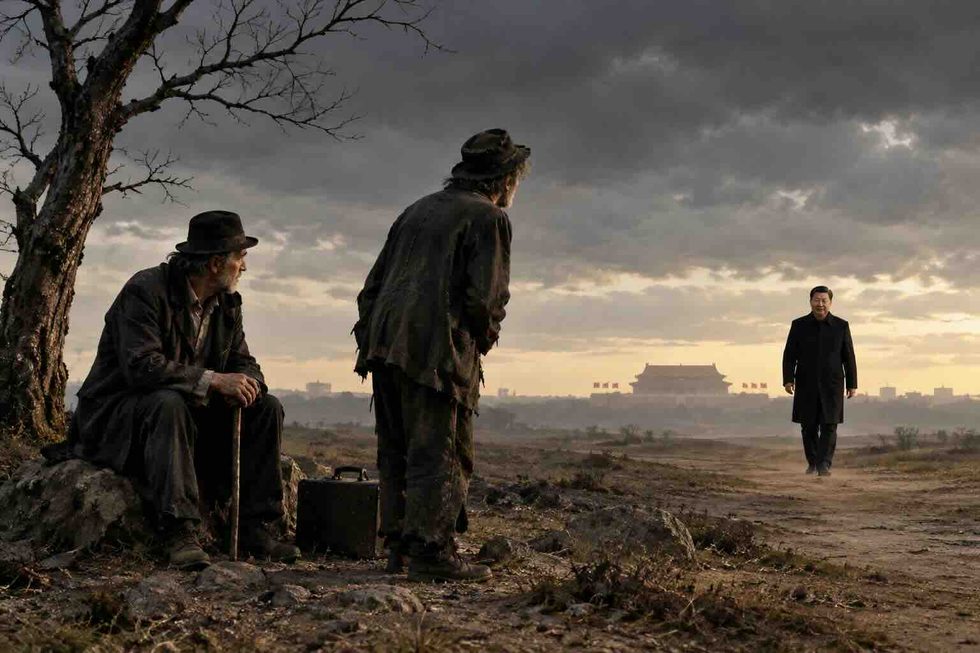
Just as Vladimir and Estragon waited for Godot in Beckett’s famous play, the world may now be waiting for Xi Jinping in the present political drama.
America is stuck in two wars. In Ukraine, it would like to reach a compromise with Russia. In the Middle East, it is trying to bring down Tehran’s regime, which backs many extremist groups in the region and blocks oil traffic through the Straits of Hormuz and Bab el-Mandeb. Both conflicts are creating an oil crisis unlike any seen in over 50 years and are driving President Donald Trump’s approval ratings down.
Trump could therefore be soundly defeated in the midterm vote on November 3, which, in theory, opens two scenarios. Either Trump contests the result at the ballot box, trapping the country in a devastating political fight that will drown America for months; or he accepts the outcome, and the new Democratic-majority Congress could wage war on him. In either case, America might have little energy left to focus on foreign affairs and to take on what was the “big target” at the start of his presidency: President Xi Jinping’s People’s Republic of China (PRC).
Xi Jinping has no interest in solving America’s problems. It would be dangerous: something could go wrong in the mediation, and the PRC would be drawn into something it didn’t start. If Xi delivered, America could return to a hostile confrontation with China. Conversely, by doing little and letting American mistakes play out, Xi can approach his next autumn’s Party congress with great confidence.
He’ll be hailed as the first Chinese head of state in history to paint the great Western power into a corner, two centuries after the disgraceful Opium War. It’ll mark the end of the century of humiliation that has nagged Chinese education for decades. A bigger result than reunification with Taiwan, an island that is de facto independent, de jure part of one China, and claimed by the PRC.
The context
This happens in a complex new global context. On September 23, the UN General Assembly convened in New York. The two powers, America and China, set aside the big Apple and met in Washington. This effectively hollowed out the UN. Both preferred meeting each other to attending the General Assembly. If the biggest players don’t attend, what is the UN for?
In May, the two met in Beijing. It was perhaps a ceasefire, a moment of pause. In September, it marked a real truce. It doesn’t mean there will be no flare-ups of tension, but the truce should hold at least until next autumn, when the Party congress opens and most likely renews the entire leadership group. It could even hold until the 2028 US presidential election.
During this truce, signs suggest the two powers might take some steps forward, though these steps are delicate.
One step is the reopening of military dialogue. Perhaps the main reason for interrupting the dialogue was that the Americans wanted to establish codes of conduct for encounters at sea or in the air between Chinese and American forces. The Chinese were reluctant to establish such codes because doing so would, in some way, authorize the American presence in areas that China considers its exclusive domain.
A second important point is how closely all the Asian countries, particularly Japan, watched this meeting. Outside China, Japan is something of a leading country on an “anti-PRC” front. Japanese Prime Minister Sanae Takaichi went to Washington in person the day before Xi’s arrival and announced that she had a phone call with Trump right after Trump met with Xi.
The Trump-Xi summit was not simply a two-way meeting; it was multilateral, and America apparently accepted that. America considered the needs and requests coming from its Asian allies, particularly Japan in this case.
A new outline
Things have clearly changed since the start of Trump’s presidency, when he said, “We’ll corner China with tariffs, because we hold the upper hand, since we are their market.” That facile approach is gone, but it remains unclear what a new long-term American plan will be. How will China be managed? Will China simply be treated like any other country, or will the United States actually begin to apply what Trump announced during his first presidential term in 2016, decoupling China from the rest of the world market?
And China, for its part, what will it do? Will it endure and wait for American decisions? Will it try to align its financial, economic, and even political systems to integrate into the world system? Or, conversely, will it try to sabotage this system and create a new one?
Over the next two years, we’ll see whether this truce is short-term and will then spill over into an even harsher conflict, or whether it will lead to lasting peace. Or the truce could be extended, shaping the new Cold War 2.
Iran is a first test. In the joint statement, China said it opposes a nuclear-armed Iran and that Iran should free the two straits. The Houthis, Iranian proxies, control Bab el-Mandeb. Here, a larger conflict may loom as the Houthis threaten Saudi Arabia. [1]
Can China manage to create an economic, commercial, and financial system alternative to the current one? The first step would be to unhook the RMB from the dollar, but that would create new problems. [2] What China is doing, successfully, is to detach from the dollar payments system. All international payments pass through an American hub called SWIFT.
China has established an alternative payment system called CIPS. As a result, China has gained greater privacy for its transactions. If all its transactions went through the American system, Americans would have known exactly how, where, when, and to whom Chinese money went. This is how the US learned that China had ignored some international sanctions while officially declaring it had upheld them.
Meanwhile, the dollar is in the midst of another paradigm shift. It abandoned the gold standard, and today, more than 50 years later, the dollar, aware of its weakness, is creating stablecoins, that is, cryptocurrencies anchored to real assets. This monetary transformation carries risks because, as some economists like Paolo Savona point out,[3] we can’t be sure the assets underlying these cryptocurrencies are real.
In 2006-2007, on the eve of the 2008 financial crisis, it became clear that derivatives were sometimes backed by unsound assets. The mismanagement of derivatives, one of the great American financial innovations of the time, also led to the 2008 financial crisis.
American reform may carry similar risks today. But only America is taking on the challenge; China is not undertaking a program to reform its currency or the global financial and commercial system.
At least for now, the terms for a Chinese alternative are not in place, and America, with the dollar and Wall Street, remains central. China is playing defense.
China’s financial turnaround
What China should do, though at considerable cost, is carry out meaningful reforms to its domestic market and political system. With a population of 1.4 billion, it can’t grow by consuming only 350 million Americans or 500 million Europeans.
It may have started it. Chinese fiscal authorities are pursuing unpaid taxes from the wealthy. The state is clearly strapped for cash and now needs more contributions from those who made most of it over these decades. It’s a delicate move. If the rich pay, they either get something in return (usually representation goes with taxation[4]), or they might become less entrepreneurial, which could drag the whole economy down.
If China does indeed act on it, it might announce it at the 2027 Congress.
Some in China may still be enamored with the old thesis of Marx, Lenin, and other socialists that the capitalist system will collapse sooner or later. Of course, that is possible, but the thesis is now 200 years old. The capitalist system has suffered severe crises, yet each time it has emerged stronger, not weaker. Will it be different this time? It’s unclear, but unlikely.
Yet, China’s choices are not straightforward. The situation could become more complicated over the next 12 months. The two ongoing conflicts are growing messier. Russia is certainly not winning. Iran, which has achieved a not-insignificant result by blocking oil flows, is suffocating under its own naval blockade. The blockade works both ways: the US gets little oil, and Iran gets no economic revenue either. The Iranian economy is imploding.
No prospects are visible in the short or medium term on either front. Therefore, China, supporting these two countries, has no medium- or long-term prospects of its own. America, by contrast, a champion of centuries of successful capitalism, should have many medium- and long-term prospects, despite its mistakes and missteps.
Waiting may work for a year, or maybe not. Iran or Russia might yield; new troubles could erupt in any European country, and anything could happen anywhere in the world. The Houthis may have started a regional conflict that draws Turkey in.
Everything is in motion. China could slip on anything and become even more defensive and cautious. Some tension is good for China, keeping the world’s attention away, but too much chaos could spill into China itself.
For Trump, the maverick of chaos, choppy waters abroad, coupled with stormy weather at home, might be easier to navigate. Or he could eventually be engulfed by them.
If something major adds to the present chaos in the next 12 months, China’s plans for a quiet Party congress could be thrown out of the window.
EU’s straits
If Trump can’t resolve the blockade soon, everything could become much harder. Timing is decisive. It is in Tehran’s interest to keep the straits closed until after the elections to try to put Trump in jeopardy and thus score a victory. Russia is not helping Trump with Iran, though it could push Tehran to cave to the US if it really wanted to. Iran could hold out for at least a month.
The agreement with Russia on diesel should, in theory, offset Iranian resistance. But it’s unclear whether it will work and to what extent. Russia has little or no diesel to spare.
Europe, as such, is not in the picture. It has a radical problem. For decades, it has outsourced almost everything: defense to the US, energy to Russia, labor to immigrants, industry and markets to China and the US, and technology to the US and China. One can and should outsource some things, not everything.
The US has outsourced part of its industrial production to China and its labor to migrants, and is suffering for it. But its market, defense, and technology are world-leading. What is Europe first in the world at? Cultural tourism?
On top of that, some wounds may never have fully healed. After the Cold War ended, Yugoslavia’s breakup put European countries on the spot. France and the UK would side with Serbia; Germany would back Croatia. To avoid a bitter division that could ignite continental friction, the EU begged the US to intervene.
America didn’t want to step in. I remember a conversation with Edward Luttwak at the time, urging Europeans to send troops to Yugoslavia and, through that sacrifice, to mold a new common identity and forge a new political union. Europeans dragged their feet, wanting US intervention to solve their troubles. At the same time, they launched the euro without sufficient agreement and dialogue with the US.
The EU’s expansion to more pro-American Eastern European nations only partially fixed the fissure between America and Western Europe. This remains a problem for European countries where the controversial Trump administration soured ties, but it also affects the US, which may view Europe as a burden rather than an asset.
A duel of images
All of this percolated into the public images of China and the US. On one side, America’s poor management of its image; on the other, China’s careful management of its own.
America dismantled the information apparatus it built during the Cold War, and for decades no one maintained its public image, precisely when it needed to consolidate it and project it into a new phase. The confrontation with the Soviet Union was over, but the political questions of freedom and democracy still needed a new footing.
On top of that, the Trump administration didn’t care about projecting a positive image to the world. It focused only on telling one part of America’s gut, the part that felt cheated and betrayed, that the government in Washington would stand up to a world taking advantage of America. This message helped his election but damaged America’s image abroad.
China, by contrast, has done almost the opposite. It has projected a positive image of itself and has a real story to tell. Its story is one of breakneck development, going from underdevelopment to building science-fiction infrastructure in 40 years. China’s superfast trains, its cities teeming with skyscrapers, the creativity of young people in Beijing and Shanghai on TikTok, and the success of companies producing electric cars: these are stories that almost sell themselves.
Antonioni’s 1972 documentary on China, Chung Kuo, shows the poor, simple life in Beijing 54 years ago and testifies to the country’s progress over the decades.
They can argue that the Chinese political system is efficient and delivers results, beyond the easy criticisms of democracy and human rights that circulate widely, and even that it works better than a democracy. America tried to export democracy to Iraq and Afghanistan and failed; China resisted those pressures and transformed its country, and perhaps even the world.
This is a strong, convincing story, and it does not seem to me that America challenges it decisively and precisely. In fact, is it totally true? It may be more complex than this.
On a broader scale, the US might want to learn something from China. China has perfected a long-term planning system that guides the country through daily ups and downs. The US, conversely, seems to revisit its plans and ideas with every presidency, and now, with Trump, possibly every day, a new plan emerges. This system deprives America of a strategy, and without strategy, as the military says, tactics or brilliant sudden ideas are only the din before the defeat.
America needs a long-term plan for the world it wants for itself and for everyone else. China’s rise and the challenges it poses are a major part of this, but ongoing wars show that the US and the world order face much more.
During the Cold War, the US maintained consistency across presidencies; now it needs something similar. To do that, America should find common ground in the center and cut the radical wings, as it did 80 years ago. If the US finds a balance, it will warn China; if it doesn’t, China may think it can keep pursuing survival-focused policies amid growing chaos.
(Discussions with Giuseppe Rippa and Marco Mayer were useful to develop the arguments here)
[1] https://www.appiainstitute.org/articles/middle-east/oils-slippery-slope/
[2] See https://www.appiainstitute.org/articles/china/china-only-one-money-2/
[3] https://www.appiainstitute.org/articles/china/economy/a-money-challenge/
[4] See my In the Name of Law, China’s Inevitables — Death, Taxes and Democracy https://www.google.it/books/edition/China_in_the_Name_of_Law_A_New_Global_Or/biWICwAAQBAJ?hl=it&gbpv=0