



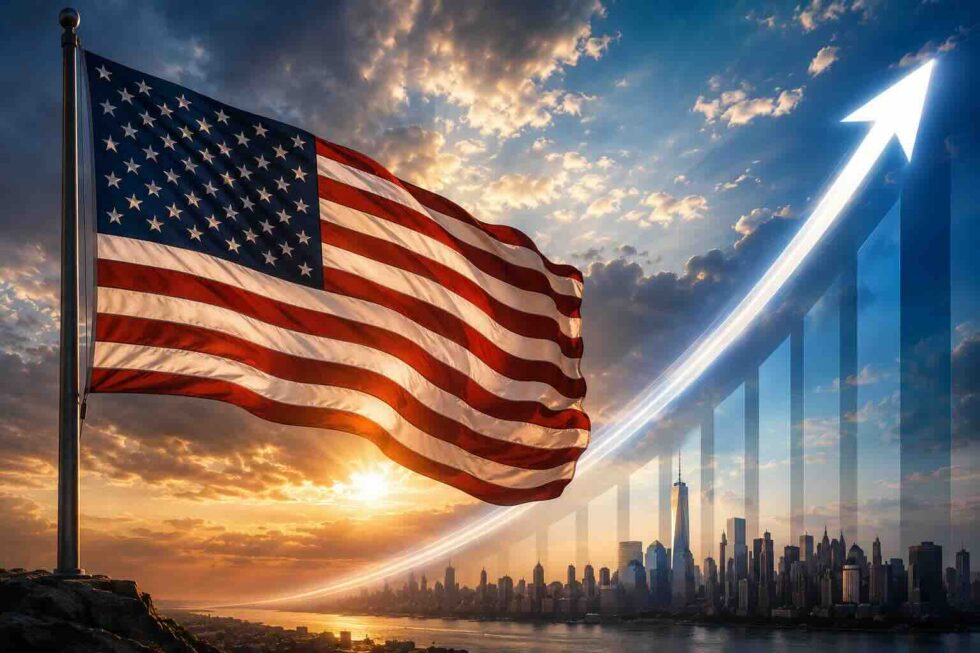
In the 20th century, the US emerged victorious from World War I, World War II, and the Cold War. Yet today many in America and abroad speak as if the country were in irreversible decline.
Some prepare for a world without American primacy; others demand that Washington restore a supremacy they assume has vanished. We beg to differ. Perhaps the problem is the angle.
America has lost ground on some measures over the past couple of decades compared to the end of the 20th century.
Its share of world output is smaller than it once was, and the dollar no longer holds the share of global reserves it held a generation ago. But in 2025, the United States still accounted for $30.77 trillion of the $118.35 trillion global economy and 33% of global military spending. In early 2026, the dollar still made up 57.13% of official foreign-exchange reserves. NATO had 32 members; Washington remained tied by treaty to allies across Europe and Asia.
Unlike in the past century, no power is defying the US global role and seeking to replace it. Some powers challenge America in this or that area, but there’s no overall competition like before.
There is more. It’s true that America’s share of global manufacturing has been declining over the past few decades, and that China has gained a chokehold on crucial primary and secondary industrial production, such as Rare Earths, capital goods, and consumer goods. But the trend can be reversed, although it will be logistically hard and costly.
In the meantime, America’s Stock exchanges account for 60-70% of all global listed markets. In other words, all people with money in the world trust America more than any other place with their wealth. The percentage increases if one includes the Stock markets of countries allied with the US, such as the UK, Japan, or Germany.
This money can fund new frontiers of knowledge and technology. All technological breakthroughs over the past 40 years have come from America. Other countries tried to catch up; some did, but none took over America’s leading, trailblazing role. America has a unique chemistry between capital, knowledge, and institutions. This chemistry is delicate, and one should be careful in tinkering with it.
China or Russia is in a more difficult position to challenge the US in this crucial arena because doing so would entail something these countries are unwilling to give up – political control over markets. They do not trust that wealthy people in China (the US’s biggest competitor) would voluntarily vote with their cash for their own countries.
The US, conversely, proves every day that people overall trust the relative transparency, fairness, and returns of Western markets. Despite some allegations of insider trading, and despite the fact that no position is unassailable and trust is a delicate chemistry, the US fares much better than its competitors. The vast majority of people with money, and by extension people in the world with their little or big savings, vote with what matters (their investments) for America.
The US may need a decade and substantial resources to reindustrialize, but no systemic change. China may need no time but a systemic change to become the world’s capital center. It’d need to become a place with freedom of information and transparency, in other words, a full-fledged democracy. Is the ruling Communist Party in China willing to embrace it, with all that it involves? China and the Party should do it; will they?
This does not look like vanished power. It looks like American power changing form.
The US system
The American system itself offers a clue. It is geared so that the president and Congress are almost chained to the same pair of oars. They can fight, delay, obstruct, and exhaust one another. Yet neither can easily own the state. Presidential and congressional elections occur on different clocks. Leaders come and go. The machine lurches, but it survives disagreement.
This serves to limit the power of Congress and that of the President; it forces Congress and the President to find a national unity beyond the necessary and virtuous differences of opinion. Unity is not imposed by force through autocratic power but must be found in the sense of a national unity.
In practical terms, of course, this is very complicated and leads to real day-to-day difficulties and to a system that often advances in fits and starts. But it has the effect, at least according to the system, of obliging everyone to be united.
It’s somewhat like the Chinese idea of the Tao as the unity of the opposites, Yin and Yang. Without Ying or without Yang, there is no Tao. In reality, this can be achieved on the basis of a shared cultural idea of what politics and the national interest ought to be. This cultural idea seems to be wearing thin, and America today appears in some way split between conflicting tendencies. Some seek Western values that no longer exist.
The system can look weak. Sometimes it is weak. But there is another side to it. Britain replaced its prime minister in May 1940 without destroying its constitutional order. Fascist Italy removed Mussolini in 1943 amid military collapse. It led to a revolt inside the regime, German occupation, national division, and civil war. Nazi Germany failed to replace Hitler by attempting to assassinate him.
The point is not that democracies always endure. They do not. Nor do dictatorships always collapse. Some build institutions that manage elites and succession quite well. Just look at North Korea. The point is simpler: a political order that can survive defeat and correction, and in which the country can thrive. A democracy possesses a kind of strength that a cult of unity can hide until the moment it breaks.
Here, it is important to make a distinction. Actually, there are two kinds of “West.”
Wests
The old “West” was not a single order but was divided into at least three parts, and then into four after the 1648 Treaty of Westphalia, all of which claimed a legacy from Rome.
Constantinople directly inherited the Roman imperial legacy, placing Christianity and its hierarchy under its protection and oversight. Its universality was challenged in 800 AD by the Holy Roman Germanic emperors, who devolved spiritual authority to the papacy. With the fall of Constantinople in 1453, the legacy split again. Moscow developed the idea of a Third Rome. Mehmed II took the title “Caesar of the Romans” after sitting in Constantinople. With the Reformation, the power of the Holy Emperor was challenged, and Europe and its Christianity were split in two by the Peace of Westphalia.
Then a new kind of “West” started to emerge, with its roots in Rome but removed from its “Caesarist” tradition.
The 1649 English Revolution, the 1776 American and 1789 French revolutions, and the Industrial Revolution produced something different. The new order spoke the language of rights, constitutional government, equal citizenship, and open exchange.
It recognized the open, liberal global market as the true central organizing principle. This system opposed and swept away all the old Western systems and founded a new Western order that has no limits of ethnicity or faith but transcends both faiths and ethnicities.
While the old West died definitively with the end of the First World War, when all three surviving old imperial systems (the Holy German Emperor, the Russian Czar, and the Turkish Sultan) collapsed, the new liberal Western system is stronger today than ever.
Of course, the liberal system is fragile and can be undermined. Fair, regulated liberal markets, with transparency in production costs and prices, took centuries to emerge and establish themselves as the norm.
Old Markets
Free markets first emerged in Italy between the 12th and 13th centuries, but by the 14th and 15th centuries they had already been undermined by capitalists, as we would call them today, who sought to close the market to their own advantage while simultaneously seizing power. Florence and the Medici family are a classic case.
Medieval Florence was a great center of trade, banking, credit, guilds, privilege, and political influence. The Medici turned commercial wealth into political power while many republican forms remained standing. Cosimo and Lorenzo did not abolish Florence’s institutions; they learned how to dominate through them.
Elon Musk is not a Medici. The comparison should not be forced. But the old question returns in a new setting: what happens when private wealth, public power, and vital infrastructure meet? SpaceX serves commercial customers, but government agencies are also major customers and development partners. NASA and the Space Force have awarded it multibillion-dollar business. Launch, satellite communications, regulation, national security, and competition with China now meet inside the same field.
That is not ordinary commerce. Nor is it state control. It is mutual dependence, and mutual dependence creates power.
Netflix shows another face of it. The service reaches more than 190 countries and regions. In 2025, 70% of viewing involved members watching titles from outside their own country. America has built something like a United Nations of culture: productions from many national and linguistic traditions can circulate through the same platform and reach audiences far from home. The power is not only in making the movie. It is also in organizing the theater.
Apple points to the same problem from a different angle. The mouse, windows, networking, and graphical computing had important roots in Douglas Engelbart’s work and at Xerox PARC before Apple’s Lisa and Macintosh. Apple did not invent all of this. It did something else: it helped turn graphical interaction into a mass language of computing and later carried that language into the mobile era.
The analogy is Renaissance perspective. Brunelleschi did not invent sight, but perspective gave European artists a grammar for organizing space. Once a grammar spreads, it begins to shape what feels natural. Interfaces can work the same way. They influence how people encounter information, what developers build, and what users expect.
This is the part of American power that decline theories often miss. A country can produce a smaller share of the world’s goods while remaining powerful in the channels through which goods, money, information, culture, and technology move. Power belongs not only to the factory owner or the army commander. It also belongs to those who build the networks, set the rules, create the interfaces, finance the exchange, and make others want to enter the system. Therefore, through these architectures, it gains and maintains trust.
America’s problem, then, is not decline. It is coherence. It needs to maintain and further gain global trust.
The country has military, financial, and technological power, cultural appeal, alliances, and institutions. Too often these move without a common political purpose. Retreat would not merely reduce commitments; it could weaken the systems America helped build and leave more room for rival models. But power without restraint can also destroy trust. Leadership cannot mean obedience.
Unity through contradictions
The new West now has a de facto definition that is political, not racial or geographic. Its unity doesn’t come from silencing contradiction; it comes from airing them and finding a way to let them grow stronger together. It comes from the ability to argue, correct, replace leaders, and remain one political community.
This shows that America is still—or perhaps more than ever today—the great force in the world. Of course, it exerts this force by breaking through the old boundary of what the West used to be, grown from the Mediterranean basin, and expanding it to the whole world.
It occurred with a sense of greater freedom and tolerance that the new West discovered precisely with the American and French revolutions. To give up this reality, this force, this victory, today would seem madness. Moreover, one risks doing so by seeking a false unity and giving up a deep and genuine unity.
America also needs a particular kind of confidence. A free republic must criticize itself. But self-criticism is not the same as self-repudiation. If every exercise of power is treated as hypocrisy and every achievement as disguised domination, a country can lose the will to defend anything at all.
The myth of American decline mistakes transformation for the disappearance of power itself. America remains present throughout the systems by which much of the world communicates, trades, invests, watches, builds, and organizes. Its power is less like an emperor on a throne and more like the room’s architecture.
That can be a great advantage. It can also become a great danger if America no longer knows what the room is for. The task now is not to restore a vanished empire. It is to understand the power already there, discipline it, and wield it effectively.
The simple awareness of America’s real power changes all political equations. If the US feels it is in decline and has to reinvent itself, anyone around it and within the US could start to run from it or attack it. If the US is self-confident for the right reasons about its place, the exact opposite will happen.



I can agree that America overall is not in decline. There are spiritual and cultural things that show signs of decline, and if left alone too long to fester, we can rise and fall as Rome did. A godless people with a lack of any moral compass can contribute to their own downfall. Historically God tolerates just so much then he rules, “enough, it stops now”. America has a lot of success even now. But as a nation we are failing in the spiritual arena, in the family, and in the community and even in the church there is much apathy. An awakening is in order. Godly leaders are trained from the cradle to the grave. If the community, the church, and the family ignore what is happening, the “world” will steal the minds of our children and destroy the real future along with everything we hold dear.
Миф об упадке Америки | Время И Мир