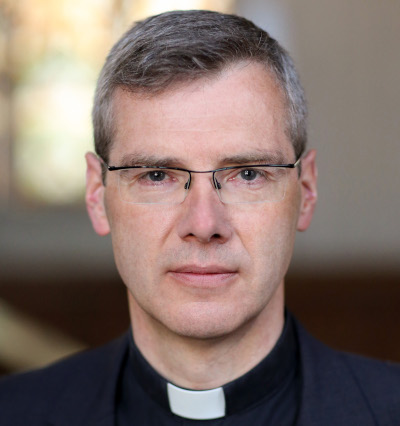




In June, the annual report on cases of antisemitism in Germany in 2025 was published (compiled by the Association of Research and Information Centers on Antisemitism). In addition to an overall increase in cases, politically motivated incidents involving the German far right increased by 60%, rising from 502 in 2025 to 807 in 2026. The Central Council of Jews in Germany stated that “in order to protect themselves, Jews are increasingly avoiding public spaces, concealing their identity and refraining from openly wearing symbols such as the Star of David or kippahs.” In this sociopolitical context, the speech by Heiner Wilmer, SCJ, bishop of Münster and president of the German Bishops’ Conference, is a cornerstone regarding the relationship between Jews and Christians in Germany and worldwide (delivered on 12 July, at the opening of the annual conference of the International Council of Christians and Jews – ICCJ).
Distinguished presidents, honorary presidents, and members of the executive board of the International Council of Christians and Jews; distinguished representatives of Jewish communities, the Churches, the academic world, and all those present who are engaged in Christian-Jewish dialogue: I am very pleased to convey to you today the greetings of the German Bishops’ Conference.
The theme of this conference — “Repentance, Repair, and Reconciliation: Religious Resources for Tumultuous Times” — addresses issues of the greatest importance at this moment. We live in a world marked by wars, conflicts, polarization, and a frightening erosion of trust. The painful conflicts of our time, particularly in the Middle East, affect Christians and Jews in a distinctive way.
They put existing relationships under severe strain. Many people today ask themselves how reconciliation can be achieved and how broken relationships can be healed. It therefore appears all the more important to keep open spaces for dialogue in which mutual listening, respect, and a shared search for peace remain possible.
I sincerely thank you, dear leaders of the ICCJ, for making this commitment your own and for creating, within the framework of this annual conference, spaces dedicated precisely to this purpose. This is part of the exceptional work the ICCJ has carried out for years in support of Jewish-Christian dialogue at the international level. With great tenacity and foresight, you are committed to building bridges and fostering dialogue. In doing so, you demonstrate that true dialogue is far more than a simple exchange of positions. It lives on trust, on personal encounter, and, not least, on the willingness to confront even the difficult questions of history and the present.
Through your commitment, you show how, out of mutual respect and esteem — while honoring every difference — a shared sense of responsibility for our society can be born. To all those who are engaged in the ICCJ with passion and expertise, and not infrequently with great personal dedication, goes my sincere gratitude. All of you gathered here today, who are committed within your respective societies to Christian-Jewish collaboration, and beyond that, at the national and international levels, make an indispensable contribution.
It is therefore an extraordinary joy and honor to welcome you to Germany for your work and meetings this year: a country in which, for historical reasons, questions concerning “repentance, repair, and reconciliation” remain of the utmost importance today. The Jewish-Christian dialogue shows that, even after the gravest of historical trials, trust can be reborn. In recent years — particularly since the conciliar declaration Nostra Aetate, whose 60th anniversary we celebrated last year — friendship, understanding, and trust have been reborn from mistrust, devaluation, and distance.
This development is among the most encouraging examples of ecclesial and social action in the postwar period. Our thanks go in particular to our Jewish partners in dialogue, who, despite the failings of the past, have once again granted us their trust and made it possible for us to walk this path of conversion.
Even though it would be presumptuous to speak of “repair” in these contexts, these experiences are nonetheless a strong sign of hope, because they clearly show that reconciliation is not a naive illusion but a concrete possibility for human coexistence.
Faced with the challenges of our time, we must not lose hope in this possibility: peace, justice, and reconciliation should not be seen as abstract, unattainable ideals but as concrete tasks to which each of us can contribute. This responsibility includes, in particular, a commitment to opposing every form and excess of antisemitism.
The growing hostility and threats against Jews in Germany and around the world cause me great concern and underscore once again how indispensable vigilance, solidarity, and resolute commitment are.
In the coming days, this conference will pay particular attention to the potential of religious resources in confronting difficult times such as those we are living through now.
May the work you are beginning here in Hanover help bring these potentials to bear once again and encourage us to take up together the responsibility for a more just and peaceful world. And may it further strengthen Christian-Jewish dialogue, one of the most precious achievements of recent decades.