


The Catholic blessing of the U.S. president may backfire as the Church distances itself from the show and grows warier of a presidency keen on using religious symbolism for electoral ends.
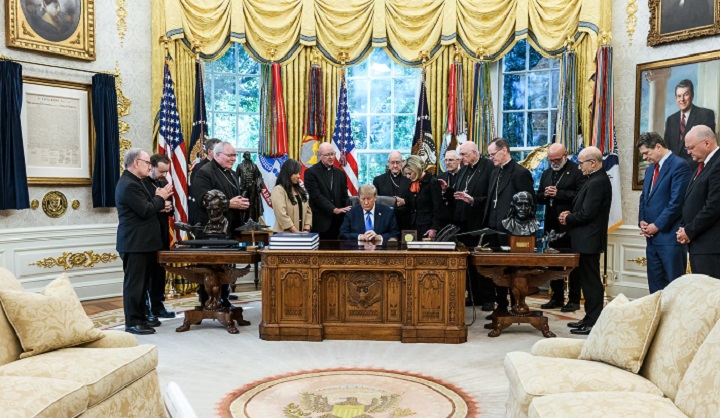
On Thursday, October 22, twelve Catholic bishops attended a meeting with the White House Faith Office at the invitation of the Heritage Foundation. Several Catholic members of the Trump administration joined them. After the meeting, the bishops were escorted to the Oval Office, where President Trump was waiting for them. They gathered around him for a moment of prayer.
Shortly thereafter, the White House posted a video online showing the bishops praying with Trump, which gave the impression that the bishops were endorsing President Trump’s Republican candidates ahead of the midterm elections scheduled for November 3. These elections will play a crucial role in determining the composition of Congress and the course of the next two years of the Trump presidency.
After the video went viral, causing considerable embarrassment among American Catholics and the bishops’ leadership, the United States Conference of Catholic Bishops (USCCB) issued a brief statement distancing itself from the event publicized in this manner: “This was not an event organized by the USCCB. It is not affiliated with the Conference.”
The White House reacted immediately through its new spokeswoman, Taylor Rogers: “President Trump has stopped the weaponization of the federal government against Christians. He has proudly defended and expanded our religious rights, pardoned pro-life activists, stopped the chemical mutilation of our nation’s children, and protected parents’ rights.” These are initiatives that may find support among the American bishops and Catholics in general.
Whether attending a meeting at the White House shortly before the midterm elections was the best and wisest decision on the part of the participating bishops remains a question. By now, it should be clear that the Trump administration has an instrumental view of American Christianity. This view is shaped by the evangelical vision of a militant Christianity that uncritically supports the president’s policies. This vision is orchestrated by Paula White-Cain, Trump’s advisor and strategist on religious policy.
Furthermore, the bishops should have considered the aggressive stance Trump and some top members of his administration have taken toward Pope Leo and the part of American Catholicism not aligned with his agenda (including many bishops).
The opportunity for dialogue to address the concerns of the American Catholic Church regarding the state of the nation, the tensions dividing American society, and issues central to the Church’s pastoral mission in America—such as the inalienable dignity of every human being, regardless of status or immigration—is important. However, the twelve bishops—especially those not aligned with Trump’s policies—should have given more careful consideration to the appropriateness of the timing of the meeting. At the very least, they were naive not to consider that the visit to the White House could have been a political trap set by the current administration.
As for the bishops who attended the meeting and found themselves in the global spotlight in a video of them praying with Trump, it’s fair to say that the meeting backfired. After some hesitation, some of them felt compelled to clarify their position and apologize for causing harm to Catholics and American citizens who viewed their supposed alignment with the Trump administration as inappropriate and inconsistent with the U.S. Conference of Catholic Bishops’ guidelines on the matter, especially in the run-up to the midterm elections.
On Friday, October 23, Denver Bishop James Golka, who led the prayer in the Oval Office, said that he had wondered whether he should attend the meeting: «I wasn’t sure what to do. On one hand, it was a great opportunity to raise important issues for the Church’s benefit. On the other hand, I knew people might be upset. Though I originally thought it would be a private meeting, I knew that it could be shared and that some might use it for political purposes. But as I prayed about it, I thought that this is what Catholics do. We pray for people. No matter whether we agree or disagree on anything, we always pray for our country and leaders.»
However, he ultimately acknowledged the ambivalence of his decision, which caused a great deal of hurt and misunderstanding among American Catholics: «I understand that many people saw the video, posted by the Administration twelve days before an election, as an endorsement. That was never my intention. The bishops of the United States teach that the Church cannot champion any candidate or party. I hold to that. However you vote, you ultimately belong to Jesus who loves you infinitely more than you can imagine. I’ve had a lot of people, really good friends, ask me, ‘What were you doing?’ ‘Why did you do that?’ (…) I’m heartbroken that people are hurt, and that there are people intentionally using this moment to sow disunity. That’s not a fruit of the Spirit. As Christians, we’re called to look beyond the headlines, which are often crafted to provoke, towards the full truth.»
Overall, Gulka’s statement remains a weak defense of his decision to attend the meeting—more of a self-justification than an actual explanation—especially considering that an American bishop should be well aware that image is more powerful than reality and that headlines determine what matters and the nature of public discourse.
More convincing is the letter “A Public Apology” written by Milwaukee Bishop Jeffrey Grob: «Over the past several days, I have received many questions and comments about the October 22 meeting I and 11 other bishops attended at the White House, which was soon thereafter publicized by the administration without the consent of the participants. Please know that my intention was never to cause confusion, anger, or disappointment among the people entrusted to my care. My hope here is to provide some measure of context for my decision to participate. To begin, the meeting was in no way an endorsement of the president, his policies, or his party. (…) We were told the meeting was to be a private discussion, that several Catholic members of the cabinet might make an appearance, and that there could be an opportunity to pray privately with the president.»
«So, following a 90-minute discussion with White House domestic policy staff and advisors, we were eventually ushered into the Oval Office. The president greeted us, took a seat at his desk and presented us with commemorative tokens. We were then directed to stand behind him and pray. After which several photos were taken and we were ushered out. Unbeknownst to the group of bishops a video was also taken. But permission for the public distribution or posting of either the video or photos was not given by the bishops. It did not take long thereafter for the White House to post a video and photos of the prayer. I soon began receiving messages of serious concern over the possibility that I had inadvertently participated in a political event less than two weeks before a national election. I also heard from some who felt wounded because of the ways they or their family had been harmed by the president’s policies.»
After listening to the voices of his people, who made him aware of the inappropriateness of his participation in the meeting and the harm it caused members of his Church, Bishop Grob offered his sincere apologies and asked for forgiveness. However, he also strongly criticized the White House for exploiting a deeply religious moment, such as prayer, as a political ploy ahead of the upcoming midterm elections – without any mention of the content of the gathering or the concerns presented by the bishops to the White House.
«I feel a heavy sadness, not only over the pain I caused, but also for the fact that something so sacred to a group of religious leaders, prayer to our Heavenly Father, would be manipulated in that way. We came in good faith to try to work for the betterment of our fellow human beings, to ease their suffering, to build up the common good, and to pray with a president, not to pose for a political photo opportunity to benefit the few. We should never have been put in that position by the White House. I did not go without reservations. I wish I had heeded them. Please know that I have heard these concerns, understand how I caused them, and I apologize for any damage my actions have done.»
Ultimately, releasing the video of the twelve American bishops praying with Trump backfired on the president and the electoral ambitions of the Trump administration officials who orchestrated this ambush against the American Catholic Church. Following this incident, the rift between Trump and many American bishops and Catholics may widen further. This incident could prove constructive for the second half of Trump’s term if he were to learn his lesson and realize that the Catholic Church’s critical stance toward certain aspects of his policies is not meant to undermine his authority as president, but rather to contribute to the common good of the whole country.



I vescovi e la trappola di Trump - SettimanaNews