



The clash between the US president and the Pope is the first for America, but not for the Vatican and Western history. A thousand years ago, by repenting, a holy emperor re-established his clout. Is there an old lesson for the modern emperors?
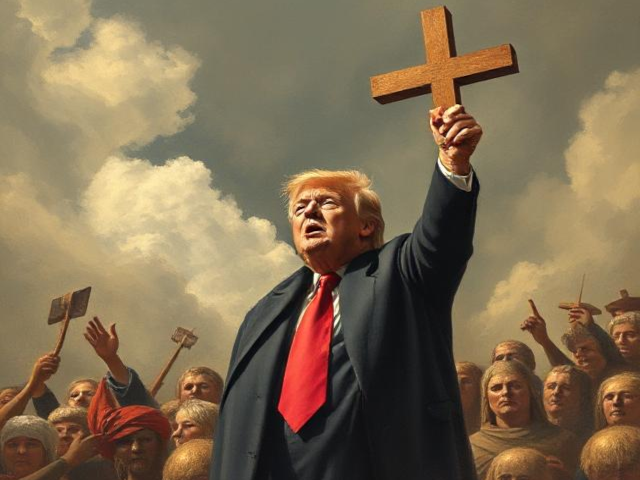
US culture was born largely Christian, and in opposition to the Pope. Still, things have changed greatly in the United States and the world in the 250 years since the proclamation of independence from Anglican England. The United States looks to the world not only as its home turf, and so does the Pope. The recent friction between President Donald Trump and Pope Leo is a global event that could have significant domestic and international consequences. History could help.
In 1077, 277 years after Charlemagne had been proclaimed Holy Roman Emperor in Rome by Pope Leo III, his successor, Henry IV, had been excommunicated. At Christmas, facing a revolt by his princes, Henry made his way to Canossa, near Rome, and waited for three nights in the snow, a penitent before Pope Gregory VII.
At the crossroads of these two episodes, European culture was born and took shape. It was the offspring of the Western Roman Empire, distinct from the Eastern one, with its capital at Byzantium. There, Constantine had proclaimed Christianity the state religion at the beginning of the 3rd century AD, after — according to legend — the cross on his legionaries’ shields had brought him victory over his rival, Maxentius, in Rome.
In 410, when Christianity had become dominant throughout the greatest empire of the age, Rome fell under the siege of Alaric. From Hippo, in North Africa, Augustine followed events as though they signaled the end of the world, and helped theorize a Christianity and a papacy capable of living and growing even without the protection of the empire. Having converted the Roman emperor, Christianity now had to speak with the new peoples — the barbarians — who were destroying the Roman empire.
This was the foundation of Charlemagne’s coronation. Indeed, between Leo III and Gregory VII, the papacy invented the Holy Roman Empire, entrusted to Germanic peoples who came beyond Rome’s ancient dominion. The relationship between pope and emperor was not hierarchical but dialectical — unlike in Constantinople, where the patriarch was subordinate to the emperor.
Augustine helped conceive the Western dialectic with the emperor. His follower, the Augustinian friar Martin Luther, in the 16th century, then conceived a Christianity pitched precisely against the emperor, and therefore against the pope. Today, the first Augustinian pope, Robert Prevost — Leo XIV — must rethink the Church also in relation to the empire of our own day: the American one, his country of origin.
What skeptics dismiss as coincidences, the Church may read as signs of Providence — and perhaps not even the president of a country as deeply Christian as America can afford to ignore them.
From Henry’s act of penitence and forgiveness at Canossa, the empire was reborn and strengthened. Does this mean that President Donald Trump must today go to Canossa and repent?
The world, however, is very different now. Around the year 1000, the Bishop of Rome navigated a complex web of relationships. There were kindred Christianities, with an important pole in the Patriarch of Constantinople; the menacing presence of Islam, still often regarded at the time as a Christian heresy; and pagan cults besieging the shores of the Mediterranean. Beyond that basin, Christianity existed only in scattered outposts —the Christian kingdom of Ethiopia and a handful of converts in the Indian subcontinent and China. The relationship with the Germanic emperor was therefore vital for the Bishop of Rome.
Today the Pope has learned and adapted through a series of historical upheavals: the Peace of Westphalia in 1648 (which marked the acceptance of Catholicism’s retreat from parts of Europe); the French Revolution of 1789 (which legitimized atheism and spread a new deism); the fall of the Papal State in 1870; the Russian Revolution of 1917 (which militantly propagated atheism); and the end of the Holy Roman Empire in 1919.
For over a century, the Pope has faced a new world, stripped of imperial protection — indeed, operating despite it. The Church’s horizon is no longer that of the Mediterranean or of the Western civilizations born from it. That West ended more than a century ago. The future is being built around other principles — born in the West, to be sure, around the free market, but having gathered ideas from across the world.
The Pope’s audience today, as never before, is eight billion people on this earth. Either the emperors and kings of our time align their aims and ambitions with those of the wider world, or they enter into friction — if not collision — with the pope. It is possible that from these clashes and frictions the pope might emerge battered. But given the current balance of forces, it seems more likely that it will be the Trump administration that has to retrace its steps and do penance at Canossa. With that act of sincere and profound penitence, Henry VII refounded the empire. History cannot repeat itself, but perhaps there is something worth reflecting on in the relationship between new empires and the pope, not only for Trump, of course.