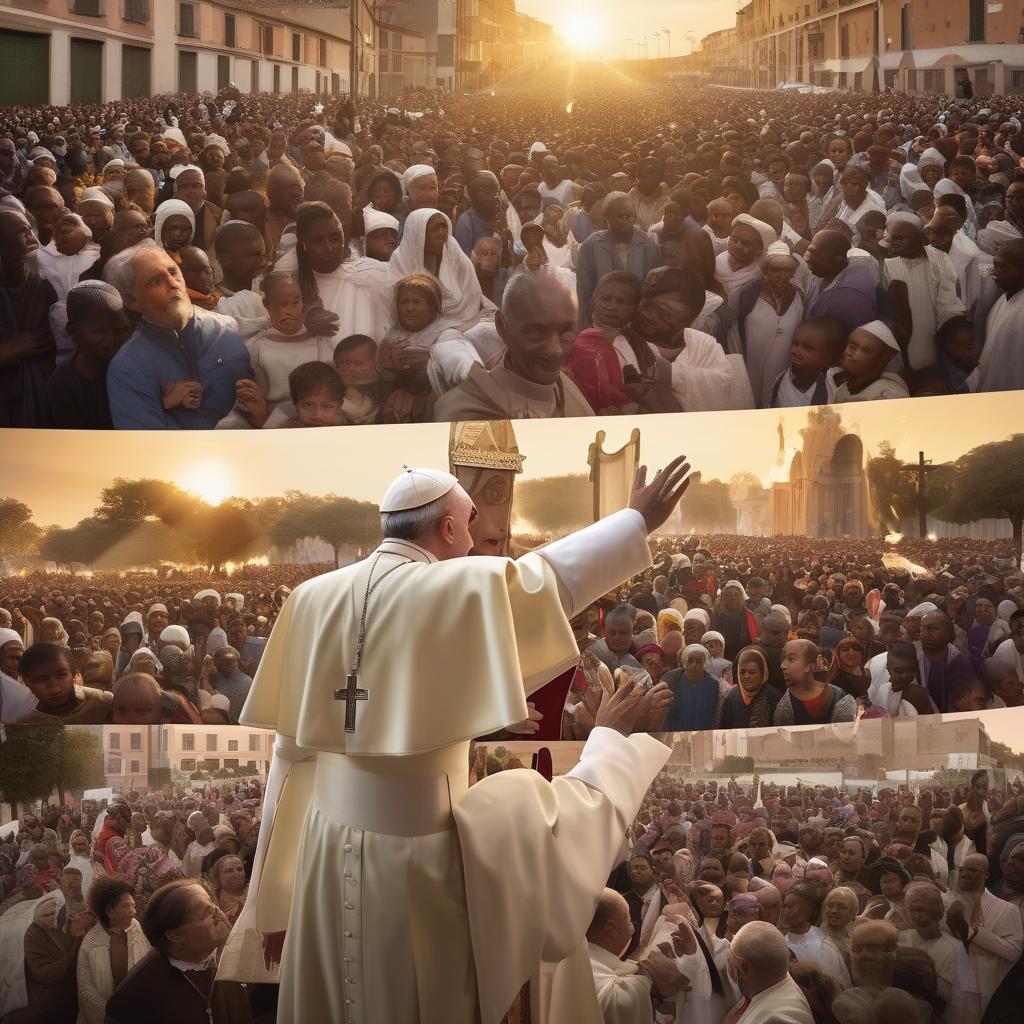



In a recent interview with Crux correspondent Elise Ann Allen, Pope Leo briefly touched on the issue of democracy, adopting an apparently negative tone: «Democracy is not necessarily a perfect solution to everything.» However, when you consider the context in which this statement was made and the subject to which Pope Leo refers, it becomes clear that this is neither a negative judgement on democracy itself nor an endorsement of the totalitarian tendencies currently evident in many democratic systems around the world. First and foremost in the United States, to which Pope Leo feels he belongs.
The theme of democracy follows Pope Leo’s extensive reflections on synodality as a means of envisioning and shaping the Catholic Church. Therefore, one cannot properly understand his approach to democracy without analyzing what he means by synodality.
According to Pope Leo, «Synodality is an attitude, an openness, a willingness to understand. Speaking of the Church, this means that each member has a voice and a role to play through prayer and reflection, and through a process.» It is an «encounter» between believers with different visions of the Catholic Church and, consequently, different ideas about its future.
Synodality therefore means viewing diversity of vision not as opposition, but as an opportunity for mutual enrichment. Diversities must meet and talk to each other in order to find shared ways of facing today’s great global challenges, both ecclesial and geopolitical. Synodality requires anyone who wants to be part of this Catholic Church to be open to «dialogue and respect for one another.»
However, synodality also represents a legitimate form of criticism of a distorted understanding of power within the Catholic Church, which sees the Church centered on «institutional hierarchy.» Synodality, in fact, does encourage the Catholic Church to think in terms of processes of encounter, dialogue and mutual listening, rather than in terms of hierarchical power. These processes generate a sense of «we together».
Understood and practiced in this way (as has been the case for decades within the Catholic Church in Latin America), a synodal Church «can teach a lot to the world today». According to Pope Leo, synodality is «a sort of antidote» to the growing polarization that divides peoples and nations.
This is where the issue of democracy comes in. On the one hand, synodality is not, for Pope Leo, a tool for transforming the Catholic Church into a «democratic government.» However, if we examine how Pope Leo interprets synodality as the center of gravity of the Catholic Church, we can observe that actual synodal practices can reactivate central aspects of democracy within our political systems and the balance of the world order that are being dismantled by today’s polarized factions.
On the other hand, Pope Leo observes the functional limitations of today’s democracy: «If we look at many countries around the world today, democracy is not necessarily a perfect solution to everything.» Every word carries weight and must be understood to grasp the meaning of democracy for Pope Leo.
Today, in many countries around the world. Perfect solution to everything. The current state of democracy is being judged, not democracy itself as a method of governing people — the only one we have found so far that is capable of guaranteeing citizens’ real freedom, safeguarding human beings’ fundamental rights and calling every citizen to their duties before the social body to which they belong.
Democracy is, of course, a historical value, not an absolute outside the time of human life. But precisely for this reason, it must be safeguarded and cultivated with extreme care, passion and attention. If we consider the situation in many countries around the world today, it is clear that the next step beyond democracy does not lead to greater freedom for all, but rather to the domination of a select «few when everyone else is suffering.»
Therefore, Pope Leo’s realistic critical view of the global state of democracy does not mean he is departing from it. This is not because Pope Leo has «high hopes for human nature. There are bad actors, there are temptations. On any side of any position, you can find motivations that are good and motivations that are not so good. And yet, to continue to encourage people to consider higher values, the real values, that makes a difference. You can have hope and keep trying to push people and say to people, let’s do this in a different way [i.e. not in a polarized way. We have to continue to remind ourselves of potential that humanity has to overcome the violence and hatred that is just dividing us more and more.»
Democracy stems from this potential of humanity, and today we are faced with the task of saying to ourselves: let’s try to do democracy all together in a different way.