

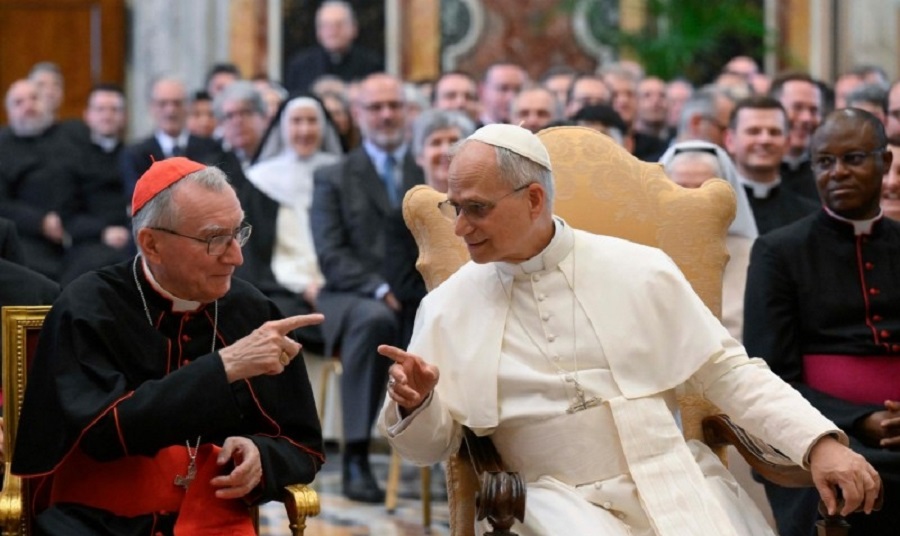
Yesterday, Thursday 5 June, Pope Leo XIV met with the staff of the Secretariat of State of the Holy See. Marked out by a cordial and grateful atmosphere, this was perhaps the first programmatic act of the new pontificate.
The reform of the Vatican Curia launched by Pope Francis has remained suspended, mainly due to a lack of operational guidelines. The speech given yesterday by the Pope to the staff of the Secretariat of State may represent the beginning of a new phase in the recent reform of the internal offices of the Holy See.
In the words of Leo XIV, the dynamics of the reform of the Vatican Curia implemented by Paul VI and Francis are intertwined, with the former, that of Pope Montini, functioning as the operational principle of the latter. The Secretariat of State is thus clearly entrusted once again with the role of “coordinating the other dicasteries and institutions of the Holy See”.
The two structuring elements around which Pope Leo XIV stated the task entrusted to the Secretariat of State during his pontificate are those of the incarnation of God in human history and the universality of the Church in its mission for the world’s sake – of peoples and nations. The result is a dynamic vision, immersed in the dramas and joys of humanity, of the function of the Secretariat of State – which must respond to «emerging needs both within the Church and in relations with States and international organizations».
According to Pope Leo, the operative force that unites the Petrine ministry and the activity of the Secretariat of State must be that of synodality. A synodality that has to be affective and operational: «I am comforted by the knowledge that I am not alone and that I can share the responsibility of my universal ministry with you. (…) It is evident to me that the Pope cannot work alone. There is a great necessity to relay on the assistance of many people in the Holy See, and in a special way on all of you in the Secretariat of State. I offer my heartfelt thanks».
Incarnation, on the one hand, requires the Catholic Church to be able to mediate the Gospel «through today’s cultures and languages»; on the other hand, the universality of the Church’s mission requires it «to appreciate different cultures and sensibilities». These two forces require fidelity to human history and a continuous commitment to weaving the threads that make it a common and shared history.
Of these operative forces, for the Church and for the world, the Secretariat of State must be a place of synodal synthesis: «Incarnation reminds us, then, of the concreteness of reality and the specific, particular issues dealt with by the various curial institutions. At the same time, universality evokes the mystery of the multifaceted unity of the Church and subsequent effort of synthesis to assist the Pope’s mission. It is precisely the Secretariat of State that offers this service of unification and synthesis».
Three fundamental lines clearly emerge to define the mandate of the Secretariat of State: 1) it is an institution (made up of people) alongside the Pope, that assists him in his ministry and work; 2) it is responsible for coordinating the activities and orientations of the offices of the Holy See; 3) in order to achieve a synodal synthesis of the Church’s mission in the world able to actualize the incarnation of God for the sake of all humanity – a mission to which the cultures and sensibilities of peoples/nations can contribute in a constructive manner.
In this way, the function of operational principle and synodal guidance that Pope Leo XIV entrusted to the Secretariat of State within the Vatican Curia is clearly stated. On the other hand, there is full awareness that the fulfilment of this function requires considerable commitment and ability: «I know that these tasks – the Pope said to the staff of the Secretariat of State – are very demanding and, at times, may not be well understood. This is why I wish to express my closeness to you and, above all, my heartfelt gratitude. Thank you for the skills you place at the service of the Church, for your work, which almost always goes unnoticed, and for the evangelical spirit that inspires it».