

China or Russia might be betting on the wrong horse in Ukraine and Europe. They overlook the complexity and depth of the US relationship with its allies. The new Hannibal bet.
October 14 could be a pivotal moment for Europe and America. SpaceX abruptly imposed a speed cap on Ukraine’s Starshield service without warning Kyiv, disrupting many battlefield operations, including mid-range drone strikes and air defense. The US platform Starshield had been vital in coordinating and spotting Russian targets for Ukrainian attacks.
Only a few days later, after a wave of protests in America and Europe, the service was basically restored, and in Washington, officials blamed each other for ordering the disruption. The episode could be a turning point in transatlantic relations. It shows a large majority in both America and Europe supports Ukraine, while some opposition parties in Europe and parts of President Donald Trump’s administration are lukewarm about Kyiv.
Brynn Tannehill[1] argues that:
“The Starshield decision was likely meant to pressure Ukraine into complying with US demands to stop hitting Russian oil facilities, so that the president could be seen as bringing fuel prices down before the midterm elections. But why, then, would the administration call for Starshield to be switched back on?… Messing with Ukraine’s defensive capabilities doesn’t cause problems for just Kyiv: Poland and Germany supply and pay for Ukraine’s Starlink and Starshield terminals, and these are directly pertinent to Poland’s defense. Russian drones have repeatedly breached the Polish border… The episode signaled something that many American allies already feared: that U.S.-made military technology could become a liability to those who depend on it… The incident puts all American allies on notice: Developing homegrown technology, however expensive, may be better than relying on SpaceX and the United States. (italics mine)
The episode prompted China’s semi-official commentator Hu Xijin[2] to write:
“After Zelenskyy’s break with Trump, if he can survive politically, and if Ukraine’s war machine can continue to function even with reduced U.S. aid, and if the Ukrainian front lines do not collapse, this would not only be a major victory for Zelenskyy, but also the beginning of Europe’s true political and military independence. This war was originally seen as Ukraine’s ‘war of independence’ to free itself from Russian influence; going forward, it may become ‘Europe’s war of independence.’”
Hu is stating an obvious alternative: by pushing Ukraine, against its will, into a compromise with Russia, the US risks losing Europe to Russia. Worse, the US could lose Europe without gaining Russia and, in doing so, lose itself.
It’s a matter of life and death for the US, more than for Ukraine. Ukraine could keep fighting even without US intelligence and deny Russia a military victory; the US might lose its allies, a mainstay of its power for 80 years.
Post 9/11 doldrums
But something very real lies behind this controversy. Trump is grappling with the US’s difficulty leading Europe. This stems from a deep strategic misalignment between US and global interests, which has long- and short-term causes. The US post 9/11 policies in the Middle East created a gap in understanding and assessment of international politics, China, and the Middle East. The controversial Trump presidency has widened the gap.
In a nutshell, the political and economic dividends of WWII and the Cold War are gone; the solidarity for 9/11 is history. The US needs a clear platform to pursue its strategic goals.
It doesn’t have the platform. Without it, pushing around allies and friends doesn’t work. That’s for ethical reasons (countries won’t just cave because the US is stronger; the US needs to provide a reason) and because the US squandered much of its massive clout (political, economic, and prestige).
This poses short- and long-term choices for both the US and its allies. The choices are not clear-cut, partly because there is no alternative to the US. In WWII or the Cold War, the Allies had a clear alternative in the fascist Axis and the communist Third International. They presented all states with an alternative order, a fascist or communist dictatorship to lean on.
Now, neither Russia nor China offers an alternative order that Europeans or Asians can join. Their deal is: minor states must accept a new ‘semi-colonial’ status in return for marginal benefits. They argue that the US is doing the same, but badly, promising and then breaking its promises every time. Therefore, the US is unreliable, while Russia or China are better because they are trustworthy.
If this narrative gains traction, the US is done for, as Trump, with his sudden changes of heart, is far less reliable than chess-master Russian President Vladimir Putin and Buddha-like Chinese President Xi Jinping.
Many Chinese love to repeat Kissinger’s quip: it’s dangerous to be America’s enemy, but to be its friend is fatal. The oracular statement from the American statesman that helped shape decades of US policy is interpreted to mean there is only one way to survive with America: be its enemy; it’s less risky than being its friend.
But if this narrative were true, why would Trump be upset with NATO, America’s leading military organization, and try to twist its allies’ arms? And why doesn’t the Trump administration own up to its decision to switch off Starshield?
The reality is that the US does not give its allies a ‘semi-colonial’ status. The US offers its friends a seat at the table, starting an intricate, dialectical relationship in which the US must work to keep its allies in line, and the allies, in turn, must work to maintain their ties with the US. It’s neither a straightforward hierarchical nor an equal relation. It needs a lot of bilateral management.
Some Chinese may think (or wish) that a conflict between the US and its allies will destroy the alliance and the ‘American Empire’. The opposite may be true. After the controversy, the ‘American Empire’ could be stronger than ever.
American Socii
The US and its allies have a relationship similar to Rome’s with its allies, the socii, who even fought against Rome for equal ties, not to destroy the Roman Empire. They did so after most stood firm with Rome against its mortal enemy, Carthage, in the 2nd century BC, roughly when China was first unified under Emperor Qin Shi Huangdi.
It’s a complex but crucial historical and logical sequence. After the wars with its socii (91-88 BC), following Rome’s victory over Carthage (146 BC), the Roman Empire thrived for centuries. The socii had preferred Rome to Carthage. It could be dangerous for China to confuse reality with wishes. A year ago, I wrote[3]:
“The US’s present socii don’t want to topple America. But they require their strategic interests to be considered. Some in Washington may see allies as a headache. They are troublesome, but more dependable than vassals who betrayed the USSR, like Yugoslavia, China, and Albania, during the Cold War. The USSR had to let them go or force them back with tough invasions, such as in 1956 in Hungary, in 1968 in Czechoslovakia, and in 1979 in Afghanistan. In the end, the last invasion of Afghanistan failed and brought down the Soviet Empire.”
The Russian invasion of Ukraine was an attempt to reimpose the old Soviet pattern and force satellite states back in line, and it failed. Ukraine is now, for Russia, almost what Afghanistan was for the USSR. Moscow knows it; it’s desperate and trying everything it can to forestall what looks inevitable: Russia’s disintegration, like the USSR’s.
Most people in Europe or America don’t want Russia to disintegrate. It could be very risky. But trying to avoid it can’t go so far as to jeopardize the US alliance system and thus the US itself. America needs to find a balance that its people and its allies can stand by.
On the other hand, the US is very different from Russia. Presently, despite all of Trump’s Sturm und Drang, a US invasion of the UK, Germany, or Canada, like Russia invaded Ukraine, is unthinkable. Even the more modest ‘invasion’ of Greenland petered out.
If it did happen, it would mean the US really imposed a semi-colonial status on its allies, changing the world’s political chemistry and the US-Russia or US-China relationship. But this scenario doesn’t exist yet, despite some forces in Europe and America pushing for it. So far, it’s like the few Roman socii who sided with Hannibal; they didn’t change the balance of power.
What is on the table is a strained, unhappy relationship that the US needs to fix first to re-establish its leadership. Or it could charge ahead like a bull in a china shop, destroying everything. Or it won’t make a clear decision, wearing down the current situation and creating more confusion.
If the United States finds a new direction, things could get back on track, and relations among the US, Europe, and other allies could become stronger than before, based on new understandings. Moreover, the expected confusion after the midterm elections could push the US to refocus on new relationships with its allies.
There may be signs that this is indeed happening. Ambassador Joseph DeTrani[4] quoted the US Secretary of State as saying recently in Athens, “We must rebuild our institutions and our alliances to face these threats together,” and commented, “Mr. Rubio’s message was clear: Western nations are at a critical point, facing a choice between maintaining global leadership and sliding into ‘atrophy and servitude and decline.’” The ‘Western nations’ are intended as US friends and allies.
China can pursue its wishes, risking exchanging them for reality. Or it could try to deal with reality, and that may lead to very different conclusions
Or the history and present politics tell a different story, so I’m watching mirrors and shadows. If so, US allies are set to bend the knee to Russia or China, putting America under siege.
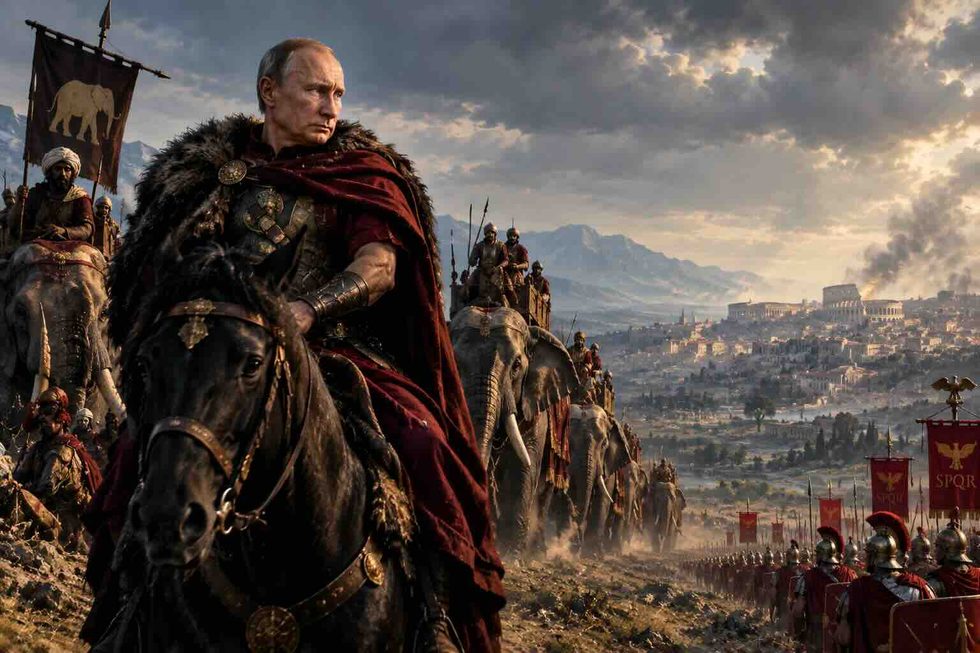
It’s the old Hannibal’s bet.
The Carthaginian general Hannibal Barca spent 16 years (from late 218 BC to 203 BC) campaigning on the Italian peninsula during the Second Punic War, hoping the Roman socii would turn against Rome and that the Roman Republic would collapse. They didn’t. Conversely, Roman consul Scipio’s much shorter campaign in Africa (from 203 to 201 BC) broke Carthage’s alliances and its republic.
In a nutshell, the Hannibal game was Putin’s bet at the start of the Ukrainian invasion. Five years later, Europe and America haven’t collapsed.
[1]https://www.theatlantic.com/international/2026/10/starshield-ukraine-military-technology-vulnerability/689035/
[2] https://x.com/HuXijin_GT/status/2111137479663476928?s=20
[3] https://www.appiainstitute.org/articles/america/socii-tensions-in-america/
[4] https://www.washingtontimes.com/news/2026/oct/13/us-pushing-europe-chinas-arms/