


The US and Iran have reached a plateau where they could really negotiate, as the power balance in Tehran evolves. Meanwhile, China’s game could be at a turning point, and the Pope is in it.
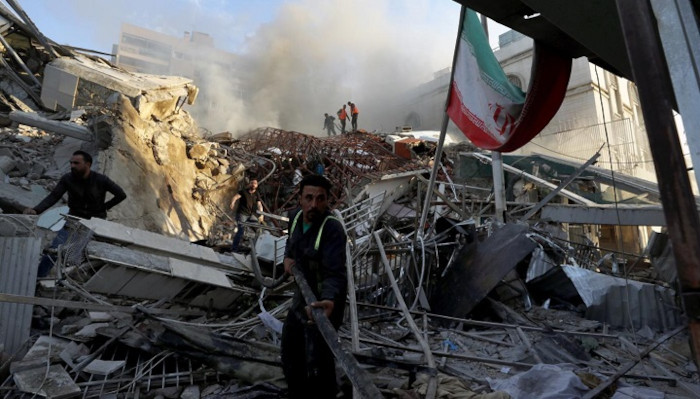
In a twilight between war and peace, Iran may not yet have found its new dimension. The nation is in a special moment after the death of its supreme leader, Ayatollah Ali Khamenei, six weeks of crippling bombing, and the blockage of the Strait of Hormuz, the global energy gateway conditioning world prices.
The Economist reported (here) that the Iranian delegation quarreled among themselves to the point that the Pakistani had to intervene to mediate. Almost two months after his demise, Khamenei’s funeral has yet to be scheduled. The event would be a statement about the country’s future. The lack of a date means the new leadership doesn’t know what to say about it, and it’s bitterly divided.
The newly appointed leader, Khamenei’s son, Mojtaba, is allegedly seriously wounded, in hospital, and nowhere near the steering wheel. The local leaders, allowed to make decisions in the event of the top leadership’s decapitation, aren’t eager to surrender their newly acquired power.
Iran declared it would open the Strait of Hormuz, and a few hours later, it announced it would close it again.
Iran is in deep disarray. There are deep divisions, and thus there’s little hope for a swift and lasting peace. But in parallel, there are also grounds for hope in a regime’s evolution, if not sudden change. In fact, as the US has come to recognize, regime change in Iran has already happened. A process has started. Now patience is needed. The US has little reason to prolong the attacks.
At the same time, Iran needs to sort out its domestic confusion. A continuation of the war in this chaos wouldn’t solve the problems; it could make them worse.
The present situation was reached because of mistakes by both the US and Iran, proving a basic tenet of Clausewitz’s theory of war: It’s necessary to recognize the culminating point of victory and stop there before turning things around, before victory turns into defeat.
The US should have stopped it a week, ten days after killing Khamenei, before Iran blocked Hormuz. The Iranian blockade turned the tide, giving Tehran the initiative and a win.
Iran then made a similar mistake: it should have opened Hormuz a few days after closing it, before the US intervened and ended the Iranian blockade. Iran’s blockade is theoretical; they have not effectively stopped or sunk any ship crossing the Strait. Their blockade serves as a scare, prompting insurance companies to hike premiums and making shipping companies hesitant. Iran should have stopped after the scare, preempting US intervention.
Conversely, the US blockade is more real; they have had a recent experience in Venezuela, where they choked oil shipping, and they can do the same with Iranian oil.
Iran can try to raise the stakes once more, but they hardly have an escalatory edge. They could be better off bargaining now, as they are still standing and have a few cards to play.
Also, the USA may not want to overreach. War is uncertain, and as we saw, victory can easily turn into defeat after the point of culmination.
In theory, there’s a balance to be found. The Gulf States are pressing for it, as the old balance has collapsed. The world, hooked on oil, needs it or its economy will crash.
China and the Pope
This scenario calls in the elephant in the room, China, where Presidents Donald Trump and Xi Jinping should meet in May.
Not siding with Iran (unlike what it did in Ukraine, Gaza, and Venezuela) gave China the highest returns, although many in America dispute that China was actually neutral. Some in China saw the war as an opportunity to advance the internationalization of the RMB against the US dollar. Beijing stresses the importance of the petrodollar as one pillar of American power.
As explained in a recent Chinese Phoenix TV report (see here), Beijing believes US power rests on three pillars: military strength, technological preeminence, and financial markets. China is credibly catching up with America in technology and military. In these two fields, China has made great strides over the past 20 years and has narrowed the gap with the United States.
Where it has instead lost ground over the past 20-30 years is in its financial markets. Here, it inherited a special position with Hong Kong. Thirty years ago, Hong Kong was one of the three leading financial centers in the world, along with London and New York. Today, it is lagging behind both Tokyo and Singapore, even within its own region.
The petrodollar system works because oil-producing countries can not only convert their revenues into dollars but also freely intervene in the United States’ open financial market. China is no alternative from this point of view. The RMB could, in theory, serve as an alternative to the US dollar. Given that it is not freely convertible and that China lacks an established financial center, the petrodollar might remain unchallenged in the foreseeable future.
But it’s not the end of the story.
Freedom is fundamental for the Stock Market. Lawsuits against the press for bias when it is critical of the US president, accusations by the press against the US president of acting against press freedom, and suspicions of systemic insider trading in America all poison the wells of the basic freedom of a fair market.
Without this freedom, China can become — or appear — more reliable. Its RMB, backed by a state that thinks long-term, can be more credible than the dollar. Today, freedom in general — and therefore the market as well — is, in practice, spearheaded by the authority and freedom of the Pope and the Church, who stood up in a poised and authoritative manner against some recent intemperance by the US administration.
Here, China could have a leg up and could catch up with the US. It needs freedom to improve its financial markets. After all, money is what wins wars, and without well-oiled financial markets, any technological or military catch-up is doomed. Beijing should work to improve ties with the Holy See, but this is hardly happening. Besides, the Vatican, to preserve its freedom, can’t move towards China at the slightest wink from Beijing, which is hardly more credible than Washington when it comes to freedom. Certainly, the Vatican has an interest in improving ties with Beijing, but not at the cost of damaging those with Washington.
Everybody has an interest in patience. But the game is very complicated, and many may lose patience, leading to very serious problems in the near future. The US, with its notorious temper, could be worse off than China, with its famous temperance. Character could mean a lot. But characters can also change. The Pope is patient and American.