



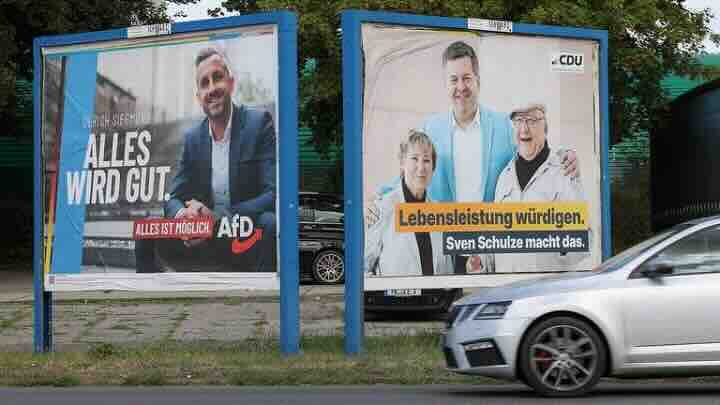
The vote in Saxony could be a turning point for all of Europe. It risks isolating Poland and spinning it into a loop of fear. The German Catholics need to step in to prevent a major crisis.
The week leading up to the election in the German state of Saxony-Anhalt (September 6) begins with a date that is part of Germany’s collective memory. On September 1, 1939, Hitler’s Nazi regime invaded Poland. In light of polls predicting an unprecedented electoral victory for the far-right Alternative für Deutschland (AfD, projected at around 40%), the date is no longer merely a symbol but a turning point.
Among its foreign policy platform points, the AfD aims for a decisive rapprochement with Russia — with all the consequences this would have not only for relations between Germany and Poland but also for the overall stability of Europe.
Cultivating a political friendship with Russian leader Vladimir Putin would mean sealing the tomb on the difficult and still-unfinished process of reconciliation between the two countries, the two peoples, and the two histories. The Catholic Churches of Poland and Germany have been the protagonists in this risky reconciliation.
+++
In the mid-1960s, as the Second Vatican Council was drawing to a close, the Polish bishops, with evangelical boldness and prophetic politics, wrote to their German counterparts. They extended a hand to begin reconciliation between peoples and nations. Thus began a painful journey, also marked by internal controversies in each country over the critical assessment of their own past. Nevertheless, it led to a gradual rapprochement and the necessary clarifications.
If parts of Germany are now seeking to abandon this process by reaching out to Putin, it is the German Catholic Church that must assume the political role of preserving the 60-year-long practice of peacefully reconciling memories and lived experiences.
At this moment, Polish Catholicism should be one of the central concerns of the German Bishops’ Conference. Poland, surrounded by “hostile” countries—Putin’s Russia on one side and a possible AfD-driven Germany on the other—would further destabilize the threshold uniting/dividing Western and Eastern Europe.
The risk of Poland’s complete absorption into the mindset and political action of the “Visegrad Group” could be one of those contradictory outcomes that only politics knows how to generate and nurture. At this moment, the Polish Catholic Church must be offered not just moral support or courtesy visits, but real collaboration. It needs to bring forth the tools of evangelical and historical discernment to prevent it from becoming the backbone of a national realignment that, by distancing Poland from Europe, would leave it at the mercy of its most feared and hated enemy—Russia.
+++
After the elections on September 6 in Saxony-Anhalt and on September 20 in the city-state of Berlin, an extremely delicate phase will begin for the German Bishops’ Conference. It will be called upon to clearly identify its most urgent priorities—even if this means temporarily setting aside long-cultivated internal projects.
There is no other institution that can begin weaving the fabric of a Central European alliance, within and beyond Catholicism, to imagine and build together a positive way out of the crisis of liberal, representative democracy. The Vatican must understand that, right now, the German Catholic Church needs the internal freedom of mind to take up this pastoral, social, and political project of uniting Central Europe’s best spiritual and intellectual resources.
+++
The AfD feeds on and organizes precisely the worst fears among citizens. It presents them skillfully and, in many cases, constructs them out of nothing as virtual realities that don’t actually exist. It can do all this because large segments of the German population are, in fact, no longer politically represented on the country’s current political scene. This accumulation of the “forgotten,” resentful, rightly or wrongly, has found its political condensation in the AfD. The other German parties’ serious difficulties not only risk radicalizing citizens by pulling them onto the AfD’s own guidelines, but ultimately confirm the AfD’s necessity, casting it as the real solution to the country’s and its people’s problems (real and imagined).
In the AfD’s federal platform and in those of the states now heading to the polls, there is more than just the well-known themes of “remigration” and open hostility toward anyone who doesn’t share the “German matrix” as the party defines it.
One could start with schools and youth hardship. In brief, the platform calls for an end to socio-pedagogical practices in both areas: performance and discipline in schools; and the wholesale criminalization of youth hardship, with the age of criminal responsibility lowered to 12. Regarding schools, in the name of a not-yet-attained religious maturity, it demands that (Muslim) girls under 14 not wear the veil. It calls for homogeneous grouping based on student performance, not just within individual classes but across entire school complexes.
This would transform today’s social diversity in Germany—stemming from the presence of different cultures, languages, and ways of life—into a mirror-image social divide among “true Germans,” based on an elitist notion of merit that would exclude a large part of Germany’s young population.
This group would indeed be excluded, but not forgotten, since it would be propped up with a series of ad hoc subsidies and services designed to satisfy it and make it more acceptable that it no longer gets to decide its own fate or its own participation in the country’s life.
There is also the elimination of educational and social inclusion for children and young people with learning disabilities, cognitive impairments, or other disabilities. For the AfD, placing them in school alongside “normal children amounts to discriminating against the latter by preventing them from moving swiftly along the path to success or total failure.
This social group too would be excluded but not forgotten: it would have its own spaces, of course, its own subsidies, its own privileges. But these would be sustained on the logic that they must not disturb or slow down children and young people capable of delivering measurable results that they themselves cannot provide.
+++
This economic policy of placating the excluded, so that they don’t feel forgotten and don’t become a subversive force against AfD policies, amounts to a practice of public welfare dependency built on generous handouts from municipalities, states, and the federal government. In other words, the excluded citizenry is being bought off to pacify it electorally.
The AfD is the creation of a certain way of doing politics in Germany since reunification onward—the result of selective economic policies pursued by the parties that have shaped Germany from the end of Nazism to today.
It is, in a sense, the nemesis of what these parties should have been but chose not to be. These parties continued to draw on the “forgotten and unrepresented” as if they stood with them. But over the years they grew more distant from the people. Now these parties find themselves face-to-face with all the anger such people carry—ready to tear down, without hesitation, the very system that produced them. They are ready to remain on the margins, to be irrelevant, used and excluded by a Germany now slipping into the hands of the party built on their resentment.




Futuro Nero? - SettimanaNews