


The AfD’s victory stems from many unresolved issues since unification. The President of the Conference of Bishops calls for addressing the cultural and social roots of the problem.
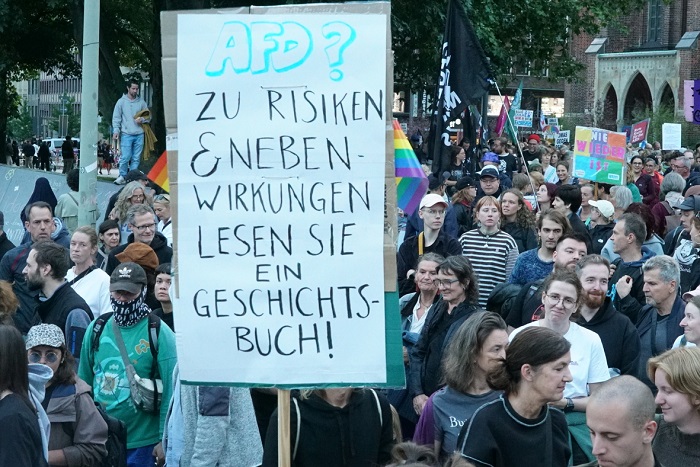
The Alternative für Deutschland’s (AfD) overwhelming electoral victory in Saxony-Anhalt casts a long shadow over the stability of German constitutional democracy. The events unfolding in Germany, Europe’s leading economy, which rose from the ashes of the Nazi regime and absorbed the severe social and economic consequences of the collapse of communism, directly concern not only the European Union but also the world.
The events of Sunday, September 6, 2026, culminate a long journey that began on November 9, 1989, with the fall of the Berlin Wall—a moment filled with hope and promise. The failure to fulfill these hopes and promises in reunified Germany fueled resentment, fear, and disillusionment among the population of the former East German states, upon which the AfD has built its political success step by step.
***
However, it would be a mistake to view the AfD solely as a regional phenomenon confined to the eastern territories and the population that remained there. This population gained civil liberties while paying the price demanded by the logic of the market and neoliberal finance. Freedom comes at a cost. It exposes us and demands that we educate ourselves. Otherwise, as with the people of Israel in the biblical Exodus, the slavery of the past looms as the best solution for today.
The mistake of the West German “locomotive” was to view the East through its own lens and imagine that the mimetic effect would produce a unified Germany by itself. This did not happen. Germany remains a divided nation, albeit united under a single sovereignty.
It is precisely the enormous cost—not only financial—of this stalled reunification that is sowing the seeds for more or less explicit support of the AfD, even among the population in the West. The commercialization of the Enlightenment ideal of freedom instills in citizens the desire to free themselves from anything that hinders optimal performance, competition, and individual success—whether as individuals or social classes. The AfD’s political rhetoric skillfully presents the party as the representative of opposing factions of the German citizenry. When a party becomes the unifying force between opposing sides of the social conflict, supported by both, its rise to power may extend beyond the old borders between West and East Germany.
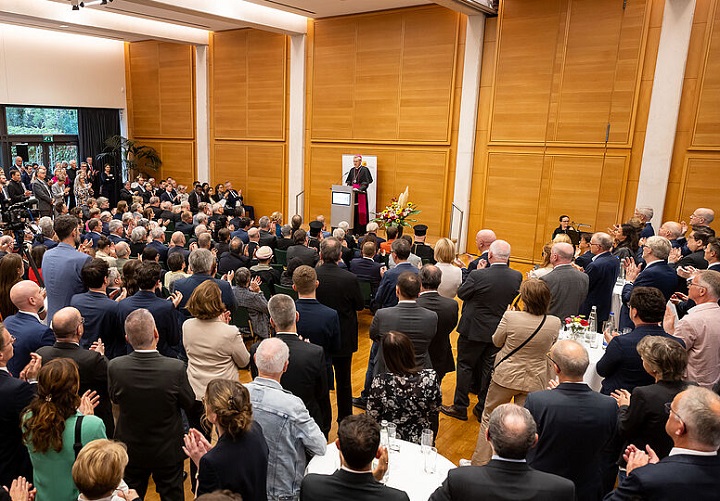
If one institution in Germany has clearly perceived this possible outcome, it is the Catholic Church. On September 9, just three days after the election results in Saxony-Anhalt were announced, Bishop Heiner Wilmer, president of the German Bishops’ Conference, took a clear stance on the current situation in Germany, both politically and socio-culturally.
This occurred during the traditional reception organized by the German Catholic Church in Berlin to mark the opening of the parliamentary year. Addressing politicians, as well as representatives from finance, business, culture, and various churches and religions, Bishop Wilmer identified the mechanism by which freedom erodes itself paving the way for a democratic exit from democracy: «Maybe the loss of freed does not start when we are no longer permitted to take decision, but in fact much earlier. We delegate our judgments: the path that we take, the news that we read, the reality that we perceive. And at some point, the insidious thought present itself: The machine will surely know what the right is for me, won’t it? This gives rise to an uncomfortable question: What happens to a democracy when the people in it forget how to reach an opinion? The temptations of our time don’t come in the shape of dictatorships. They come along claiming to offer us convenience and superficial efficiency.»
***
When democracy is understood solely as an institutional procedure, a mechanism through which citizens delegate their freedom and responsibilities to representatives in Parliament, this form of political coexistence among the people begins to suffer. For Bishop Wilmer, it is therefore important to rediscover and properly nurture the original setting of democracy: the «street» with its myriad daily encounters. The biblical concept of truth, which is not merely «a statement, but also includes the fields of meaning, reliability, constancy and loyalty», can play an important role in shaping a new democratic model in Germany. «A society needs precisely this dimension of truth: not only verifiable information, but also trust in the reliability of shared foundations.»
The AfD threatens this «trust in the reliability of shared foundations» because it envisions a Germany that turns its back on the post-Nazi constitutional order. More importantly, its political rhetoric amplifies the dissatisfaction some people feel about the current state of the Federal Republic’s common foundations.
The Germany that might emerge from this would be an unknown (and probably unreliable) quantity for the entire world. By saluting the local victory, American President Donald Trump cast a vote of no confidence in the federal government democratically elected by the German people. It could backfire against the US. Not all European right-wing parties, particularly the French one, view the AfD’s electoral gains favorably.
Amid the void of political wisdom, the libidinal trivialization of the duties of freedom, and the deconstruction of the foundations of trust, the German Catholic Church presents itself not only as a guardian of the democracy we have inherited, but also as an active participant in a new democratic experiment at the heart of Europe.
«The elections in Saxony-Anhalt three days ago – said Bishop Wilmer – showed drastically how a radical political party was democratically legitimized by the will of the electorate and with a clear majority. In common with many in this room, I too am speechless in the light of this electoral result, at least at first. But I am determined as to what to do: The AfD has been proven to be nationalistic and “folkist” (völkisch). There is no room for such ethno-nationalist ideas, either inside or outside houses of God, not in Christianity, not in Judaism, not in Islam. I very much hope that the truth will set us free here too, will reveal the hollowness of the slogans and take the magic out of electoral promises which are bereft of any realistic foundation. As a Church, we are not withdrawing. On the contrary: We talk back when fear is played off against solidarity. We talk back when people are brought into conflict with one another. We talk back when democratic institutions are weakened. This is neither leftist nor rightist. Our standard is neither party politics, nor ideology, but the Gospel and the inalienable dignity of each human being which it entails. And yes, we may and we must also complain from time to time.»