


by Flavio Lazzarin
Should we return to Ithaca or travel to understand the other? Should Homer or Lévinas accompany us on the journey? A movie, a poem, and a fundamental question in modern times
Christopher Nolan’s film The Odyssey, based on Homer’s celebrated poem, has sparked numerous reactions, at times polemical ones. It once again, after 3,000 years, reveals the poem’s capacity to engage with and challenge the present.
How Many Ulysseses in History
This is nothing new. If we think of James Joyce’s Ulysses, embodied in Leopold Bloom, a navigator through the scorching and banal themes of modernity — in an odyssey that coincides with everyday life — and of the radical overcoming of the obedient, submissive Penelope by the emergence of the rebellious, resentful Molly Bloom, there is no trace in Joyce of nostalgia or of a search for a return to humanity’s traditional order: God-fatherland-family.
Then there’s Stanley Kubrick’s 2001: A Space Odyssey, in which the goal of the journey is not an Ithaca situated in the past, but rather a future that is unknown and yet technologically attainable.
Amid the diversity of modern interpretations of the figure of Ulysses, however, one common denominator prevails: Ulysses is the symbol of Western reason, of Greek origin. Dante himself, in the Comedy, describes a Ulysses who seeks to know everything, transcending every limit: “You were not made to live like brutes.”
In the 20th century, the most famous philosophical interpretation appears in Dialectic of Enlightenment: for Adorno and Horkheimer, Ulysses represents the emergence of the modern rational subject who, though seduced by the sirens’ song, nonetheless surrenders to reason to control himself and administer the world.
It is a reading of an Apollonian Ulysses, almost in radical opposition to the Nietzschean interpretation, which underscores his Dionysian vocation, whereby, like Zarathustra, he does not intend to know himself but to create what does not yet exist. For Nietzsche, in fact, “becoming who we are” is the fundamental principle. This is not a matter of recovering a lost identity but of producing a higher form of oneself.
The Modern Ulysses
In our time, in the modern Ulysses — a figure of humanity that surpasses itself and seems to be winning in the spaces of power, knowledge, and money — we are witnessing the delirium of transhumanism. There’s the idea that human beings can and should expand their physical, cognitive, and even emotional capacities through technology, in order to pass from the human to the post-human, through genetic engineering, artificial intelligence… a radical extension of life.
Yet the present sociopolitical circumstances show, once again, the paradigm of Ulysses crystallized within his own Ithaca: broad sectors of Western societies are living through, with traumatic nostalgia, the traditions that once wove together the social order.
Ulysses, caught off guard by the “melting into air of all that once seemed solid,” is fatally condemned to the exercise of an oppressive and even more violent power.
In this case, nothing remains of the Greek paradigm of rationality, nor of the Roman paradigm of the rule of law. Yet the continuity of a Greek legacy that subjugates and eliminates the other — seen as barbarian, poor, woman, indigenous, black, foreigner, migrant, homosexual, transgender — seems nonetheless undeniable.
Nothing remains of the universalist perspective — opposition to every form of tribalism — that once flourished within various strands of Marxism, an inalienable fruit of the Enlightenment adventure, which never fully freed itself from colonialist Eurocentrism: a universalism that has grown quite faded, even on the Left.
Lévinas’s Ulysses
This context brings me to Emmanuel Lévinas’s reading of the figure of Ulysses. For Lévinas, Ulysses is the poetic version of the “Aristotelian principle of identity and non-contradiction,” the foundation of that Western philosophy which has always concerned itself with affirming identity and difference (diastasis) in relation to any form of otherness: A=A; A≠B. This is the legacy left to us by Parmenides, the inspiration behind the Platonic system, who, by affirming the primacy of being over the materiality of the world, founded the hierarchical anthropological dualism of the soul as a superior instance and the body as something inferior — a paradigm which, reinterpreted and popularized by Christianity, still permeates the Western world.
Lévinas — a conservative Jew with Greek credentials — penetrates Greek philosophical territory, riding the horses of Ulysses and Diomedes, introducing an existential and gnoseological alternative, Semitic and biblical, to Greek-Indo-European hegemony. I am not demonizing the Greeks nor sanctifying the Jews, because just as the Greeks had their barbarians, the Jews had their goyim.
For Lévinas, Ulysses symbolizes the coercive movement of returning to oneself: after so many adventures, his identity becomes unshakeable and incorruptible because he returns to Ithaca.
Ulysses represents the philosophical tradition that transforms reality into something assimilable and reducible to the ego, thereby reducing otherness to what is already known. The different is welcomed only in order to be understood, integrated, and ultimately brought back to the “I.”
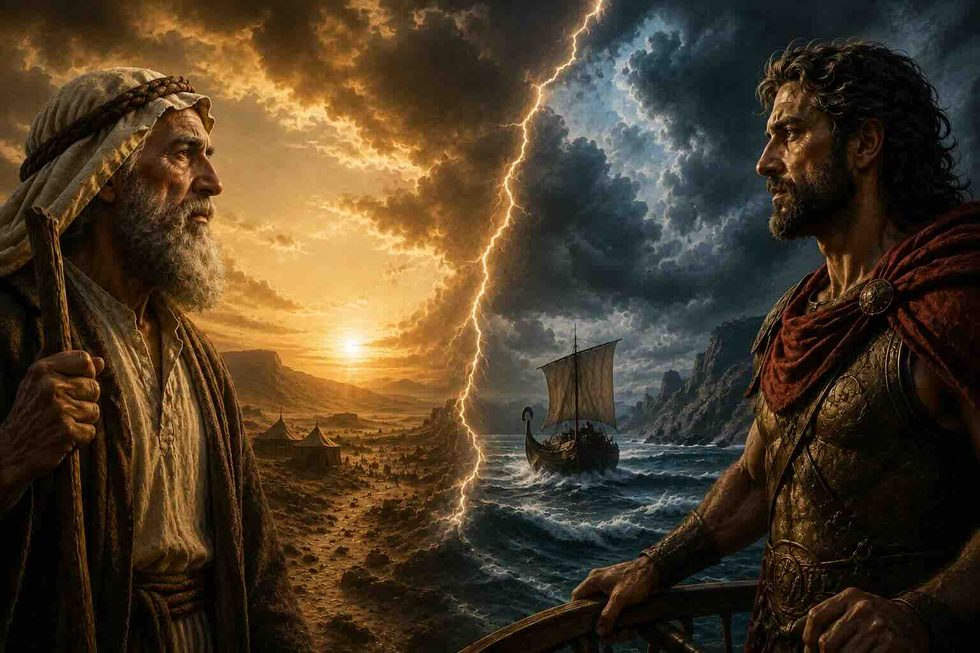
The alternative is the figure of Abraham, who neither remains nor returns to his own land, but travels into the unknown, responding to a call that leads him to encounter the Other, even amid conflict.
Nietzsche made an analogous attempt by choosing Zarathustra as an alternative to the Apollonian Ulysses. If, instead of emphasizing the theological differences, we focus on the existential dimension of the paths taken by these two figures, Abraham and Nietzsche’s Zarathustra turn out to be quite similar.
Both move away from their former way of life, abandon what is known, endure an exodus marked by unpredictability, uncertainty, and danger, and become strangers, often neither understood nor recognized in their own surroundings.
What sustains the two paths is, naturally, different: in Abraham’s case, trust in God; in Zarathustra’s, trust in his own capacity to create meaning. Both, however, symbolize the human being who must abandon one world so that another may be born.
The radicalism of the Lévinasian reading, however, goes further than the Nietzschean perspective. Abraham symbolizes the fundamental ethical disposition: stepping outside oneself, escaping the traps of the West, adopting a stance of contemplation, and welcoming the face and the trace of the Other. Instead of incorporating what is different through the cognitive process, we can allow ourselves to be called into question by an otherness that remains forever mysterious and irreducible.
For Lévinas, ethics is first philosophy. Instead of starting from the question “what is being?”, the initial question becomes “what is my responsibility in relation to the face and the trace of the Other?” In short, Ulysses asks: “How can I understand the other?” and Abraham answers: “How should I respond to the other?” Before the face of the Other, an implicit ethical commandment challenges me: “Thou shalt not kill.”
I would like to pose one final question, to which I find no answer either in Nietzsche or in Lévinas: when the Other — that irreducible otherness which calls me to ethical responsibility — becomes a homicidal and genocidal threat, might the appeal to the commandment “thou shalt not kill” appear insufficient?
Lévinas himself struggled to come to terms with the violence of the State of Israel against the Palestinians. His philosophy offers tools for criticizing every form of dehumanization, including that practiced by states —yet Lévinas himself did not always draw out all the consequences of that position.
If We Listened to the Gospel
This contradiction is evident in Christianity’s examples across every season of Western history. Consider the philosophical and theological positions of Augustine, Aquinas, and the entire scholastic tradition on war. Consider the complicity of both Catholic and Protestant Christianity in the violence of colonization. Consider the centuries-long persecution of Jews as “Christ-killers” and the naturalization of the long era of the enslavement of Africans.
We would be mistaken, once again in the manner of the Greeks, to seek an answer within theologies marked by the ontological paradigm, whereas we would be right and on safe ground if we followed the counsel of Francis of Assisi, who tells us that the Gospel is the only reading capable of guiding our path.
The living word of the Messiah — Jesus of Nazareth — is given to us so that we might meet him, silently hidden within the crosses and the hopes of the poor, in the blood mingled within his cosmic chalice with that of the victims, the prophets, and the martyrs. Who are, after all, the Other who extends a hand, who challenges us and calls us to acceptance, to the recognition of dignity and compassion.
It is not the seductive sirens that put us to the test and awaken our controlling, ordering rationality, drawing us back into a past that no longer exists; it is the “little ones,” the insignificant, the mikroi — those who helped Jesus himself encounter, once again, both himself and the One who had sent him.