




Trump’s presidency is the latest development of a long way where those “left behind” rallied for a new messianism that changed the old deism of the framers and ushered in a new religious-political wave of the US.
Currently, judgment seems to prevail over understanding when it comes to the United States. However, without understanding, judgment could become nothing more than an emotional reaction to the policies implemented by the Trump administration. There is here an underlying and illusory assumption that once Trump is gone, everything will return to normal, or at least to a superficial level of normality.
Rather than being the instigator of this state of high geopolitical instability, Trump has been its ruthless accelerator, removing the fig leaf behind which we tried to hide the decline of the legal, political, and diplomatic instruments that characterized the post–World War II era.
Following the dispute Trump initiated with Pope Leo XIV, even non-American bishops and Churches have found their voice to express their opinions and judgments about today’s United States and its administration. A little bit too late, and their tone is essentially rhetorical rather than analytical. Also statements of theologians with whom the United States is familiar don’t offer much help when they are permeated by resentment over a love gone bad.
Left Behind
Therefore, before being judged, the United States and its Catholic Church deserve an attempt at understanding.
The first step is to overcome the illusion we secretly harbor. Trump is not a problem in and of himself but rather the outcome of a long and complex social, cultural, and political process that has been underway in the United States for decades. Trump’s electoral base is not a collection of madmen who have suddenly lost their political senses but rather a segment of the citizenry that has experienced the 20th and 21st centuries as an unjustly imposed punishment—and sometimes with good reason.
The weakening of social bonds and the consequent loss of a sense of community and closeness within shared living spaces is a phenomenon that has been underway since the 1970s. This has been accompanied by the slow disappearance of spaces for socializing together among different social classes and groups of diverse cultural and ethnic backgrounds. This process of deconstruction has been observed, yet no effort has been made to create alternatives aimed at building a new shared sense of belonging. This phenomenon has been amplified by the high mobility of U.S. residents, primarily for employment or educational opportunities.
This dynamic has reinforced a characteristic of American residential and social culture: clustering into identity-based enclaves that facilitate living in a nation characterized by strong cultural, ethnic, linguistic, and religious pluralism. This social insularity followed a sort of tectonic movement where plates drift apart and come together, causing outcomes ranging from friction to conflict with every shift.
A sense of loss of identity has become the driving force behind the search for belonging, which could find an extremely effective emotional placebo in mirrored sameness (a mechanism reinforced by the algorithmic logic of new digital communities). In this social dynamic, the American Catholic Church is not without fault, beginning in the late 1980s. First and foremost, it has internalized the logic of the culture wars and organized itself accordingly, rather than presenting itself as a sociocultural space where these conflicts could find resolutions and reconciliation through dialogue and respectful engagement with the perspectives of others. The synodal practice of believers coming together, strongly desired by Pope Francis, seeks to constructively remedy this situation today.
These are also the decades in which a liberal-democratic cultural mainstream emerged. Beginning with the legitimization of the civil rights of Black Americans and culminating in the acceptance of the privatization of rights aligned with the value orientations of a segment of the citizenry without heeding the voices of those who struggled to find themselves within them.
This “left-behind” group endured the imposition of liberal culture primarily through legal means, a process that found its symbolic culmination in the 1973 Roe v. Wade Supreme Court ruling. But that is not all. Following this ruling and others that transformed personal desires and needs into law, a form of public and academic discourse emerged that was intolerant of any dissent or different value system. For decades, for example, one could not speak of abortion in America without being stigmatized and pigeonholed into the “pro-life” category. One could not discuss the numbers or possible social policies to reduce them. Paradoxically, the period during which the United States experienced the most significant reduction in abortions was during Obama’s second presidential term.
Obama was a resolutely pro-choice president who implemented a policy of economic investment in welfare through Obamacare. This policy had the most significant impact on an issue at the heart of the culture wars and the values of those who had been left behind and did not feel represented by the liberal mainstream. To stay in the realm of paradoxes, the number of abortions has begun to skyrocket again due to the complete dismantling of the Obama administration’s welfare and healthcare package following the ruling in Dobbs v. Jackson Women’s Health Organization (2022)—by a Supreme Court designed by Trump in part to achieve this legal outcome. The former “left-behinds” achieved a formal victory by overturning the landmark ruling of the liberal cultural era. However, they lost in substance, so only a handful of wealthy individuals and an even smaller group of digital magnates can truly celebrate the end of the Kennedy brothers’ era.
The group of Americans, now orphaned of liberal victories, should have learned something from all this. Today, it finds itself in the uncomfortable position of becoming the new “forgotten” group in the Trump era. However, much remains to be done to begin this learning process and write a new page in American history.
A recent event illustrates the situation on this other side of America well. During a panel on “Christian Nationalism” at the last annual meeting of the American Academy of Religion, a colleague—speaking of those who are not like him (though he actually meant “us”): liberals, Democrats, the enlightened, and those in step with the times—made a somewhat gratuitous remark: “Can you believe there are still people in America who think there are only two genders?”
His smirk and derisive tone revealed not only this segment of America’s inability to learn but also their lack of touch with the reality the nation produced by electing Trump to a second term. He spoke of these “people”—who have triumphed politically and culturally after decades on the fringes of the liberal and democratic world—with arrogance and disrespect. He acted as if those who believe there are only two genders were not worthy of being recognized as fellow citizens.
He did not realize that his tone and mindset were identical to those of plantation owners in the American South before and after the Civil War. His contempt for “them” resembled that of many white Americans in the 1950s and 1960s toward emancipating African Americans from racist social and cultural structures.
Institutions
Trump can do what he is doing because he has been placed in institutional and sociopolitical conditions that allow him to do so, and this did not happen overnight. His second term has likely dealt the final blow to an institutional system that has slowly become distorted over the past few decades. Today, not only does this system no longer function as the Founding Fathers of the U.S. Constitution envisioned, it has also become dystopian.
Congress is the institution where this process of deconstruction is most emblematic. It was artificially revived by the recent Constitutional Court ruling on tariffs but remains comatose regarding the far more serious question of who in the United States has the power to declare and initiate a war.
For the framers of the Constitution, Congress was an institution of identity for its members, rather than a gathering place for political parties. In other words, loyalty to Congress’s constitutional duties took precedence over compliance with party lines. This is the basis on which the fragile system of checks and balances, upon which the American democratic experiment rests, can function effectively. In short, the “legislative power” and the other constitutional prerogatives of Congress were conceived as powers standing on their own, distinct from the executive power of the president and the interests of the parties to which members of Congress are affiliated.
Congress was thus conceived as an institution responsible for controlling and restraining the executive branch and as a political agency in its own right, distinct from political parties. Within this framework, the congressional procedure now called “bipartisan” has developed over time. However, its meaning is not what we commonly attribute to it, namely a compromise agreement between the two represented parties, but rather the effective exercise of legislative power as an autonomous political agency that expresses its political subjectivity through that procedure—an alternative to the other branches and the parties.
The framers conceived this approach to prevent the American president from becoming the hated King of England, from whom they had definitively emancipated themselves by enshrining their distinctiveness in the Constitution. Despite ups and downs and varying degrees of effectiveness, the U.S. Congress remained faithful to this prerogative for nearly two centuries. Then, gradually, a “partization” of Congress began—that is, House and Senate representatives became increasingly dependent on their respective political parties. One reason for this departure from the original design is the skyrocketing cost of election campaigns. This binds elected officials not only to the lobbies that financed their campaigns, but also to their parties, which invest huge sums of money to elect them.
Members of Congress thus lost the autonomy necessary to make Congress an institutional political agency in its own right. The situation could worsen if the Supreme Court accepts the Republican Party’s petition to consider consolidated party budgets for election campaigns as protected by the “right to free speech.”
This partisanship introduces a “parliamentary democracy” dynamic within a democratic institutional framework that is not parliamentary. This could compromise its constitutional functions of oversight, scrutiny, and autonomous political agency (and, if necessary, an alternative to the other branches of government), creating a profound and dangerous disarticulation of the American institutional system.
Another dynamic has emerged as a logical extension of this one: it partially turns members of Congress who belong to the party of which the incumbent president is a representative into a legislative arm of the executive branch. Congress would no longer represent the body against which the institutional identity of its elected representatives is shaped. Having been replaced in this role by their respective parties, Congress would be no longer conceived as an alternative power and a check, if necessary, to the presidential executive branch. Instead, Congress would act as a legislative transcriber of the incumbent president’s political will.
Without Congress’s long history of departing from its original constitutional function as a truly autonomous political agency with legislative power independent from the American president’s executive power, Trump’s current unchallenged actions would not be possible.
The question of judicial power, particularly that of the Supreme Court, in Trump’s America must be analyzed within this dystopian outcome of Congress’s legislative power. Here, too, the current president inherits long-standing traditions and adapts them to fit his vision of the presidency. Unlike the continental tradition, the judiciary is a political office at the state level in the United States. At the federal level, however, it is an extension of the executive branch’s policies. Therefore, it is inappropriate to categorize the current situation of the judiciary as the politicization of judges and state attorneys because the American legal system is conceived as a political agency, further distinguishing it from Congress, the parties, and the executive branch. As a third political agency, the judiciary balances, evaluates, and corrects executive and legislative policies.
While Supreme Court justices are appointed by the president, they must pass Congress’s scrutiny. To the extent that Congress becomes the presidential longa manus rather than an autonomous political agency, the justices of the Supreme Court also become potential executors of executive policies. This is potential because the Supreme Court’s institutional identity has enjoyed the capacity to shape the judicial body of which it is composed for longer than Congress. In the mythology of the American experiment, the Supreme Court is encircled by a sacred aura. Its task is fascinosum et tremendum—to keep the nation and its institutional system within the framework of the Constitution.
The justices of the Supreme Court are the true priests and priestesses of the American Constitution. Their ministry is accompanied by sacred symbolism and a veritable procedural liturgy. The power one holds upon entering is certainly alluring. Once attained, it is not easily relinquished to profess anti-constitutional docility to the sitting president. This power is potentially “supreme.” The current Supreme Court has swung like a pendulum between affirming Trump’s conception of executive power and offering some formal restraint against its excesses.
A decisive moment could be the Supreme Court’s ruling on citizenship by birthright, which Trump wiped out with one of his first executive orders after more than two centuries. After relinquishing its “supreme” power to Trump with the ruling that granted him immunity—even for acts that effectively violated the Constitution—and somewhat restoring its credibility with the ruling on tariffs, the Supreme Court now finds itself in an extremely uncomfortable position. In deciding on citizenship, the Court must choose between becoming a legal vassal of the executive branch (like the Congress) or reaffirming its prerogative as the supreme guardian of the Constitution, even in the face of presidential interference. In the last case, the Court would become part of the “rogue power” system Trump described, which dares to oppose him.
After all, Trump has publicly declared that he will tolerate no limits on his presidential power, stating that he has no limit other than his conscience in exercising executive power and making related decisions. While this statement is tolerable at best for citizen Trump, it is charged with subversive potential capable of upending the American institutional system when uttered by President Trump.
The Construction of Messianic Power
Even regarding Trump’s unprecedented attack against Pope Leo XIV, a long groundwork was laid upon which it took root. This is not only because the United States has previously refused to comply with requests from the Pope and the Holy See regarding the choice of diplomatic channels over war. Indeed, this has been the case from Reagan through Bush Sr. and Jr., precisely with the pontiff most in tune with the values of the Republican administration in terms of opposition to liberal hegemony (John Paul II). But also because the American experiment has been characterized from the beginning by religious and messianic allure.
Overseas territories appeared to offer abundant prosperity and were viewed as the biblical land of “milk and honey” flowing beyond necessity. This self-understanding of territories becoming the nation echoes in the inalienable rights granted by the Creator to new American citizens, perceived as self-evident truths: “life, liberty, and the pursuit of happiness,” inscribed in the Declaration of Independence’s preamble.
Of course, these rights are granted only to white, English-speaking, Protestant males, not to all human beings. Native Americans, women, and enslaved people of color were excluded from this chosen category. From the colonists onward, this becomes a sort of new people of God. The nation’s path to emancipating itself from this “original sin” would be long, constantly facing the possibility of returning to the original conditions of racial and gender exclusivity. Today, this possibility is not so far-fetched, at least in the imagination of some of Trump’s supporters.
Two religious matrices lie at the foundation of the American nation and would accompany it throughout its two-and-a-half-century experiment: philosophical deism, which unfolded primarily along the legal-constitutional axis; and a sense of identity as a Christian nation, which permeated the overall atmosphere of American society. These two principles, sometimes in tension with each other and sometimes working together, continue to influence the imagination of large segments of the American population and guide the various political and legal doctrines that have shaped its history. In a sense, they function in relation to one another much like the institutional system of checks and balances, checking and limiting one another.
This is why their conflation becomes possible precisely at a time when that systemic framework has entered a state of crisis. President Trump’s decision to “rededicate” America to God on May 17 “as a nation under God” moves in this direction. Those called upon to speak at the “National Jubilee of Prayer, Praise, and Thanksgiving,” part of the 250th anniversary celebrations for the Declaration of Independence, are all Christian, except for Rabbi Meir Soloveichik. Absent are all non-biblical faiths, the religious expressions of Native Americans, traditional Protestant churches, and churches that are historical expression of Black Americans—as well as Islam.
In this Trumpian version of the “nation under God,” the original matrix of deism is equated with the God of the Christian nation. This dramatically restricts the space for effective citizenship based on non-Christian religious freedom. This religious spectacle, to be celebrated in the symbolic heart of American institutions (the National Mall), has a messianic quality. Trump organized it to establish himself as the leader who will guide the nation back to the true God after its exile into secularity, forced by the secular ideology of liberals.
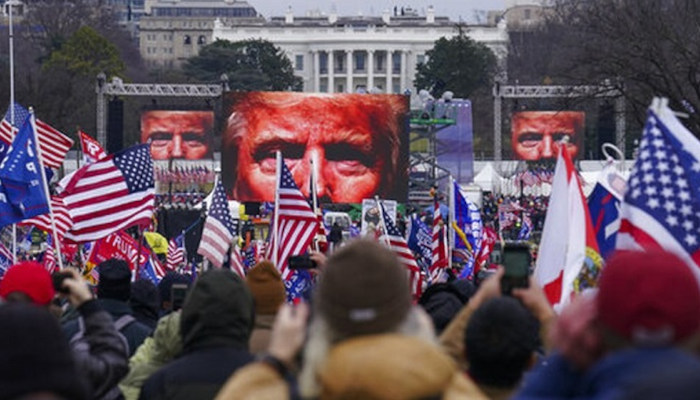
However, Trump could not have conferred this messianic mission upon himself without the legal construction of a necessary premise. In Trump v. United States (July 2024), the Supreme Court granted Trump absolute immunity for actions concerning the core of his presidential powers and presumptive immunity for all official acts, regardless of their content—including the instigation and support of the attempt to storm the U.S. Capitol in Washington to prevent Biden’s presidential election.
The “immune” one is separated from the rest of the community to allow him to lead without impediment—except that of remaining under God. This is messianic power—certainly not that of Jesus, but rather, that understood by his disciples, not only those of that time: “Jesus began to explain to his disciples that he must go to Jerusalem and suffer greatly at the hands of the elders, the chief priests, and the scribes; that he must be killed and on the third day be raised to life. Peter took him aside and began to rebuke him, saying, ‘God forbid, Lord; this will never happen to you’” (Mt 16:21–22).
The difference between Jesus’s messianism and that of his followers is an opening through which the aspiration to messianic power has found a way in from the very beginning. This internal Christian tension has spanned every era with endless variations—right up to the version shaped by President Trump. Pope Leo XIV’s polite but firm opposition denounced the reappearance of a political interpretation of Christian messianism, which is in stark contrast to the words and deeds of Jesus.
Trump’s entourage’s reaction was clumsy but revealed the true crux of the matter. When Vice President Vance, a Catholic, decided to instruct the Pope on his role (one favored by the current U.S. administration), he asked the Pope to “focus on matters concerning the Church” and to “be more cautious in theological matters.” In other words, according to Vance, Pope Leo XIV should not concern himself with worldly matters because they fall outside his jurisdiction. Conversely, the Trump administration’s messianic power not only allows it to discuss religion and theology, but also legitimizes its actions in the world in the name of God.
The great instigator of the American experiment, which, under Trump, will rediscover its original mission, is no longer the God of the deistic tradition, but rather, the Christian God, who has anointed and set aside his Messiah in the person of the current president. Through Christian iconography 2.0 and, in one instance, Catholic imagery, Trump announces his messianic mandate to refound the nation and select its chosen people. Those who seize the moment and recognize the messiah will establish the true American people, just as early Christianity emerged from the chosen people of Israel two thousand years ago. The “rededication” of the American nation to God celebrates the beginning of this new people in power and strength at the heart of the secular sanctuary of the American experiment—certainly not in the seclusion of a small upstairs room where God becomes food for humanity, so no one need be sacrificed in his name again.
The Catholic Church in the United States
Two dates encapsulate the transformation of the American Catholic Church’s relationship with Donald Trump and his reconstruction of American greatness: On January 6, 2021, in the face of an attempt to subvert the presidential election won by Biden—the second Catholic president in U.S. history—the U.S. Conference of Catholic Bishops remained completely silent, issuing no statements or official interventions. Only a few individual bishops denounced the act as an attempt to undermine the U.S. Constitution. On February 26, 2026, the USCCB filed an amicus brief with the Supreme Court in the case of Barbara v. Trump, arguing for the right to US citizenship by virtue of ius soli. The brief challenged the constitutionality of President Trump’s executive order that revoked this right based on a narrow interpretation of the citizenship clause of the 14th Amendment.
The brief states that it is «inspired by the teachings of the Catholic Church, including the fundamental conviction that every person is endowed with inviolable dignity and that all human life, created in the image and likeness of God, is sacred. From this perspective, the Church advocates “treating people with humanity and dignity” (Pope Leo XIV). These teachings extend to immigrants in the United States without legal status and to their American-born children. Pope Leo XIV repeatedly emphasized that the dignity of all people—including immigrants and children—must be respected. The Friends call for a comprehensive and humane approach to migration that ensures respect for the God-given dignity of all people».
What are the reasons for this shift in direction by the American Catholic Church? The reasons must be sought in the differences between Trump’s first and second terms. His first presidency presented itself as a possible foothold for the part of American Catholicism that did not identify with liberal culture or the values. It also presented itself as a clear partisan stance in the culture wars that U.S. Catholicism has internalized for decades. This segment of American Catholicism saw the possibility of winning the culture wars and definitively establishing itself as the American Catholic world within the Catholic Church itself—a success partially already achieved thanks to the episcopal overrepresentation enjoyed by this segment of Catholicism across the Atlantic. This explains the credit granted to Trump, which outweighed any personal moral issues or legal concerns.
Trump’s first executive actions in his second term touched on issues that the American Catholic Church has always considered central to its participation in the life of the country, despite deep internal divisions. These issues include undocumented immigrants, peace and war, and the United States’ geopolitical role in international relations. In a few short days, Trump shook the foundations of these three crucial areas of American Catholicism: mass deportations of undocumented immigrants coupled with revoking citizenship by birthright, launching a tariff war, and threatening to annex Canada and Greenland. He also upended all institutions of international relations, replacing them with the logic of the strongest—even threatening a lightning war in Venezuela and a far more intricate one against Iran.
Even the Catholic bishops most sympathetic to Trump have wavered and begun to publicly express reservations in the face of this overture to a second term. These include Military Ordinary T.P. Broglio, who questioned the lawfulness of immoral orders and opened the possibility for Catholic soldiers to refuse to carry them out; Cardinals B. Cupich, J.W. Tobin, and R.W. McElroy, who declared the immorality of a foreign policy pursued through war and expressed concern over damage to the United States’ image in international relations; the ten border bishops who wrote a letter opposing repressive and violent policies toward undocumented immigrants; and the U.S. Conference of Catholic Bishops, who wrote an amicus brief on the issue of citizenship rights.
Following Trump’s recent attack on Pope Leo XIV, Monsignor R. Barron of the Diocese of Winona-Rochester—the Catholic bishop most closely aligned with the Trump administration and a member of the Commission on Religious Freedom established by Trump (along with Cardinal T. Dolan, former Archbishop of New York)—has been compelled to intervene. He declared the inappropriateness of the president’s remarks against the pope and asked Trump to apologize to Leo XIV.
Another difference between Trump’s first and second terms is the pontiff himself: Following Francis, with Leo XIV, the Catholic Church has, for the first time, a Pope who is American. Through an implicit Vatican practice, the election of Prevost made the United States a matter for the Holy See, not just the local American church. This development was advocated by Secretary of State Cardinal P. Parolin during the final months of Francis’s pontificate. Without deviating from the Holy See’s diplomatic style, Pope Leo XIV has followed in Francis’s footsteps by rejecting war as a means of managing international conflicts. He has reaffirmed the democratic system and multilateralism in international relations. He has paid special attention to the most vulnerable in society, particularly innocent civilians who are victims of armed conflicts. He has emphasized the normative nature of international law, the sovereignty of states, and the right of peoples to self-determination.
A Pope speaks to his church and to the world, grasping the global implications of national policies and their repercussions on Catholicism, peoples, and nations. His words offer believers the Gospel’s guidance and ideals to anyone willing to listen. He calls for a commitment to building societies and relationships shaped by the Gospel of Jesus Christ—the message of a God of care, dedication, and unconditional love that Jesus demonstrated through his actions and words.
For American Catholicism and the Church, having a Pope who is also American means no longer being able to maintain the distance and distinctions from the Holy See that characterized the position of most U.S. bishops during Francis’s pontificate. When Pope Leo speaks to the world, he also speaks to bishops, Catholics, and the American people—and he does so in their language when he wants to be understood in detail.
On the other hand, having a Pope who is also American is certainly a significant source of support for bishops and the entire Catholic community in the United States when taking a stand against policies that undermine human dignity or attempts to legitimize war, even extermination, theologically. The Catholic silence that Trump relied on January 6, 2021, no longer exists. Nor does the deep internal rift within the U.S. Conference of Catholic Bishops exist anymore. These were the conditions that granted Trump an unusual line of Catholic credit for himself in the face of a practicing Catholic president like Biden.
In the transformation of the Church’s public stance in Trump’s America and its communion with the Holy See’s diplomatic activity, Cardinal Dolan’s and Bishop Barron’s participation in the “National Jubilee of Prayer, Praise, and Thanksgiving” on May 17 is problematic and ambiguous. However, it no longer represents the U.S. Conference of Catholic Bishops’ position, as it might have a year ago. Instead, it has become a personal matter for two high-ranking Catholic Church prelates in the United States.
While celebrating the nation’s history in prayer is appropriate, participating in an event based on a theo-political project that interprets messianic power as the law of the strongest—rejecting the limits set by the Constitution and the Bible—should prompt caution. Here, one must decide which form of messianism to embrace: the power of the American president or Jesus’s self-sacrifice on the cross.





Capire gli Stati Uniti - SettimanaNews
Entendiendo a los Estados Unidos