

Beijing is uncertain. Domestically, it faces many problems, and foreign examples aren’t reassuring. If the US offers a positive model, Beijing might reconsider, but MAGA proves its point. The Pentagon versus the Confucius Centers.
In the early 1980s, after the Wall of Democracy protests in Xidan, and in the early 1990s, after the pro-democracy demonstrations in Tiananmen, when today’s leaders in Beijing took their first steps in politics, China feared heping yanbian, “peaceful evolution.”
The phrase described the gradual transformation of a communist state into a capitalist democracy, achieved not by tanks or revolution but by trade, ideas, and contact with the West. For a generation of Chinese officials, it was the great strategic danger: communism could collapse because of it. Yet it was also an unstoppable force. The Chinese state had to embrace reforms, i.e., peaceful evolution; otherwise, it wouldn’t work.
Today China is watching a heping yanbian of another kind: the United States is evolving into something else. Is this the end of the United States, or a further stage in its development? The lack of clear answers in America and the West contrasts with the certainty of 40 years ago, in the final phases of the Cold War and right after the collapse of the Soviet Empire.
The US then had a ‘cultural hegemony’ over China and the world, defending its democracy; now apparently, it doesn’t.
Chinese people are pragmatic and empirical. At the end of the day, they all believe, as Deng quipped, that no matter whether the cat is black or white, as long as it catches mice. In the 1980s, Deng believed that following the US model was the right cat.
China wanted to become like the USA and better than the USA. For decades, the US was an aspirational model for China. This Chinese aspiration was an important instrument the US used consciously or unconsciously in dealing with China. If China no longer wants to become like the US, the US loses an important pathway for dealing with China. China will try to face the world following its own model, believing it is on the right path
The fundamental point now is: does China have the right cat? Many domestic troubles suggest it doesn’t, but the comparison with the external model, the US, may say otherwise.
Models
The question of external models to follow is not new. This thinking has been important in China’s thinking of itself and the world for over a century.
In the 1920s, during the hot lull between the world wars, China faced a similar dilemma: after the ruinous collapse of the traditional empire, which West should it follow? Which would work better to guarantee Chinese success as a state? Was it Communism from Russia, fascism from Italy and Germany, or liberal democracy from Great Britain, France, and the US? Each seemed a plausible future for the world and for China, and each had admirers in China. The three models competed worldwide.
Then China felt culturally, politically, and militarily in tatters. It felt it had to follow a successful foreign model, and it ended up following the Soviets. Half a century later, post-Maoist China felt the Soviet model hadn’t worked. The country wasn’t much better off than decades earlier, so it was willing to adapt the American model in some ways. It was because America was ‘the best model’, winning the USSR and guaranteeing development and wealth to its people.
Now China feels more successful than the US. For the first time in two centuries, its leaders talk on equal terms with the Western superpower, the United States.
Donald Trump started his presidency two years ago promising he’d put down China’s surplus and relaunch America’s economy. Some 24 months later, the US is bogged down again in a Middle Eastern war, with Iran this time, causing the biggest oil crisis in half a century and driving the markets mad.
Not much to look up to in Beijing. Especially because it’s not only about US foreign misfortunes. The American ‘cat’ no longer seems to be working for America; therefore, it won’t work for China either. Beijing won’t try to adapt the US model to its reality; quite the contrary. This changes the roots of the dynamics of bilateral ties after half a century.
This shift happens because of what Beijing sees happening in America.
A fog without a compass
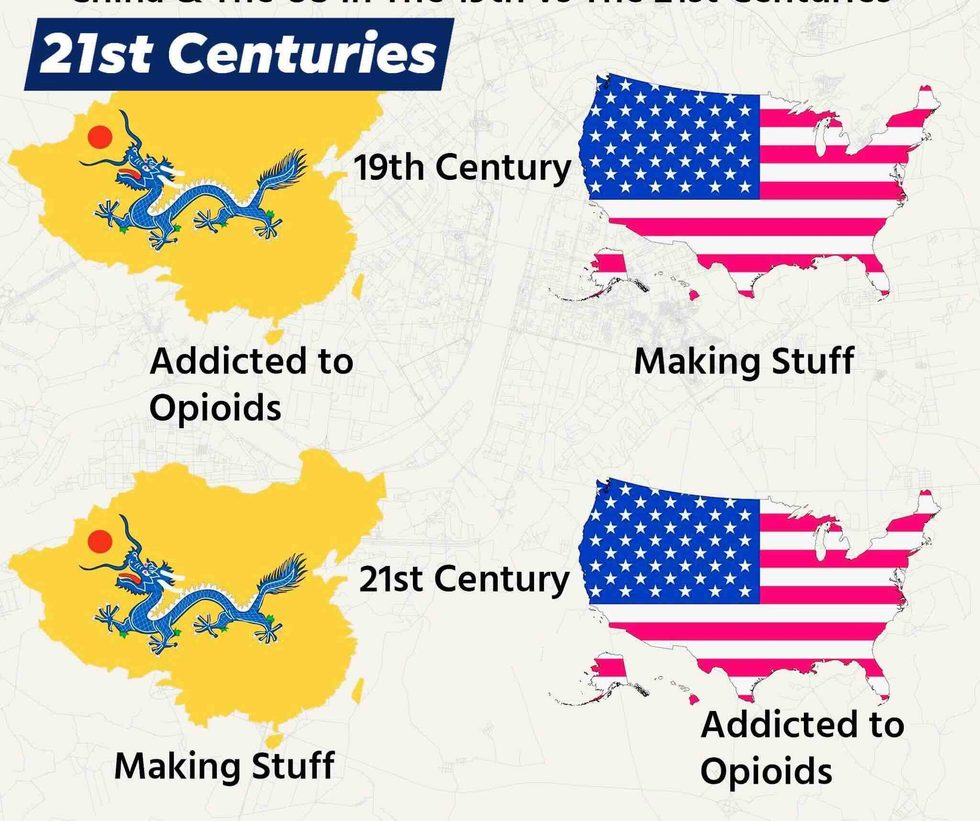
Everyone sees the other through the lens of their own experience. What China sees across the Pacific is a society struggling in a thick fog that ominously resembles China’s own 19th-century toils. Then, the abuse of opium and the spread of fanatical pseudo-Christian faith, the Taiping, wrought havoc on the empire, pushing it into a self-destructive civil war.
Today in the US, fentanyl addiction and the abuse of prescription opioids have devastated communities. TikTok and dozens of other social media platforms are not a fanatic religion, but they blur the line between truth and falsehood into an uncontrollable, almost incomprehensible ball of confusion.
In Beijing, the US’s present plight may look gloomily similar to the Chinese predicament two centuries ago. Fentanyl now in the US is like opium two centuries ago in China, and the nonsense peddled on social media now in America is like the Taiping fanaticism 200 years ago in China.
TikTok and many social media platforms have two sides: they gather information about individuals (thus improving levers of central control), and they spread superficiality. Conversely, sophisticated societies need people with depth and sophisticated education to navigate today’s society.
The US has only a few educational platforms, and not much quality control protects children or citizens. American society inspects food and medicine, but not social media. These are all signs that society doesn’t work in America, as seen in China. You can gather information on your people, but do you want to educate them, or is there a deliberate intention to miseducate them in America? But if you don’t take care of your human capital, the state will fall apart.
China, for its part, feels it has built its own cultural bubble to guard itself from what it seems to be a self-destructive Western loop of chemical drugs and new social media garbage. Drugs are strictly forbidden, and the internet is tightly controlled, spreading only Party-sanctioned education. It believes this will make it strong while the US rots. This happens because the Party also believes it promotes real positive values, not just ‘empty propaganda,’ as some Americans may think.
The analysis is superficial, glossing over the layered complexity of American education, including elite schools, yet it raises a real question: are young people, the masses, better left to the chaotic exposure of the social media maelstrom or channeled by the Party’s wisdom? In Beijing, the answer, given the social results, seems obvious: enlightened leadership needs to step in.
The fraying of the res publica
Beneath these symptoms, China reads a deeper unease in the US leadership: a sense that the liberal res publica, the common public good that citizens share and defend, is fragmenting. Two pressures stand out.
The first is the new class of billionaires. Many pursue personal, egotistical agendas, and the idea of the common good has shifted. There is no common, clear cause against communism, as during the Cold War. Conversely, agendas conflict over how to tackle national issues and what the priorities should be.
China put its billionaires under the Party’s leadership, creating a clear hierarchy between those who can make money or technology and those who can steer the country.
Immigration and Islam appear to be divisive issues for the people and the leadership.
The liberal order rests on a principle that took centuries to secure: citizens of all faiths, or none, enjoy equal rights under a single law. In the West, the state and religion are separate, and a single legal system applies to everyone.
Sharia, understood as a comprehensive legal order, operates on a different premise. In systems governed by it, believers of different faiths do not enjoy equal standing in matters such as family law, inheritance, testimony, and the rights of women and converts.
That is why parallel legal practices are troublesome when they take root in Europe, whether through informal arbitration, community pressure, or political demands that the state accommodate religious law in civil matters.
If they grow, they could create a patchwork of communities governed by different rules inside one state. That would erode precisely the equal citizenship on which the liberal res publica depends.
The concern is not about Muslims as people, or about Islam as a faith, which many Europeans practice peacefully as citizens within the existing legal framework. It is about a legal and political model, and whether democratic societies are willing to defend the principle of one law for all, even when doing so is uncomfortable.
The same issue appears from the other side. In many Muslim-majority countries, the role of sharia as the source of state law makes it hard to build a full liberal democracy.
When religious law is the ultimate standard for legislation, it narrows what parliaments can decide and what minorities, women, and dissenters can claim as rights. It also blurs the democratic separation between state and religion.
Some Muslim-majority nations have developed elected governments and vibrant civic lives, and many Muslims inside and outside those countries argue for reform from within. But the tension between democracy and sharia, and the problems it creates, is real.
Catholics do not ask for, nor do they pretend, that Canon law should rule society or Catholics. There is a division between state and religion that some Muslims seem to ignore. Even so, there are gray areas, but centuries of refinement and friction have found a viable way to manage them. Islam and modern democracy are new to this game.
The problem with Islam then goes to the heart of liberal democracy. In other words, is liberal democracy still working? People in China may wonder. Beijing has done it differently. The billionaires have been put under state control, and so has Islam, crushed wherever it posed a threat. A radical Islamic country, like Iran, has turned a blind eye to this in return for economic and political support against its main enemy, the US.
This perception may carry a lot of weight in Western countries, where long-term misalignment with the US combines with short-term controversies during the Trump presidency.[1]
China can feel satisfied with this perception, as it also aligns with much of America’s public rhetoric. The MAGA movement is glaring proof of China’s analysis. Why would Americans feel they have to make America great again if they didn’t realize that America is no longer great? If it’s not great, it’s declining. Then Trump, despite six years in office, still insists America has to be great again, admitting there is a lot of work to do.
Not post 9/11
From all the public debate in the American press, the US seems at odds with itself, unsure whether the challenge from China is greater than that posed by immigration, particularly from Muslim immigrants, or vice versa. After 9/11 in 2001, it decided that radical Islam was the bigger threat, putting China aside.
A decade later, it changed its mind and saw China as the real challenge. Now everything seems confused. China can go about its business, thinking it has little or nothing to worry about from a confused, declining US.
However, the United States might soon reset its priorities. Is it about China or something else? If it’s truly about China, many things could change.
Unlike after 9/11, it’s not just the US thinking about China. Over two decades ago, both European and Asian countries weren’t wary of China, but they were frightened by radical Islamic terrorism. Muslim extremists were organizing terrorist attacks in Europe, Indonesia, and the Philippines. China was not seen as a problem; quite the contrary. It had staved off the Asian financial crisis that had engulfed the region in 1997-98.
This international context made it easier in 2001 to refocus the US towards Islamic terrorists.
Asian neighbors now also worry about China, its geopolitical ambitions, and mercantilist trade practices. Europe, once inattentive to the ‘China threat’, now sees China backing Russia and Iran, both of which pose a real danger to the rest of the continent. If China backs Russia and Iran, it is also a political and military risk for Europe.
This international context makes it easier for the US to regain focus on China. Then Beijing’s calculations about the US could be off, because the picture has changed so much from the past, and even if the US and the rest unravel, it might not save China.
Here are two elements. The Chinese analysis of the US is correct; still, China has to face a new wave of opposition in Europe and Asia that could be harder to manage than the US. If the Chinese analysis is wrong, the US could bounce back with vengeance.
If the US can’t project leadership, everything could become very confusing, and in the fog of chaos, it could be easier to slip into an uncontrollable situation.
Fights in Ukraine or Iran, after all, were just that: two powers underestimating the risks of starting a conflict. They thought it would be minor; it turned out to be more serious. It’s not impossible that something similar could happen in Asia, with so many flashpoints and declining US clout.
The US might already be shifting direction. Symbolically, on October 23, US Secretary of War Peter Hegseth designated China-sponsored cultural centers, the Confucius Institutes, as national security threats.
This seems like the latest step in the US’s long march to confront Chinese influence in America. In 2017, there were 118 Confucius centers and 100 affiliated colleges in the US. Now only 10 remain. Hegseth announced the closure of 80 Chinese centers established after most Confucius Institutes closed. The US may really want to roll back the Chinese idea of America, but MAGA and its propaganda might have to go, too.
Meanwhile, it’s unclear how the US plans to engage with China to counter its analysis and narrative, or how convincing the US narrative will be to the Chinese and the world.
[1] See https://www.appiainstitute.org/ukraine/dreams-and-reality-for-the-us-or-china/