

Italy’s streets are on fire, and Moscow may be holding the match. European governments must act to end any political ambiguity that favors Russia’s government. The US can’t gift France or Italy to Putin
Two forces, converging yet distinct, drive the violent protests in Milan and, perhaps, those in France and other European countries. The first is resentment, a social discontent that accumulated like dry wood. The second is the group that fans discontent, not to solve the problems but to make them grow. That probably helped organize the violence in the streets in recent days.
The two forces meet in a spark, which can be an incident, even an accidental one, during peaceful demonstrations. The incident, of course, may not be accidental; it may have been deliberately provoked.
The two forces must be addressed separately. Both are political, but they call for different policies. The first requires thorough analysis and medium- to long-term measures to remove the wood from the fire. The second requires swift action to prevent the fire from becoming a conflagration.
Today’s problem, as it was 80 years ago at the end of World War II, is the enemy on the other side of the Curtain. It was once made of iron; today it is thinner, made of perforated plastic, because, unlike then, communications between the two sides are more transparent.
Suspicions are growing that forces stirring up the crowds are being steered from Moscow, seeking in Milan or Paris the successes it cannot win on the Ukrainian battlefields.
The method is old. Wilhelmine Germany backed and facilitated the Bolshevik Revolution in 1917 to free itself from Russia on the Eastern Front.
Afterward, the Soviet Union supported and organized revolutions around the world, driven by a mix of idealism and the expansion of its geopolitical ambitions. The later color revolutions (no longer red), backed by America and the West, followed the same pattern but with far less skill than the Soviet Union’s professional revolutionaries. Today, Moscow appears to have returned to its old trade, one it practices better than anyone else: exporting subversion.
Revolutions are serious business, and sometimes even just, when they oppose a system that doesn’t allow free participation in politics. But using violence in an open, free system subverts democracy and everyone’s freedom, and imposes the will of an aggressive minority on a majority that may think differently.
It cannot be tolerated if a democratic system is to survive, especially when it is organized, in whole or in part, by a non-ally state that is often hostile.
This urgently raises the need for firebreaks: cut down trees near the fire to keep the blaze from spreading. In other words, what was called the “K factor” during the first Cold War in Italy is relevant again: those ideologically close to the Soviet Union could not govern.
Italy resolved this delicate problem for a democracy by granting pro-Soviet forces parliamentary representation and freedom of expression but barring them from the corridors of power.
It was an uneasy divorce. In 1946, all the forces that had fought fascism gathered to draft the Republic’s constitution, but two years later they split into those who would govern and those who would remain in opposition. The fundamental divide was between an alliance with America and one with Russia.
Today, the country faces the same juncture. The political problems that have fueled the dissatisfaction and fury of the people in the streets of Milan and Paris call for a nuanced political response. But the forces that light the flames, or even those close to them, must be kept away from the levers of government.
That does not mean arresting every dissident. On the contrary, dissenting and strident voices must remain a force and a stimulus for Italian democracy. But if such forces aim to violently subvert the democratic system, or to cheer it on, they cannot reasonably lead a government that has chosen to stand on the other side.
Or they must clearly call for a change in Italy’s international position toward the European Union and NATO and then see what voters decide. The dividing line is the war in Ukraine.
This poses concrete questions for all the political forces that legitimately root for Russia: either they change their position, or they cannot come close to the government, or, if they are in government, they must leave it. Maintaining this ambiguity has been difficult so far, and after this violence it is becoming all but impossible.
As a result, all parties, on the right or the left, that take part in the next election campaign will have to clearly choose which side they take in international politics.
If this political choice is not put on the table, an untenable situation arises: it becomes impossible even to begin tackling the medium- and long-term problems at hand, and the police are forced to be not the last link in a long chain of institutional order but the institutions’ only barrier against chaos.
Isolated barriers eventually fall, and then comes the plundering of the city and the end of institutions. The sack of Rome or Paris would matter more than the sack of Kyiv.
It would be an enormous blow to the United States, led by President Donald Trump. Rome and Paris are his allies; why should he cede them to Russian leader Vladimir Putin? On the eve of a fiery autumn, with few firefighters and many arsonists, a solution to this quandary may lie in the chambers of the Italian Parliament.
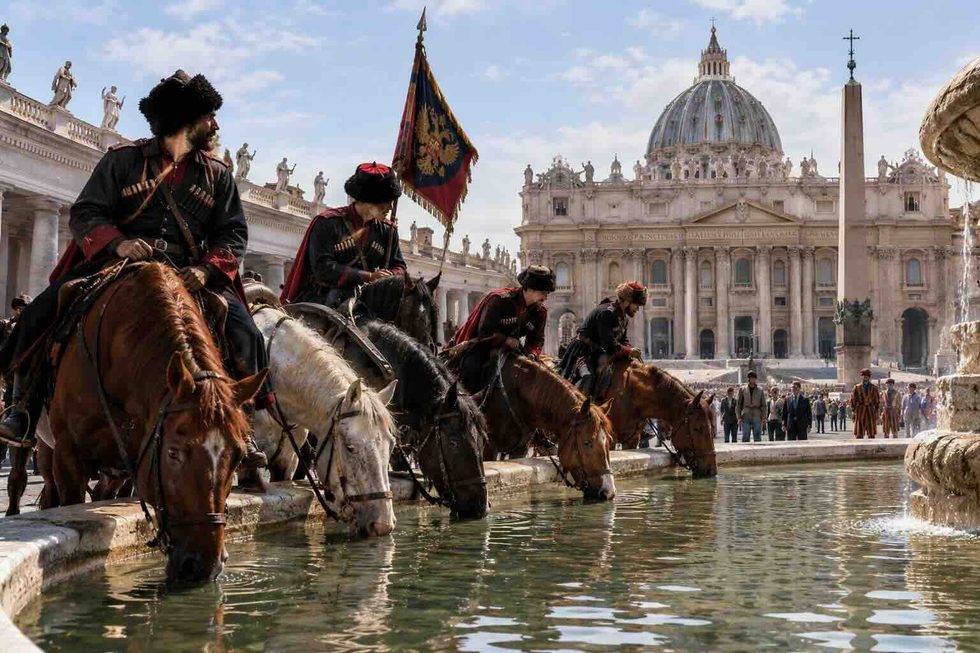
The shadows of Alaric, who sacked Rome in the winter of 410 AD, or of Cossacks watering their horses in St. Peter’s Square, as Italian anti-communist propaganda claimed in 1948, are stark, almost surreal images from bygone times. Yet they now loom on the horizon perhaps more concretely than at any time in the past 40 years.
(A version in Italian was first published on Formiche.net)