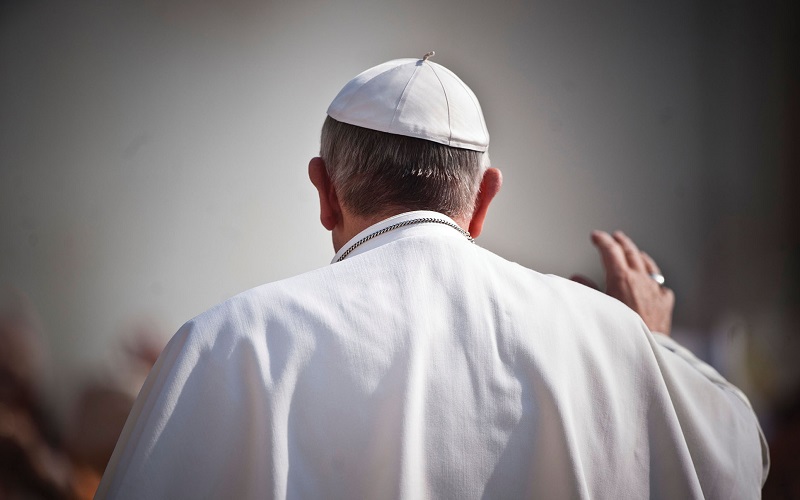




Pope Leo’s first words underline a continuity with Pope Francis about the centrality of the poor in the Church. Still, his denunciation is less direct.
Signed on October 4th and published on October 9th, the apostolic exhortation Dilexi te is Francis’s last word and Leo’s first. Beyond the title, which recalls the encyclical Dilexit nos on the worship of the Sacred Heart (here), the continuity is significant in its theme and content: “love for the poor.”
Taking up the preferential option for the poor of his predecessor constitutes a clear signal of the Pope’s will and direction. “Having received this project as a heritage, I am happy to make it my own – adding some reflections – and to propose it again at the beginning of my pontificate, sharing the desire of my beloved predecessor that all Christians may perceive the strong connection that exists between the love of Christ and the call to draw near to the poor” (n. 3).
The text is 42 pages long, with 121 numbered paragraphs and five chapters titled: “Some Indispensable Words”; “God Chooses the Poor”; “A Church for the Poor”; “A Continuing Story”; “A Permanent Challenge.”
The choice of whether to adopt a draft document from a predecessor has seen some variations. Pius XII left in a drawer a first draft of an encyclical by Pius XI against racism, anti-Semitism, and the totalitarianism of German Nazism, with the provisional title Humani generis unitas. Prepared by some Jesuits (John LaFarge, Gustav Grunlach, Gustave Desbuquois), the document did not become part of the Magisterium due to the position Pope Pacelli developed towards the totalitarian regimes of his time.
Instead, Pope Francis made his own the draft of the encyclical Lumen Fidei, which would have been the fourth encyclical of Ratzinger’s pontificate, following those dedicated to social doctrine, and to charity and hope, respectively. A continuity which later had to reckon with significant elements of discontinuity, clearly expressed in Evangelii Gaudium, his programmatic document.
Pope Leo qualifies the text as an “apostolic exhortation,” which, being a good jurist, he tends to distinguish from the more authoritative form of the encyclical, to which he will entrust the direction of his governance. However, the continuity on fundamental themes, starting with the preferential option for the poor, seems to indicate that Dilexi te will constitute a premise consistent with his subsequent directions.
A Call to Witness
The centrality of the poor in Christian proclamation and practice returns forcefully in many passages of the exhortation. With the incarnation of Jesus, one can “theologically speak of a preferential option on the part of God for the poor” (n. 16). The entire Scripture bears witness to this. “It is undeniable that the primacy of God in the teaching of Jesus is accompanied by the other firm point that one cannot love God without extending one’s love to the poor” (n. 26). “We must state without ambiguity that there is an inseparable bond between our faith and the poor” (n. 36).
It is not just a social issue; it is a pivotal point of the Christocentric nature of Christian doctrine (n. 84). Indeed, “the Church’s preferential option for the poor is inscribed in the Christological faith that led God to become poor for us, to enrich us with his poverty” (n. 99). “The reality is that for Christians, the poor are not a sociological category, but the very flesh of Christ” (n. 110). “We are not in the realm of charity, but of revelation: contact with those who have no power or grandeur is a fundamental way of encountering the Lord of history” (n. 5).
Poverty has many declinations and specifications. Its forms change throughout history, and the response will always fall short of the needs. But for the Church, it is a question of fidelity to the Gospel. “The fact that the exercise of charity is despised or ridiculed, as if it were the fixation of a few and not the burning core of the Church’s mission, makes me think that we must always read the Gospel anew so as not to risk replacing it with a worldly mindset” (n. 15).
Here we also find an authoritative response to the statements of the US Vice President, the Catholic J.D. Vance, who invoked the Augustinian doctrine of Ordo amoris to justify, as adhering to the “Christian vision,” the aggressive cancellation or suspension of almost all US foreign aid programs and the deportations of illegal immigrants by the Trump administration (cf. here on SettimanaNews). Early on – it was January 2025 – the then-Cardinal Prevost had intervened with the authority of a scholar of Augustine to reject this claim, which Pope Francis would also oppose in his letter to the US bishops (February 10, 2025).
Attention to the poor is also a condition for any possible reform of the Church: “I am convinced that the priority option for the poor generates an extraordinary renewal both in the Church and in society when we are capable of freeing ourselves from self-referentiality and manage to hear their cry” (n. 7).
The admonition rings out forcefully to those religious sensibilities that claim to ignore service to the poor: “Sometimes a deficiency or even an absence of commitment to the common good of society is found in some Christian movements or groups, and, in particular, to the defense and promotion of the weakest and most disadvantaged. In this regard, it must be remembered that religion, especially the Christian religion, cannot be limited to the private sphere, as if the faithful should not also care about problems concerning civil society and events that affect citizens” (n. 112). This is a form of worldly behavior disguised by religious practices.
An Only Indirect Denunciation of the System
Compared to the open contrast with the neoliberal and technocratic system found in Francis’s Magisterium, Leo’s words stop short. In an effort to avoid splits and oppositions, it takes a step back, convinced that the effectiveness of the witness can overcome ideological rigidities and unfounded prejudices.
But the denunciation is far from faded. The accumulation of wealth, social success, and the defensive isolation of a few privileged people are contrary to the Gospel (n. 11). “Wealth has increased, but without equity, and so what happens is that new forms of poverty are born” (n. 13). Poverty is not a choice, nor is it fate. It is a structural issue. “It is therefore a duty to continue to denounce the dictatorship of an economy that kills and to recognize that while the gains of a few grow exponentially, those of the majority are increasingly distant from the well-being of this happy minority. This imbalance proceeds from ideologies that defend the absolute autonomy of markets and financial speculation. Consequently, they deny states the right to control, as states are tasked with vigilance for the common good. A new invisible, sometimes virtual, tyranny is established, which imposes its laws and rules unilaterally and implacably” (n. 92).
It is unacceptable that, in the face of the needs of the poor, the response is to postpone addressing them to an uncertain future without tackling the “structures of sin” today. “It is presented as the reasonable choice to organize the economy by asking for sacrifices from the people, to achieve certain goals that interest the powerful” (n. 93).
Fundamental rights are non-negotiable. Attention to the less protected social classes and their active role are conditions for the development of society and a true enrichment of humanity for all.
The Uninterrupted Story
The exhortation shows a singular attention to consecrated life and the recovery of some traditional dimensions of service to the poor. The reconstruction of the history of the Church’s care for the poor starts from the Scriptural texts (Old and New Testaments) and the Church Fathers (Ignatius of Antioch, Justin, Chrysostom, Augustine, etc.) and then develops through the founders of monasteries and religious life: from Basil to Benedict, from Cassian to Camillo de Lellis, from the Vincentian Sisters to the Hospitaller Sisters, from the Mercedarians to the Trinitarians, from Francis and Clare to Dominic, from Calasanzio to La Salle, from Don Bosco to Rosmini, from Scalabrini to Cabrini.
It is a cascade of names, religious and monastic families, and new services (for the poor, sick, slaves, ignorant, migrants, refugees, etc.) that together compose the fabric of a Church of charity that continues to the present day: Teresa of Calcutta, Menni, de Foucauld, Emmanuelle, Caritas, and popular movements—a moving story, perhaps overly compact, entrusted more to charismatic intuitions than to ecclesiastical structures.
For more recent centuries, there is the red thread of social doctrine, retracing the main encyclicals and the conciliar constitution Gaudium et Spes. The reference to John XXIII’s famous speech one month before the opening of the Council (“The Church presents itself as it is and wants to be, as the Church of all and particularly the Church of the poor”) and to the intervention of Cardinal Giacomo Lercaro during the assembly (“The mystery of Christ in the Church has always been and is, but today it is particularly so, the mystery of Christ in the poor”) shows the deep roots of Leo’s formation.
The Latin American Wave
The Pope’s debt to his service in the Peruvian Church and the Latin American context is very recognizable. It is found in the remembrance of the great continental assemblies, particularly Medellín (1968), Puebla (1979), and Aparecida (2007): a creative doctrine “that has been well integrated into the subsequent Magisterium of the Church” (n. 16).
The citation of Oscar Romero’s martyrdom and the reference to urban pastoral care are accompanied by the valorization of popular movements, a characteristic of Pope Francis. Also, the call to the contact, encounter, and identification in the gesture of almsgiving, as a source of nourishing pietas in social life, recalls that root. “Without personal, frequent, and heartfelt gestures, it will be the ruin of our most precious dreams. For this simple reason, as Christians we do not renounce almsgiving” (n. 119).