



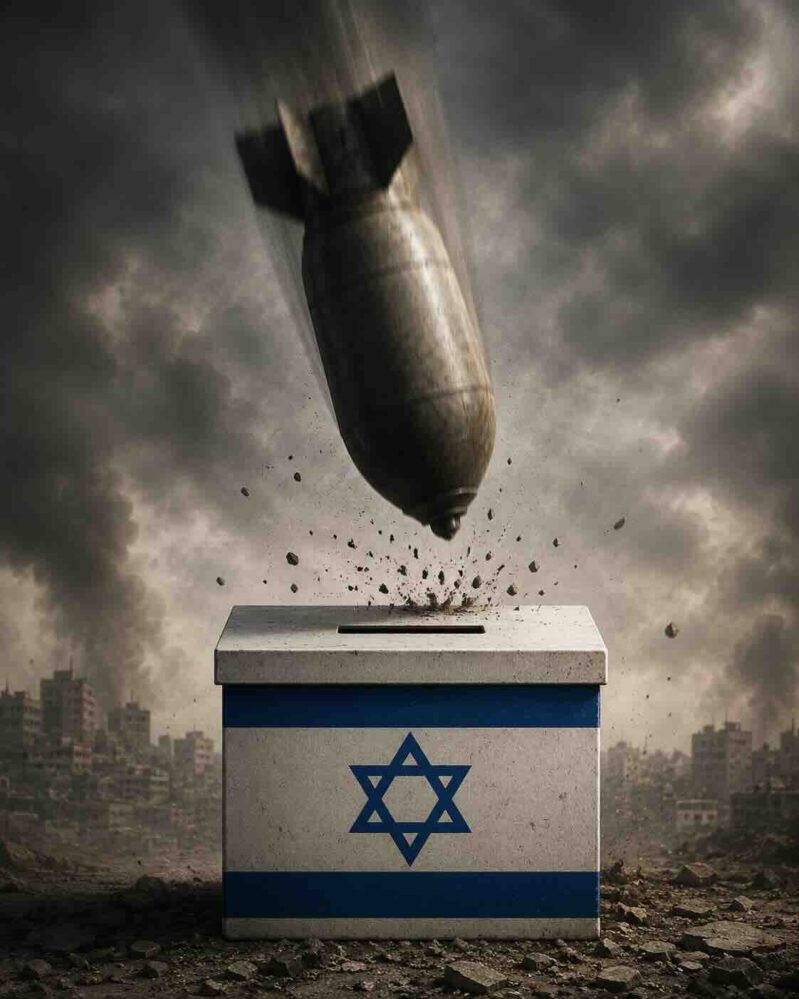
In Israel, the first elections for the new Knesset following the events of October 7, 2023 are a direct expression of a national post-traumatic condition and carry extraordinary political and historical significance. As the country prepares to vote on October 27, one fundamental question confronts Israeli voters:
Was the Hamas massacre an isolated event, or merely the tip of the iceberg?
For brevity, I will not review the extensive body of material accumulated over nearly three years of military and academic research. Suffice it to say that the overwhelming majority of analyses support the latter conclusion: over the past two decades, Israel’s adversaries had grown steadily stronger, while successive Israeli governments have failed to respond with sufficient determination, timely action, and—above all—a defensive strategy commensurate with what has become an existential threat.
I use the adjective existential deliberately, because mainstream international media often overlook an essential point: the declared objective of Iran’s theocratic regime, its regional proxies (Hezbollah, Hamas, the Houthis, and pro-Iranian militias in Iraq and Syria), together with certain factions of the Muslim Brotherhood, extends well beyond demonizing or attacking Jews. Their stated goal is the eradication of the State of Israel from the Middle East—a position repeatedly articulated by both Ayatollah Ali Khamenei and his son Mojtaba.
Among the many sources fueling contemporary antisemitism, it is worth mentioning the Arabic-language broadcaster Al Hiwar TV, based in London and closely aligned with the Muslim Brotherhood. With millions of viewers, the network recently revived the medieval blood libel, falsely claiming that Jews use the blood of non-Jewish children (“Gentiles”) in preparing matzah for Passover.[i]
One of the most thought-provoking analyses of October 7 is the 2025 study by Isaac Ben Israel and Gil Baram.[ii] According to the authors, it is misleading to characterize October 7 simply as an “intelligence failure.” Rather, the attack exposed deeper structural weaknesses in the very doctrine upon which Israel’s national security has traditionally rested—a doctrine designed primarily around conventional conflicts between sovereign states.
When intelligence agencies confront terrorist organizations and non-state actors such as Hamas and Hezbollah, the analytical framework changes fundamentally. Warning times and response windows can shrink from forty-eight hours to as little as three or four. Ben Israel, widely regarded as one of the world’s leading authorities on military intelligence and cybersecurity, argues that this distinction is crucial to understanding what occurred.
Over the past twenty years, Iran has made remarkable advances not only in uranium enrichment and ballistic missile technology[iii], but also in strengthening its regional proxy forces—a development that political decision-makers have gravely underestimated.
Since Israel’s unilateral withdrawal from Gaza in 2005, Hamas’ Al-Qassam Brigades have systematically transformed the Strip into an enormous military arsenal.
I recall visiting Sderot in March 2007, when relatively primitive rockets were already striking homes and schools in the Israeli town closest to Gaza. In the years that followed, thousands of missiles, drones, dual-use technologies, heavy weapons, launch facilities, and hundreds of kilometers of underground tunnels transformed Gaza into a formidable war machine.
An important—but often overlooked—dimension of Israel’s vulnerability concerns the remarkable technological progress Hamas has achieved during the past decade.
Beyond conventional rearmament, Hamas has developed sophisticated cyber, signals intelligence (SIGINT), and electronic warfare capabilities that enabled it to penetrate Israeli Defense Forces (IDF) communications networks, gather intelligence, and undermine surveillance systems.
Between 2020 and 2023, Hamas conducted extensive social-engineering operations targeting Israeli soldiers, gaining remote access to hundreds of military mobile phones. The organization also intercepted IDF radio communications along the Gaza border, allowing it to map Israeli patrol routines and identify operational vulnerabilities.
In addition, Hamas deployed modified intelligence, surveillance, and reconnaissance (ISR) drones equipped with thermal imaging and real-time video transmission to locate blind spots in Israel’s electronic border defenses and automated watchtowers.
During the October 7 attack, Hamas combined commercially available armed drones with portable electronic jamming devices to disable IDF communications and sensors along the Smart Fence, contributing significantly to the paralysis of Israel’s early-warning system.
As an Atlantic Council report pointed out in 2022—well before the events of October 7—these technological capabilities, developed with Iranian assistance and incorporating commercially available Russian and Chinese components, transformed Hamas into an organization possessing sophisticated cyber and electronic warfare expertise, capable of exploiting structural weaknesses within Israel’s security apparatus.[iv]
Yet October 7 also exposed a problem moving in the opposite direction.
It revealed Israel’s excessive confidence in—and growing dependence upon—technological surveillance systems, foremost among them the Smart Fence, which, as previously noted, Hamas succeeded in neutralizing within minutes through the use of commercially available drones.
From the standpoint of conventional armaments, hundreds of thousands of weapons also entered Gaza through smuggling routes from Jordan and Egypt
This raises an obvious question:
What did successive Israeli governments do to prevent Gaza’s massive military buildup?
I will frame the issue through a single question. Why did the Israeli government never strengthen intelligence operations inside Gaza by assigning the Mossad to work alongside the Shin Bet (Israel’s internal security service), which had primary responsibility for Gaza following Israel’s withdrawal?
According to former Mossad Director Yossi Cohen, Prime Minister Benjamin Netanyahu was prevented from doing so because of opposition from the Shin Bet itself.[v]
Such cooperation would have been entirely logical, since Hamas’ extraordinary military growth would have been impossible without extensive outside assistance—above all from Iran and Turkey.
Incidentally, Hamas’ close relationship with Tehran remains fully intact.
Only recently, during the period of mourning following the death of Ayatollah Ali Khamenei, a Hamas delegation met in Tehran with senior commanders of the Islamic Revolutionary Guard Corps (IRGC). Their principal interlocutor was likely Mohammad Bagher Zolghadr, successor to Ali Larijani and regarded by analysts as one of the most influential figures in Iran’s emerging leadership alongside IRGC Commander General Ahmad Vahidi.[vi]
Developments within Hamas itself also deserve attention. On July 20, Khalil al-Hayya (nom de guerre Abu Osama) was elected by the Hamas Shura Council as the movement’s leader, defeating Khaled Meshaal by a single vote. [vii]Meshaal was generally viewed as the candidate favored by Qatar and Turkey.
Although narrow, al-Hayya’s victory signals the organization’s decision to maintain continuity with the strategic direction established by Yahya Sinwar, reaffirming Hamas’ close alignment with Iran and its strong ties to Lebanon’s Hezbollah.
For Israel, however, an equally serious—and in some respects even greater—security challenge has developed in Lebanon through Hezbollah.
For more than twenty years, specialists have understood something that remains largely unknown to the broader public: since 2006, the United Nations Interim Force in Lebanon (UNIFIL) has operated under severe constraints imposed by the limitations of its mandate and restrictive rules of engagement.
Taking advantage of this situation, Hezbollah[viii]—acting in close coordination with Al-Quds Force, the foreign operations branch of Iran’s Revolutionary Guards—expanded dramatically in both capability and organization.
Although Hezbollah’s 2021 claim of commanding more than 100,000 fighters is widely regarded by experts as exaggerated, its true strength lies elsewhere.
Since 2005, the organization has constructed an extensive military infrastructure throughout southern Lebanon, including missile-launch facilities supported by an underground tunnel network estimated at roughly 70 kilometers.
Military capability, however, tells only part of the story.
For many years, Hezbollah has operated with remarkable freedom on the international stage, maintaining close relationships with major criminal organizations—particularly in Africa and South America, but increasingly in Europe as well.[ix]
Investigations by Le Monde have documented Hezbollah’s activities in Ivory Coast and Guinea. In Latin America, one need only consider the so-called Triple Frontier region—where Brazil, Paraguay, and Argentina converge—which has become a flourishing center for drug trafficking, arms smuggling, cryptocurrency operations, and money laundering.[x]
Yet Hezbollah’s extensive ties to transnational organized crime receive remarkably little public attention.
Why?
Finally, as the Israeli Prime Minister himself acknowledged in recent weeks, Hezbollah accumulated an arsenal of more than 150,000 missiles and drones in southern Lebanon.[xi]
How was such an enormous stockpile assembled?
Several compelling lines of investigation—supported by original maps—are presented in a 2024 report by the Amit Terrorism and Intelligence Research Institute.[xii]
Hezbollah, however, is a far more complex organization than a conventional militia.
It can best be described as an armed political party—one that participates actively in Lebanese politics while simultaneously maintaining an independent military force and representation in Parliament.
In April 2007, I had the opportunity to meet the controversial Lebanese Christian leader, General Michel Aoun. At the time, as he sought the presidency—a position he would eventually attain—Aoun vigorously defended his alliance with Hezbollah.
This was during the period when the “Party of God” still hoped to avoid accountability before the International Tribunal investigating the assassination of Prime Minister Rafik Hariri, chaired by the late and widely respected jurist Antonio Cassese.
In the years that followed, however, the political “honeymoon” between Lebanon’s Maronite Christians and Hezbollah gradually deteriorated until it finally collapsed.
Today, beneath the surface, Hezbollah functions increasingly as the operational arm of Iran’s Al-Quds Force and the Islamic Revolutionary Guard Corps (IRGC) inside Lebanon.
Moreover, despite recent—and notably cautious—attempts by Nabih Berri’s Amal Movement to distance itself rhetorically from Hezbollah, the Shiite party still appears largely dependent upon Tehran’s strategic direction.[xiii]
Beyond Hamas and Hezbollah, three additional threats deserve closer attention because they also pose serious challenges to Israel’s national security—threats that successive Netanyahu governments have, at least in certain respects, underestimated.
The first concerns the Houthi movement in Yemen.
This issue directly affects Saudi Arabia as well and raises an obvious question: why was the Houthi challenge not addressed during the initial phase of the Abraham Accords, when it might at least have been possible to contain the subsequent escalation?
Another front that receives surprisingly little attention—but represents a growing danger—is that of the Iranian-backed Shiite militias in Iraq.
For years, the Council on Foreign Relations warned about developments there.[xiv]
Even then, Tehran was already attempting what might be described as the “Lebanization” of Iraq by steadily increasing its support for armed groups such as Kata’ib Hezbollah and Asa’ib Ahl al-Haq, organizations that today operate under the umbrella of the Popular Mobilization Forces (PMF).
Iran’s growing political influence in Iraq has been accompanied by an equally profound—although still uncertain—transformation of Syria’s political and institutional landscape.
Following the fall of Bashar al-Assad, Iranian influence has declined significantly, while Turkey’s role has expanded. From Israel’s perspective, however, it could not only mean exchanging one strategic danger for another, but also confronting Turkey, an emerging regional power and NATO member. President Erdogan is a prominent supporter of the Muslim Brotherhood and is currently legitimizing Hamas.[xv]
Within Syria’s rapidly evolving and highly uncertain environment, evidence also suggests the emergence of a militia that appears intent on preserving much of the extensive pro-Iranian logistical and operational network that existed under the Assad dictatorship.[xvi]
Having briefly reviewed the growing strength of Iran’s regional proxy network, it is necessary to return to Gaza, which, in my opinion, represents the clearest example of Israel’s political short-sightedness.
This brings us back to the central question posed at the beginning of this essay.
Why did Israel’s political leadership—and Benjamin Netanyahu in particular, though certainly not he alone—fail to recognize the true nature of the Hamas threat despite the numerous warning signs produced by Israeli intelligence?
My answer is that this failure stemmed from a profound misunderstanding of the significance of Hamas’ violent coup against the Palestinian Authority in June 2007.[xvii]
Israeli policymakers viewed that event primarily as a temporary tactical challenge.
At the same time, they mistakenly interpreted the deep division that had emerged within the Palestinian camp as a strategic advantage for Israel.
Over the years, governments led by Netanyahu repeatedly relied upon a classic divide et impera strategy, tacitly allowing Hamas to weaken the Palestinian Authority.
For its part, Hamas carried out an extensive and remarkably successful campaign of strategic deception.
The organization deliberately cultivated the image of being a manageable actor, projecting moderation while carefully concealing its true objectives and long-term strategy.
Those within the Israeli government who regarded Hamas as a useful strategic asset naturally tended to discount the increasingly troubling intelligence reports emerging from Gaza.
In hindsight, the reality has become unmistakably clear.
Although Hamas won democratic elections, its true objective was never to govern the Palestinian National Authority. Rather, its overriding ambition was to establish complete control over the Gaza Strip and transform it into a secure sanctuary from which to launch increasingly powerful attacks against Israel with the largest possible arsenal of weapons.
In essence, despite carefully concealing its intentions and despite being a Sunni organization rooted in the Muslim Brotherhood, Hamas had already become deeply imbued with the political and religious ideology of Tehran and Hezbollah. Its glorification of martyrdom[xviii] reinforced the political-religious radicalism that had already manifested itself during the wave of suicide bombings of the Second Intifada.
Although its precise size is impossible to measure, there exists today a significant segment of the international pro-Palestinian movement—including supporters of the Freedom Flotilla—that openly argues Israel should not exist.
This current has never shown a genuine commitment to advancing negotiations toward the creation of a Palestinian state within the framework of the “Two Peoples, Two States” solution.
These ambiguities, however, receive virtually no attention in the international media.
One revealing example concerns Thiago Ávila, one of the Freedom Flotilla’s organizers. It has received almost no coverage that he attended the funeral of Hassan Nasrallah in Beirut and publicly described the Hezbollah leader as one of his principal sources of inspiration.
The governments led by Benjamin Netanyahu have not only endangered Israel’s national security through their persistent underestimation of the military threat developing in Gaza and among Iran’s regional proxy forces.
They have also, in my judgment, committed serious errors in the realms of foreign policy and public diplomacy[xix].
On the latter front, Netanyahu has plainly damaged Israel’s international reputation by consistently prioritizing the political support of settlers and the country’s most nationalist, populist, and religiously fundamentalist constituencies.
One need only consider his willingness to accommodate those demanding exemption from compulsory military service because they devote themselves to Torah study—a position that, in my opinion, undermines the principles and civic obligations inherent in the rule of law.
Regardless of who prevails in the coming elections, restoring Israel’s international credibility and reversing its growing diplomatic isolation will be an extraordinarily difficult task.
With respect to foreign policy specifically, Netanyahu’s governments—particularly after 2015—placed considerable strategic emphasis on cultivating close relations with Vladimir Putin while simultaneously expanding economic ties with China.
The results, however, have been very disappointing, if not outright counterproductive. Only weeks after the October 7 attacks, official Hamas delegations were welcomed at Russia’s Ministry of Foreign Affairs in Moscow as though nothing had happened.[xx] A few months later, Hamas representatives were similarly received in Beijing.
The critical observations briefly outlined—and the strategic misjudgments Israel has made over the past two decades—cannot, of course, be attributed solely to Benjamin Netanyahu. Nevertheless, it is equally true that he has led the country for much of that period. The upcoming elections therefore provide an appropriate opportunity for a comprehensive assessment of his years in office.
Despite the Prime Minister’s well-known tactical abilities and his often-assertive political style, it is evident—at least in my judgment—that Israel’s national security has deteriorated significantly over time. No one should underestimate the growing dissatisfaction that has emerged within Jewish communities throughout the Diaspora.
It is likely that one reason Netanyahu continues to oppose the establishment of an Independent State Commission of Inquiry into the events of October 7 [xxi]is his desire to prevent a thorough investigation into the mistakes made and the institutional weaknesses that characterized his years in government.
His position, however, has generated increasing unease across broad segments of the Israeli electorate, strengthening calls for political change and, ultimately, contributing to the growing popularity of General Gadi Eisenkot, who has emerged as his strongest challenger.
Ultimately, however, the judgment of Benjamin Netanyahu’s leadership belongs—as it does in every democratic nation, Israel included—not to commentators or analysts, but to Israel’s citizens themselves: both its Jewish population and the approximately two million Palestinian citizens of Israel.
With only three months remaining before election day, the campaign is already shaping up to be exceptionally hard-fought, and its outcome remains highly uncertain.
[i]https://www.memri.org/tv/mona-sobhy-blood-libel-matzah-damascus-affair-turkey-muslim-brotherhood
[ii]Intelligence and National Security (Vol. 40, Issue 3, 2025).
[iii]https://www.swissinfo.ch/ita/aiea%2C-iran-accelera-la-produzione-uranio-arricchito-al-60%25/89440073#:~:text=Secondo%20il%20rapporto%2C%20al%2017%20maggio%20l’Iran,seria%20preoccupazione%E2%80%9D%2C%20si%20legge%20nel%20rapporto%20dell’Agenzia
[iv]https://spectator.com/article/irans-grip-on-its-arab-proxies-remains-powerful/
[v]https://www.israelhayom.com/2026/01/04/inside-the-weapons-smuggling-network-threatening-israel-from-within/
[vi]https://www.timesofisrael.com/wading-into-politics-ex-mossad-chief-says-netanyahu-should-step-aside/#:~:tettps://www.cfr.org/backgrounders/what-hezbollahxt=He%20also%20disclosed%20that%20he%20had%20wanted,leaders%20resisted%20this%20to%20protect%20their%20%E2%80%9Chegemony.%E2%80%9D
[vii]https://www.tacticalreport.com/daily/64684-iran-irgc-commander-vahidi-and-other-new-key-decision-makers
[viii]https://iranwire.com/en/features/155258-loyal-iranian-ally-appointed-as-hamas-political-chief/
[ix]ttps://www.cfr.org/backgrounders/what-hezbollah
[x] https://thearabweekly.com/nasrallahs-boast-commanding-100000-fighters-message-lebanese-army-political-factions
[xi]https://www.lefigaro.fr/actualite-france/quand-le-hezbollah-achete-en-europe-le-materiel-pour-fabriquer-ses-drones-tueurs-20250411
[xii]https://www.terrorism-info.org.il/app/uploads/2024/12/E_270_24.pdf
[xiii]https://www.rand.org/pubs/perspectives/PEA3585-1.html / https://www.mosaico-cem.it/attualita-e-news/eventi-attualita-e-news/cosi-hezbollah-si-finanzia-nel-mondo-emanuele-ottolenghi-svela-le-reti-economiche-del-terrorismo-al-teatro-franco-parenti/
[xiv]https://english.almanar.com.lb/article/108892/
[xv]https://www.cfr.org/articles/iran-backed-militias-iraq-poised-expand-influence
[xvi]https://www.trtworld.com/article/a7ee05261c36
[xvii]https://understandingwar.org/research/middle-east/iran-update-october-3-2025/
[xviii] https://www.nytimes.com/2007/06/14/world/middleeast/14mideast.html
[xix]https:https://www.spiegel.de/politik/wir-lieben-den-tod-a-e81c76a1-0002-0001-0000-000008805772,/
[xx] www.jpost.com/opinion/article-897428
[xxi]https://mei.edu/publication/essential-questions-about-russia-hamas-link-evidence-and-its-implications/ / https://www.pbs.org/newshour/world/rivals-hamas-and-fatah-sign-china-sponsored-declaration-to-form-a-future-government-as-war-rages-in-gaza


Crocicchio israeliano: le elezioni post-traumatiche » Pensalibero.it