



The potential loss of Orban in Hungary could trigger a series of events that might alter the continent.
On April 13, the day after the Hungarian parliamentary elections, Europe could turn a new page. Less than two weeks before the vote, the opposition to Prime Minister Viktor Orbán, led by the Tisza Party, is clearly ahead. Orbán’s government, which has dominated Hungary for nearly 16 years, is expected to lose, ending Hungary’s fascination with Vladimir Putin’s Russia. This could help Europe regain unity and balance concerning its large eastern neighbor and many contentious issues.
Of course, Hungary won’t shake off Orbán’s influence overnight. He has supporters in every major institution. Neither is the opposition likely to win with a two-thirds majority, enough to change the constitution that Orbán himself championed. But even just the present challenge to his rule is an important sign.
More broadly, the national character of Hungarians will remain unchanged—a fragment of Central Asian heritage in the middle of a nearly entirely Indo-European continent. This uniqueness has likely always shaped Hungarian politics: initially, for centuries, as a restless member of the Holy Roman Empire; then, as the most pro-Western nation within the Warsaw Pact; and later, as the most pro-Russian country in NATO.
But the hit to Orbán, following the defeat of another European right-wing leader, Giorgia Meloni, in Italy’s justice referendum, could be the factor that pushes the continent in a different direction—toward greater political unification. If a real consensus is reached on such an agenda, Europe must pursue it not only with determination but also with clarity, through open and honest discussions with the United States, without secret dealings or hidden agendas. Europe was born and developed on America’s initiative, and it would be naive to think it could take a further step toward political unification against American wishes.
Yet Donald Trump’s America might now require a more politically unified Europe.
Here is a scattered list of necessities: The United States needs to restore credibility and strength in the Middle East, where the Iranian offensive seems to be growing more chaotic each day.
Furthermore, by engaging in war openly aligned with Israel, the US has shifted its long-standing stance in the region. America was always viewed as equidistant between moderate Arabs and Israel—or at least it could claim to be. That facade has now broken down.
Certainly, many Gulf Arab countries today support and back the US offensive against Iran, fearing much greater retaliation from Tehran at this point. But this more natural relationship between Israel and the United States undoubtedly shifts many balances in the region, regardless of whether there is a regime change in Tehran.
More broadly, America today might benefit from a touch of European moderation, as it is seen as confused and disorderly in other parts of the world. Also, an American pope at the heart of Europe could help facilitate this transition.
For this reason, Europe needs to take two quick steps after April 13. First, it must expedite the United Kingdom’s return to the European Union within a few months. With the UK, Europe is simultaneously stronger and more closely aligned with the United States.
The second vital step is to develop a quick method for approving majority voting within the union. This should then be supported by increased commitment from European countries within NATO’s defense framework.
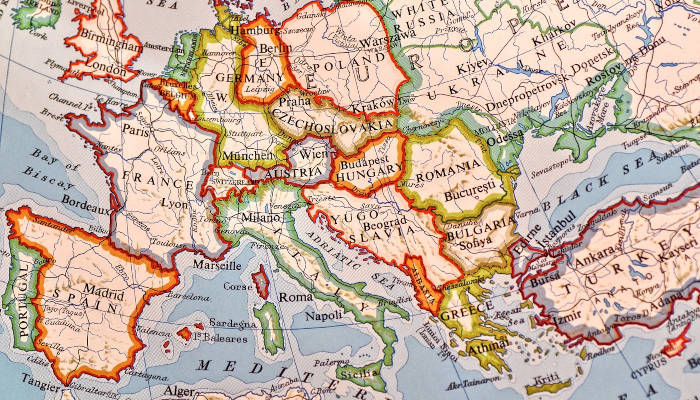
Especially now, it is hard to imagine a European army separate from NATO. That could immediately spark a conflict between Turkey and Greece. Greece is part of the EU, but Turkey is not. Turkey is already tense because of the US’s actions against Iran and the stronger US-Israel relationship. A European army outside NATO might be the last straw. At the same time, NATO needs more commitment on many issues.
By that time, Europe would die in its cradle.
Will these actions be completed? German Chancellor Friedrich Merz, with his close ties to London, Paris, and Warsaw, has so far been the engine of this change. It is up to him now to find balance and measure, rallying Europe’s best forces. In this context, the new archbishop of Münster, neo-president of the Bishops’ Conference, Heiner Wilmer, could play a role beyond just the religious domain.
The obstacles to this are huge and deeply built into the local culture of every European country, which mostly believes that national identity supersedes the European effort. Still, if managed carefully now, there could be a chance to change it. Just over two hundred years ago, Europe believed in loyalty to monarchs, not nations. But within a few years, around the time of the French Revolution, everything shifted in a different direction.
European leaders, along with their fellow Americans, will need to prove their mettle. The world might be counting on an America at its best.