


As oil prices skyrocket amid new wars in Iran and Yemen, a Chinese scholar reconsiders the history of the petrodollar and what could change today. That could be crucial for China.
## I.
Before Nixon severed the dollar’s link to gold on August 15, 1971, global oil prices (including in Saudi Arabia) had already been rising for nearly a year. By 1981, when the riyal was informally unpegged from the Special Drawing Right (SDR) and effectively re-pegged to the dollar, Saudi Arabia had spent 12 years continually adjusting its exchange-rate arrangements, its choice of currency for oil pricing, and how it reinvested oil revenues (including reserves). That period was precisely the 12 years during which the dollar’s exchange rate fluctuated, its international standing was damaged, and its global credibility was ultimately rebuilt.
American companies began Saudi Arabia’s oil industry through investment and development. Standard Oil of California (Socal, today’s Chevron) was the first to enter the Saudi oil business. Before any commercially viable oil was discovered, Socal had already extended 50,000 gold pounds in loans, structured as gold advances, to Abdulaziz Ibn Saud, who was then in financial straits. This financing was a key condition in the company’s 1933 negotiations with the Saudi royal family over oil concession rights. The concession was granted that same year, leading to the founding of the California-Arabian Standard Oil Company (CASOC)—the forerunner of today’s Aramco. After 1948, four American companies jointly controlled Aramco: Socal, Texaco, Exxon, and Mobil.
Once commercial production began, Aramco gradually became the Saudi government’s most important source of fiscal revenue while maintaining long-term control over the country’s oil production, transportation, and overseas sales systems. The U.S.–Saudi relationship, which began with oil development, soon extended well beyond the oil industry into finance and currency. From the era of the elder King Ibn Saud onward, Saudi Arabia showed a clear tilt toward the United States in its monetary system, currency management, and external financial relations—a tendency reinforced over time by the sustained involvement of American oil companies, banks, and financial advisors.
The Saudi Arabian Monetary Agency (SAMA, now the central bank) was designed and founded by the American Arthur Young (who had earlier served nearly 19 years as an advisor to China’s Nationalist government), and the Saudi riyal itself bears the imprint of Young’s ideas. Many of SAMA’s successive governors had backgrounds in American education, American financial institutions, or international bodies such as the IMF and the World Bank, and many were foreign nationals. Likewise, managing overseas petrodollar investments in the mid-1970s relied heavily on American investment expertise.
The question of Israel — a matter of geopolitics — was another important factor shaping postwar Saudi-U.S. relations, and its roots were sown as early as February 14, 1945, when the elder Saudi king met Roosevelt at Great Bitter Lake. The “Quincy” memorandum from that meeting recorded that His Majesty the King stated that Arabs and Jews could never cooperate, whether in Palestine or any other country, and that Arabs would rather die than cede their land to Jews; the President responded by assuring His Majesty that he would take no action to help Jews against Arabs, nor take any measures hostile to the Arab people. The meeting made no mention of oil or the dollar, yet its influence on both persisted ever after.
## II.
As late as the late 1960s, matters concerning Saudi oil exports—including transport, pricing, and settlement—were still largely dominated by American shareholder companies, even after Saudi Arabia achieved the Gulf region’s first 50-50 profit-sharing arrangement in 1950. Given a buyer’s market for oil and Saudi Arabia’s lack of bargaining leverage beyond its resources, this arrangement was a natural outcome. Quoting oil prices in dollars and settling primarily in dollars was standard Western commercial practice after Bretton Woods and routine business for these American shareholder companies; currencies other than the dollar were used for receipts only, depending on the counterparty and specific needs. One of the few exceptions came during the “dollar shortage” era of the early 1950s, when European oil-importing countries such as Britain, along with Japan, hoped to settle oil payments to Aramco in non-dollar currencies. Britain, together with Aramco, once proposed that the Saudi government accept an increase—from 25% to 40%—in the share of taxes and concession fees paid in pounds sterling; the Saudi government rejected this proposal.
After Young led the establishment of SAMA, Saudi Arabia’s monetary system underwent several adjustments over the following two decades. By the 1960s, the riyal’s par value was set relative to the dollar—the currency of Saudi oil revenue—with a corresponding gold content specified; in practice, the fixed relationship with the dollar was maintained through this gold-equivalent parity.
The Western economic boom around 1970 boosted demand for crude oil, while geopolitical tensions affected supply and transport. Libya seized the opportunity to cut production unilaterally, and the Gulf oil states thereafter began converting resource power into pricing power, with Saudi Arabia following suit and benefiting. Against this backdrop of a supply-demand imbalance and a growing trend among Gulf producing states toward higher revenue shares and nationalization of the oil industry, these countries entered into a series of interest and price negotiations with the international oil companies that controlled their domestic oil resources.
The February 1971 Tehran Agreement institutionalized the trend of price increases. After Nixon severed the dollar’s link to gold on August 15 of that year, the dollar depreciated, harming Gulf states that continued to settle oil trade in dollars. To offset this exchange-rate loss, in January 1972, at the urging of Saudi Arabia and other Persian Gulf OPEC members, six Gulf oil-producing states reached a currency-compensation agreement with the international oil companies in Geneva — the Geneva Agreement I — which calculated dollar-depreciation compensation using an exchange-rate index composed of nine currencies and adjusted the posted dollar price accordingly. In June 1973, Geneva Agreement II was signed, expanding the currency basket to eleven currencies. Each of these negotiations and agreements was accompanied by a price increase, yet the posted oil price remained denominated in dollars, and the dollar continued to serve as the primary settlement currency.
After August 15, 1971, the Saudi riyal maintained its gold parity while abandoning its previous fixed rate against the dollar; as a result, the dollar-riyal exchange rate began to fluctuate with changes in the dollar’s parity, though the dollar remained Saudi Arabia’s principal external trading currency. Saudi Arabia subsequently acquired 25% and then 60% participation interests in Aramco on January 1, 1973, and January 1, 1974, respectively; this brought little change to the use of the dollar in its oil sales, though it did increase the government’s say in the matter.
During the 1970s, the pound sterling’s role as a major reserve currency declined at an accelerating pace. On March 19, 1973, major Western currencies moved to floating rates, and Bretton Woods collapsed. Holders of sterling reserves simultaneously negotiated with the British government to maintain a minimum sterling share while actively diversifying their foreign-exchange reserves. The oil boom briefly increased Gulf OPEC states’ sterling receipts and reserves, but this proved to be only a short-lived rebound (1973–1974).
On March 21, 1973, the National Iranian Oil Company (NIOC) formally assumed ownership and operation of the country’s domestic oil industry, abolishing the sterling-accounting and payment arrangement that had been in place since 1954 (under which oil had been priced in dollars but settled and recorded in sterling), and switched instead to the dollar as the accounting currency, stipulating that Iranian oil revenue be paid in dollars.
## III.
Beginning in mid-1973, tensions rose across the Middle East. In August, Saudi Arabia repeatedly warned the United States that if the political situation in the Middle East continued to deteriorate, it might be unable to meet the world’s energy needs. At a September 5 press conference, Nixon remarked that oil was of little use without markets and that the United States and Europe were the markets. At the time, Nixon underestimated the oil shock’s impact. A month later, the Fourth Arab Israeli War broke out, and on October 20, Saudi Arabia announced an oil embargo against the United States. U.S. domestic inflation subsequently rose sharply, even though Saudi Arabia secretly agreed to continue selling oil to the U.S. Sixth and Seventh Fleets.
Just before the Saudi oil embargo was lifted in March 1974, the U.S. and Saudi Arabia had already begun discussing rebuilding and expanding bilateral relations. After the embargo was lifted, the two sides completed the design of an economic, technical, and security cooperation framework in April and, on June 8, issued a Joint Statement in Washington establishing the U.S.-Saudi Joint Commission on Economic Cooperation and a Joint Commission dedicated to Saudi defense training. The statement also made no mention of oil or the dollar; the two sides’ representatives were Kissinger and Fahd.
During this period, Washington attempted to extend the “Joint Commission” model to Iran and other Middle Eastern countries, but only the U.S.-Saudi mechanism endured for the long run — the aforementioned Joint Commission on Economic Cooperation continued through Clinton’s second term, and cooperation between the two countries’ militaries remains institutionalized to this day. European countries also hoped, in early 1974, to pursue long-term cooperative projects with Saudi Arabia, but the Saudi royal family turned them down, preferring to build a closer relationship with the United States.
On July 9, 1973, the Washington Post, quoting Peter Peterson (a Blackstone co-founder who had by then left government service), introduced the term “petrodollar” (the trade surplus accumulated by oil-exporting countries) for the first time, with Peterson warning that petrodollars could destabilize the global monetary system. Shortly after the June 8, 1974 U.S.-Saudi joint statement was signed, Nixon arranged for the newly appointed Treasury Secretary, William Simon, to travel to Saudi Arabia to discuss U.S. government debt.
Two days before Simon’s departure, on July 9, 1974, the International Finance Subcommittee of the U.S. House Banking and Currency Committee held a hearing on the petrodollar issue, titled “International Petrodollar Crisis.” Deputy Secretary Gerald Bennett attended on Simon’s behalf. In response to a congressman’s concern that petrodollars might trigger a currency crisis, Bennett suggested that Saudi Arabia purchase U.S. Treasury bonds.
## IV.
Saudi Arabia’s oil revenue surged from $4.3 billion in 1973 to $22.6 billion in 1974 and continued to rise through the early 1980s. Saudi Arabia’s problem during this period was not a lack of money. As one SAMA official put it, oil revenue had come to “exceed the government’s capacity to spend it,” and in some years actual budget execution fell below half of what had been planned.
Saudi Arabia’s domestic infrastructure — both hard and soft — was in such a state that officials and international organizations from around the world flocked there to borrow money, so many that some had to sleep overnight in taxis; the U.S. military used helicopters to ferry construction materials to Saudi worksites to meet deadlines; SAMA staff had to bribe hotel employees just to use one of the country’s few international telex machines to transmit financial data; and Saudi finance personnel’s work was largely limited to recording incoming dollar amounts and bank transfer balances.
With more money than could be spent domestically, officials needed to find profitable outlets for these funds abroad — the large-scale outflow of petrodollars was therefore not the result of any special political arrangement but a natural consequence of insufficient domestic absorptive capacity.
Yet decisions about where to invest these enormous sums abroad and who would manage them required the King’s personal approval — just as only the King himself could decide whether to establish SAMA. At the time, only the U.S. bond market had the capacity to absorb Saudi Arabia’s massive accumulation of petrodollars in sufficient volume.
Through introductions from the U.S. Treasury and the Federal Reserve, SAMA’s governor engaged David Mulford, who worked with British investment institutions to manage Saudi petrodollar assets. The Saudi king’s special request was that U.S. officials not publicly disclose the Treasury’s direct sales of government bonds to Saudi Arabia, to avoid giving domestic opponents or neighboring Arab brother states the impression that Saudi Arabia was indirectly supporting Israel. At the time, the United States needed external funding to help sell government bonds while also preventing Gulf petrodollars from flowing into uncontrolled channels in the West that might disrupt the international monetary system. The two sides’ interests aligned readily.
Saudi petrodollars flowed mainly in several directions: domestically, toward import spending to meet investment needs, aid to neighboring Arab states, and other forms of assistance that, while modest in scale, had far-reaching influence; and externally, toward the Eurodollar market (flowing through European and American banks to Latin America and other oil-importing countries) and the U.S. market (deposits and bonds). These two channels were the primary ways petrodollars were “recycled.”
Purchasing U.S. Treasury bonds was not the only channel for petrodollar recycling — otherwise, the Latin American debt crisis a few years later would not have occurred — nor was government-bond purchasing limited to the United States; otherwise, Saudi foreign reserves would not have included West German marks and Japanese yen. The difference lay only in timing and scale.
Saudi Arabia first replicated this model with Japan, but when it tried the same with West Germany, it was initially rebuffed — according to Ahmed Banafe (who joined SAMA in 1973), in The Saudi Arabian Monetary Agency,1952-2016—Oil Central Bank, West Germany did not agree to such arrangements until 1980.
His firsthand account corroborates research by the American scholar Barry Eichengreen: after the United States sanctioned Iran in 1979, Iran hoped to hold West German marks as reserves but was likewise refused. The only thing about this U.S.-Saudi arrangement that could genuinely be called secret was the true scale of Saudi Arabia’s Treasury bond holdings. Even when pressed by American media in 2016, the precise figure remained hard to pin down — though this kind of deliberate ambiguity by the U.S. Treasury was not unique to Saudi Arabia. Since 2015, Saudi Arabia’s foreign reserves have held over $100 billion in U.S. Treasuries; the influence of Gulf petrodollars on U.S. Treasuries and U.S. investment today is far smaller than it was in the mid-to-late 1970s, although the importance of that earlier period has also been somewhat exaggerated.
## V.
In the mid-to-late 1970s, the United States needed to resolve a crisis of confidence in the dollar: the world’s faith in it was eroding, and its position within the international monetary system was correspondingly shaken. Saudi Arabia, meanwhile, needed to resolve a different set of questions left unsettled for a decade. Ever since the pound’s devaluation in 1967, three questions had hung over Saudi oil revenue — whether the system’s anchor could still be trusted, what the riyal itself should be anchored to, and how to ensure that oil revenue would not lose value.
### (I)
After the oil embargo was lifted on March 18, 1974, raising oil prices became the norm among Gulf OPEC states, with Iran the most eager advocate and participant, while Saudi Arabia was comparatively conservative and moderated the pace of increases.
The currency mechanism under Geneva Agreement II was abandoned; oil continued to be quoted in dollars and settled primarily in dollars, with price increases calibrated to the exchange-rate losses that dollar depreciation imposed on producing countries. On December 10, 1974, the Saudi government notified Aramco that, going forward, the taxes and concession fees it paid (as distinct from oil-sales settlement revenue) could be paid only in dollars; Aramco promptly sold the pounds sterling it had just purchased to cover its tax payments, triggering a sharp drop in the exchange rate for sterling. Saudi Arabia’s move coincided with the British government’s announcement, one month earlier, that the Sterling Agreement — which had underwritten the value of sterling reserves held within the sterling area — would not be renewed after its expiration at year’s end.
Although Saudi Arabia was not a signatory to that agreement, Britain’s withdrawal of its guarantee for overseas official sterling reserves weakened sterling’s appeal as both an oil-revenue and an official reserve currency.
The Saudi notification coincided with a visit by U.S. Treasury officials to Riyadh to discuss the purchase of U.S. Treasury bonds, inevitably inviting speculation about a connection—even front-line U.S. Treasury officials were reportedly surprised. Sterling’s trajectory over the following two years proved that Iran and Saudi Arabia had merely locked in their losses early: sterling faced another crisis in 1976 and, by 1977, had finally relinquished its role as a major international reserve currency.
It took the British government 33 years of joint effort with other Western nations to manage this decline; during that period, Britain occasionally leveraged the threat that sterling instability could endanger the dollar and the entire international monetary system to obtain financial support from the U.S., the IMF, and the Bank for International Settlements — but on the whole, the British government experienced far more helplessness, even humiliation, than leverage.
The dollar faced a similar crisis of confidence in the late 1970s. After the collapse of Bretton Woods in 1973, disagreements among Western nations over the direction of international monetary reform, combined with two successive U.S. Treasury secretaries who clearly favored floating exchange rates, meant that what had originally been intended as a temporary expedient — floating rates — became entrenched, and the U.S.-led effort to reform the international monetary system was shelved indefinitely.
The dollar briefly rebounded after the first oil shock but soon weakened again. Even then, Treasury Secretary William Simon, who openly favored floating rates, was happy to see the SDR’s role in global reserves increase — a marked departure from the U.S. policy stance of the 1960s, which had actively defended the existing dollar-parity system. Beginning in 1977, the dollar’s decline accelerated markedly.
During this period, the United States was mired in stagflation and a host of attendant social problems, leaving little room for the dollar’s status or exchange rate to be a government priority. The rapidly rising and persistently high trade deficit instead made a “weak dollar” an appealing option — this was the so-called policy of “benign neglect” that drew the ire of other countries.
The attitude of then-Treasury Secretary Michael Blumenthal, discussed below, was far from isolated. In 1978, the United States convened G7 finance officials to discuss weakening the dollar’s dominant reserve-currency status—something previously unthinkable. Even in 1979, when sanctions on Iran risked affecting the dollar’s reserve status, some in the U.S. government held the view that as long as the erosion of the dollar’s reserve-currency status occurred gradually, it would cause no serious long-term harm—and that, provided change in the international monetary system remained gradual, the dollar might even benefit in the long run.
When sterling exited, the United States could offer Britain a final backstop through dollars, credit, and international cooperative mechanisms; but when the dollar itself faced a crisis of confidence, no larger national currency could assume that role. The SDR was accordingly assigned special significance, yet the proposed “substitution account” repeatedly failed to materialize, with one persistent obstacle being who would bear the exchange-rate losses arising from the difference between dollar assets and SDR liabilities.
In 1977, the five major Western economies discussed adopting a “locomotive strategy,” under which the United States hoped that West Germany and Japan would drive faster growth to pull the broader Western economy along, while also expecting both countries to shoulder greater international economic and monetary responsibility. Neither expectation was met, and the episode generated considerable mutual recrimination — further confirming the American view that a genuine substitute for the dollar was unlikely to emerge in the short term.
Under pressure from other countries, the United States launched an unprecedented dollar-defense program on November 1, 1978, mobilizing roughly $30 billion in potential foreign-exchange resources and coordinated intervention capacity, including the “Carter bonds” (the first U.S. government bonds ever denominated in foreign currencies — German marks and Swiss francs) and several gold sales. The intervention initially lifted the dollar from its lows, but the dollar still faced setbacks in 1979.
### (II)
Even after the collapse of Bretton Woods, governments and market participants continued to use the dollar, while gold’s monetary role was markedly diminished. The United States pushed for the institutional “demonetization” of gold, foreclosing any realistic political or institutional possibility of rebuilding an international monetary system centered on gold convertibility.
This was the landscape around the mid-1970s Jamaica Accords, and it was also the outcome the United States hoped for: the dollar’s dominant role could be gradually weakened, but gold’s monetary role had to be terminated for good, while the SDR’s standing should be elevated. This is why the amended IMF Articles of Agreement included language designating the SDR as the “principal” reserve asset.
In support of an SDR substitution account, the U.S. side made clear its hope that the pace of any transfer of dollar assets not be too rapid — and, more importantly, that the United States not be made to bear the costs of any resulting subsidy.
Against this backdrop, Iran, Saudi Arabia, and Qatar successively re-pegged their currencies to the SDR in 1975, while Kuwait switched to a currency basket. From 1975 onward, some OPEC members repeatedly proposed pricing oil trade in SDRs to “protect oil revenue from dollar volatility”; some of the more assertive oil producers even considered settling oil trade in SDRs.
Saudi Arabia wavered repeatedly on this between 1975 and 1978: in 1975, it briefly decided to switch to SDR pricing, then reversed course; in 1978, Saudi Oil and Mineral Resources Minister Ahmed Zaki Yamani publicly listed the SDR, alongside the Geneva Agreement II currency basket, as one of the options under consideration. But one thing never truly changed: every one of these oscillations ultimately returned to the dollar. OPEC countries were not the only ones to entertain such ideas — the U.S. government itself had plenty of similar proposals.
In the first half of 1979, then-Treasury Secretary Michael Blumenthal argued that dollar-denominated oil pricing imposed an enormous and unfair burden on the United States. Once the dollar crisis had grown severe, he opposed immediately studying a switch to a currency basket, fearing it would further undermine the dollar. After several rounds of discussion, the State Department, the Treasury, and the President’s Council of Economic Advisers agreed to maintain dollar pricing, reasoning that openly announcing the dollar’s removal as the oil settlement currency would trigger a sell-off in foreign-exchange markets. The nearly seven years from 1975 to 1981 remain the SDR’s high-water mark to this day (2026).
In 1978, Yamani gave two reasons Saudi Arabia would not switch oil payments to the West German mark or the Japanese yen: “First, it would lead to a sharp drop in the dollar; second, it is almost impossible to find another currency as large as the U.S. dollar-a currency large enough to accommodate the demands of world oil transactions”. He noted that “No other country would accept the use of its currency in oil transactions. If, for example, we were to use the yen, the Japanese prime minister would come to us in Riyadh and beg us to change our decision because it would shake the Japanese economy. The use of the yen as a means of payment is unimaginable. People who understand currency matters understand this and know that it is impossible.” (Ahmed Zaki Yamani, remarks reproduced in Congressional Record, 95th Cong., 2d sess., May 4, 1978, p. 12723).
This view echoed the quiet fizzling-out of the locomotive strategy and was corroborated by Toyoo Gyohten’s account in *Changing Fortunes*. By the same logic — a weak dollar, yet no other currency stepping up to replace it — the SDR became, in OPEC’s eyes, essentially the only viable alternative.
### (III)
Saudi Arabia’s wavering on the SDR and Yamani’s stated concern about “causing a sharp drop in the dollar” were driven not by goodwill toward the United States but by self-interest. A sharp dollar decline would inflict enormous losses on countries — including Saudi Arabia — whose reserves were held predominantly in dollars.
During sterling’s 33-year retreat from its role as the dominant international currency, most sterling reserve-holders managed to hold on until the very end; besides Britain’s backstop guarantee, this reflected a shared calculation — that if everyone rushed for the exits simultaneously, all would suffer together. This was the same logic behind the U.S. desire for a “weak dollar” that nonetheless should not fall too sharply.
The dollar’s continuous depreciation, along with the losses that would accompany any adjustment of the oil-pricing currency, did not mean Saudi Arabia was willing to simply watch its reserve assets lose value. Starting in 1977, on the advice and management of Mulford’s team, Saudi Arabia began diversifying its reserve assets, shifting toward the West German mark and the Japanese yen—to preserve value and reduce exchange-rate losses on industrial imports from West Germany and Japan.
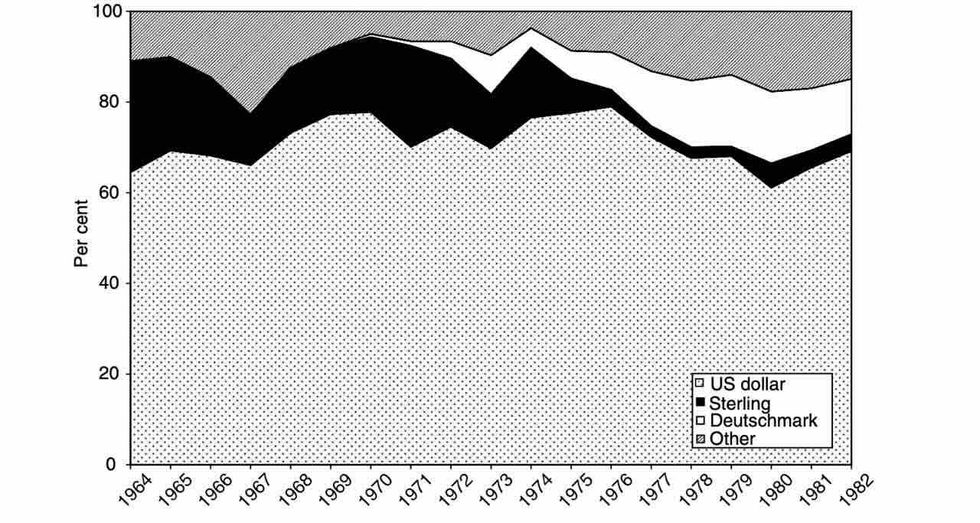
Research by Catherine R. Schenk (2010, Figure 1) shows that, from 1976 onward, oil-producing countries began reducing their dollar holdings while increasing their holdings of West German marks and Japanese yen. After the United States froze Iran’s dollar assets in the Eurodollar market in 1979, Saudi Arabia began converting half of its monthly petrodollar income into West German marks and yen. In other words, under the guidance of its American and British investment teams, Saudi Arabia did everything it could to minimize damage to its financial interests—echoing its earlier arrangements to purchase U.S. Treasury bonds.
The real turning point came after Paul Volcker took over as Federal Reserve chairman and aggressively raised interest rates: the dollar reversed its decline and entered a strong cycle after 1981; discussion of the SDR replacing the dollar gradually faded; talk of abandoning dollar pricing and settlement for oil never resurfaced; the “petropound” that had so excited Margaret Thatcher amid North Sea oil development proved short-lived; and even Iran, under U.S. sanctions, still received 70% of its oil revenue in dollars (https://history.state.gov/historicaldocuments/frus1977-80v11p1/d38).
By 1981, a strong-dollar regime had clearly taken hold. Saudi Arabia effectively re-pegged the riyal to the dollar, oil prices began to fall, and Saudi Arabia’s petrodollar boom was drawing to a close. Mulford later served as U.S. Assistant Treasury Secretary in 1984 and led negotiations for the Plaza Accord.
His successors continued to diversify Saudi Arabia’s reserve assets and, by 1986, had reduced the dollar’s share of Saudi reserves to below 30% — lower than the combined share of West German marks and Japanese yen and far below the dollar’s roughly 66% share of global foreign-exchange reserves that year (IMF, excluding gold; see Figure 2). Saudi officials came to regard this as the single most valuable piece of advice ever given by their American and British investment advisors because it earned Saudi Arabia substantial gains after 1985.
—
Originally published in the Chinese Weekly Caixin, https://opinion.caixin.com/m/2026-09-15/102485114.html?cxw=IOS&Sfrom=Wechat&originReferrer=iOSshare&readAddIntegral=6e6bncCYv3iknSlJ7R7fvDHYCvs9u9mNHG1X4YT8Kr8%3D&system=CAIXIN&articleId=102485114&referrer= Translated and republished with permission