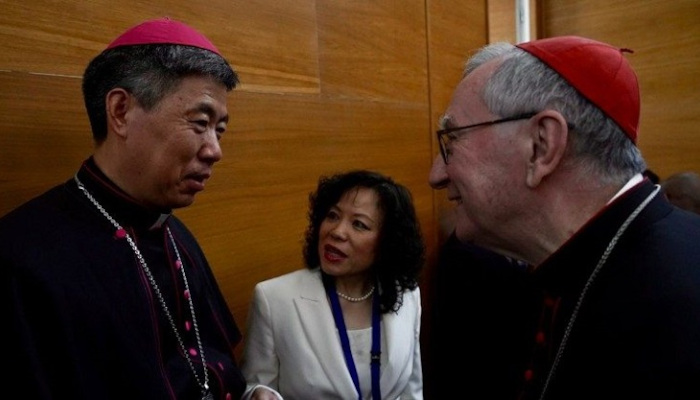




On July 22, the Holy See announced the episcopal ordination of Giuseppe Chang Yanfeng as the bishop of Chifeng, Inner Mongolia, China. Although others were expected, appointments related to the agreement with China continue, albeit at a snail’s pace.
Last March, the two delegations met in Beijing in a cordial atmosphere, which contrasted with the distrustful tone of their meeting in Rome the previous year. Since the agreement was confirmed on October 22, 2024, there have been no significant developments. The Chinese government remains firm in its position: the Church in China must be Chinese, just like any other state institution. This is evident in the statutes of the Episcopal Conference, which are not recognized by Rome and extol support for the Party, the government, and the policies of Xi Jinping.
The Vatican’s continued engagement hinges on the assurance that a schism will not arise over government-mandated episcopal appointments—a schism that would determine the future of the local Church for centuries—and on the possibility of direct dialogue, albeit extremely limited, which would otherwise be completely shut down. In the meantime, as a Vatican source suggests, “we have to swallow a bit and be very patient.” Results may be achieved in 30–40 years.
Chinese Bishops and a Not-So-American Pope
The goal in the meantime is to help the Chinese Church grow with a few respectable bishops who are officially recognized and appointed by Rome. They may not be the best, but since foreign bishops cannot be brought in, they are the best possible option today. An underground bishop—even an excellent one—who is unable to move about, meet with his priests, or celebrate Mass would not be useful or desirable.
Furthermore, some of the appointments have been made with prior, mutual consent from both sides. This makes painful missteps, such as the appointments of two auxiliary bishops during the sede vacante or the recognition of excellent underground bishops like Joseph Wang Zhengui, Augustine Cui Tai, and Zhang Weishu, tolerable. However, these bishops have been relegated to auxiliary roles and are now emeritus.
To this path, other than asking the tiny Catholic minority (12 million out of a population of 1.2 billion) to confront the regime and face persecution, isolation, and irreparable internal divisions, there are no viable alternatives.
Meanwhile, ties among the bishops are growing, monasteries are gaining strength, and some religious communities operating in the country are flourishing. Christian communities are also able to live their sacramental lives in communion with Rome.
Certain academic events are also worth highlighting, such as the conferences to be held in Rome (May 2024), Hong Kong (August 2025), and Guangzhou (June 2026), which marked the centennial of the first Chinese council and the first episcopal ordinations. Pope Leo XIV confirms the patient rebuilding of relations between the Holy See and China following the “rupture” caused by the canonizations of 2000.
The Chinese government viewed his election with great suspicion, convinced that an American Pope would be beholden to Washington. Trump’s harsh and rambling attack on the Pope, and the Pope’s measured yet clear response, convinced Beijing that this was not the case.
Administrative Harassment for All
It is difficult to speak of religious freedom or civil liberties in China. Regulation of activities is increasing for all faiths, particularly for communities and “house churches” that do not fall under recognized state structures. Restrictions and regulations limit buildings (e.g., demolition, removal of crosses from rooftops, display of the Chinese flag, installation of security cameras), communication (e.g., publications, prohibition of minors participating in services), travel, and even digital spaces.
On the Day of Prayer for the Chinese Church (May 24), Bishop Bertram Meier of Augsburg, Germany, said: “Through our prayers and solidarity, let us let them know that despite all the restrictions, they are not alone but part of the worldwide community of the Church.”
In addition to the massive crackdown on Uyghurs (Muslims) and Tibetans (Buddhists), administrative harassment and sanctions affect everyone, particularly practitioners of Falun Gong and members of unrecognized and unregistered churches and communities. Between 2014 and 2021, an estimated 96 million believers belonging to 21,000 “house churches” of the Protestant tradition disappeared. Over the past two years, there have been massive police crackdowns on them, including in July 2021 on certain communities in eastern China, in November on the “Church of Abundance” in Xi’an, and in December on the Yangyang Church in the Zhejiang region.
The most sensational case is that of the “Church of Zion,” led by Ezra Jin (also known as Jin Mingri). Founded in 2007, the Church grew rapidly, drawing several thousand worshippers to its services. The authorities shut it down in 2018, but it reemerged thanks to Jin Mingri’s online preaching. After two years in exile, he returned to the country. In October 2025, about thirty pastors, including the founder, were arrested and convicted. Mingri was released from prison and arrived in the U.S. on July 6 of this year, thanks to direct intervention by Donald Trump.
However, the U.S. president’s influence was ineffective in the case of another dissident, Jimmy Lai, a Catholic and staunch supporter of democratic demands in Hong Kong.
Strict administrative control affects not only legally unrecognized religious groups but also more traditional religions, including Taoists and Buddhists. There are five officially recognized religions: Buddhism, Taoism, Catholicism, Protestantism, and Islam.
Taoists and Buddhists
Even the more locally based religions, such as Buddhism and Taoism, have faced significant censorship – Andrew Law noted this in Asia News on May 16, 2026. A prominent example is Shi Yongxin, abbot of the Shaolin Temple and former vice president of the Chinese Buddhist Association. Known for its Kung Fu, the temple is recognized as a prestigious place of worship, commerce, and outreach. Shi, who visited the Pope in February 2025, was accused of corruption and removed from office.
The same fate befell Hu Chenglin, a former vice president of the Chinese Taoist Association and member of the Chinese People’s Political Consultative Conference. He was accused of inappropriate sexual conduct, embezzlement of public funds, and accounting irregularities.
Similar stories have emerged regarding other masters, such as Li Yi, Lu Wenrong, and Hu Chenglin. The Chinese government uses these scandals to bring all faiths into line with the guiding principle articulated by Xi Jinping in 2015: the “Sinicization” of religions. The goal is to align religions with state ideology by bending their traditions, doctrinal heritage, and norms to the Party’s agenda.
While Catholicism is interested in inculturation within Chinese civilization, it is not interested in subordination to the dictates of the prevailing ideology. Despite its limitations, the Sino-Vatican agreement publicly highlights the now-defunct ideological claim to eradicate religions and the current intention to transform them into tools that serve the exercise of power.