



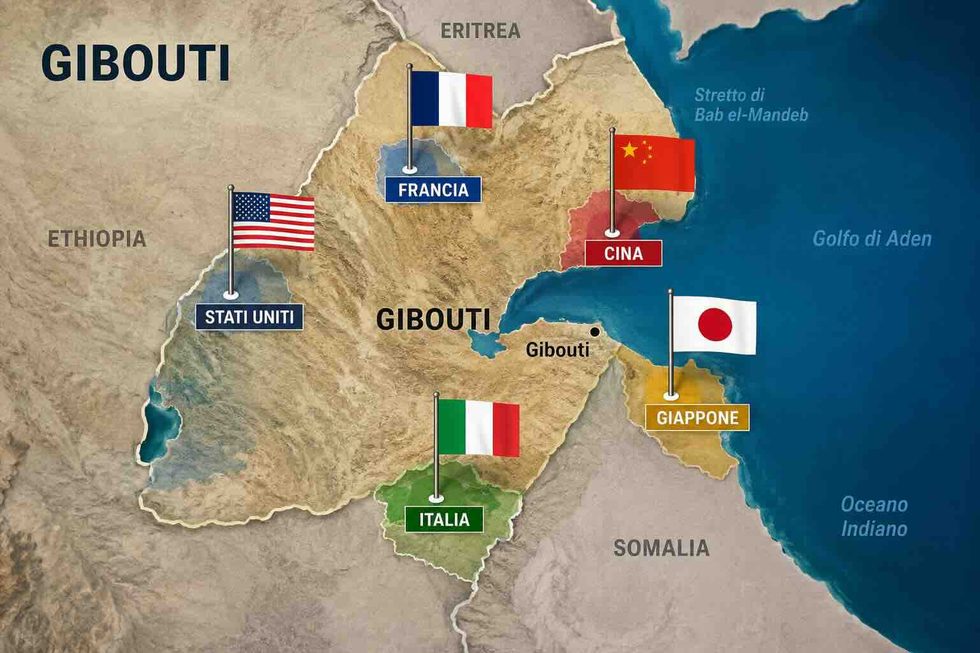
While a war strangles the Strait of Hormuz, a parallel risky run is underway for the neighboring strait controlling the routes to the Red Sea
There’s no better way to grasp how quickly the world is changing than to look at what’s happening in Djibouti, the small state on the Indian Ocean where northern Somalia meets the Danakil coast. Until a few decades ago, it was known as the “Territory of the Afars and the Issas,” named after the two ethnic groups that made up the majority of its population.
For Djibouti, independence of the territory (23,000 square kilometers) came somewhat later than in the rest of Africa and was heavily shaped by France, the colonial power, being unwilling to give up either the naval-air base it had maintained since the 1880s or its grip on “Françafrique.”
At the time, the “Territory of the Afars and the Issas” seemed to be of strategic interest only to the French, even though its geographic position—allowing control from the east over Bab-el-Mandeb, and hence the southern entrance to the Red Sea and the Suez Canal—already suggested the region’s importance.
But those were relatively calm times for shipping. Then Djibouti appeared in Western media only through the beautiful photographs of Afar and Issa children and women, not yet adapted to Western styles, taken by the great ethnographic photographer Angela Fisher for National Geographic.
Over the years, however, conditions changed rapidly. The risks to shipping posed by Somali and Yemeni piracy and by the wars affecting Arab and Iranian oil routes pushed many countries to follow France’s example and establish their own bases in the area.
As the conflict between Ethiopia and Eritrea worsened without resolution, pressure also mounted in Addis Ababa, which depends entirely on Djibouti for access to the sea and for major international trade flows.
So, one after another, international naval bases began sprouting up under the pleased eye of a government that views them as a guarantee of its own stability. It also greatly appreciates that their economic presence contributes more than 25% of its annual income.
Alongside the French presence, there has also been an American base at Camp Lemonnier since 2001. With its 4,500 troops, it is the only major US installation on the African continent.
China followed in 2016 with about 2,000 troops. Then came Japan—signaling growing Asian interest in shipping routes, and how the two rival countries keep close tabs on one another. For both, Djibouti is their first overseas base.
Then came Italy, with a presence of 80 troops that can rise to 300 if needed, concentrated at the “Italian military support base”.
Finally, it’s worth noting that many other countries—Germany, Turkey, Spain, and Saudi Arabia—without an actual base of their own, take advantage of friendly countries’ willingness to host a permanent presence.
Lastly, recently, there are rumors that India and Ethiopia are also about to request permission to establish their own bases there.
Then only a few international players remain, and naval control of this northern part of the Indian Ocean will be complete and fully inclusive.
The first is Egypt, which, caught up in other problems, seems, for now, content to control the Suez Canal and has no further ambitions.
The second is a rather non-uniform group comprising the smaller states of the Arabian Peninsula, many of which continue to harbor ambitions disproportionate to their actual capabilities—and therefore strongly destabilizing. Meanwhile, others, such as Yemen, are unable to control the extremist movements they harbor, such as the Houthis, that hamper freedom of navigation.
This is a group that must be kept on a very short leash. Perhaps only the United States could guarantee that. Some Houthi factions have long been involved in the Sudanese civil war and are therefore potentially capable of disrupting shipping from both the east and the west.
Finally, there are the Russians, who aspire to carve out a role for themselves that would also shape both Africa and international trade. They are doing so thanks to a land presence, with what was once Wagner and is now Africa Corps, throughout the Sahel region of the continent, and to a naval presence whose terms have yet to be precisely defined.
The project, under discussion for some time now and already the subject of several agreements, is to set up a base—initially small but destined to grow—at Suakin on the Sudanese coast, that is, farther north and closer to the Suez Canal than Djibouti and the bases that country hosts.